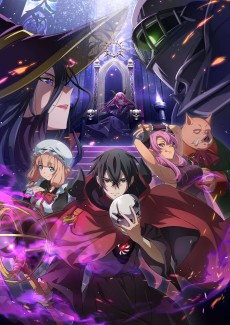
The Strongest Magician in the Demon Lord's Army was a Human
📺Anime Details
📝Editorial Analysis
The scent of gunpowder hangs thick over the ruined cathedral—stone dust motes swirling in fractured light as a single bullet punches through stained glass, shattering the image of a saint just before it tears into a demon officer’s throat. No fanfare, no slow-mo flourish—just recoil, smoke, and the quiet thud of a body hitting marble. That moment isn’t spectacle; it’s weight. It’s the sound of ideology cracking under its own contradictions.
This anime doesn’t breathe fantasy—it exhales politics. Not the kind wrapped in royal decrees or ceremonial crowns, but the kind that festers in supply lines, leaks from encrypted scrolls passed between maids and generals, and calcifies in the silence after a witch signs a non-aggression pact with a human defector. The CGI isn’t flashy—it’s functional, almost bureaucratic: motion-captured marches, stiff but deliberate gestures, faces half-obscured by helmets or hoods, eyes tired behind tactical visors. You feel the exhaustion of war not in grand speeches, but in how long a succubus waits before refilling a commander’s coffee cup—not because she’s subservient, but because she’s calculating the exact second his attention wavers enough to slip a false intel report into his briefing folder. That’s the atmosphere: suspicion, procedure, and consequence—not magic as wonder, but magic as logistics, as leverage, as ammunition.
Assassin's Creed™: Director's Cut Edition shares that same bone-deep weariness of systems grinding. Its description calls it “a next-gen game that redefines the action genre”—but what sticks isn’t the parkour or the hidden blades. It’s the way Altaïr moves through Damascus: every rooftop jump is surveilled, every alley conversation parsed for double meaning, every assassination premeditated not as vengeance but as corrective maintenance on a broken hierarchy. The player review admits the models are dated—but that’s part of the texture. Like the anime’s CGI, the rough edges don’t distract; they ground. You’re not playing a hero—you’re playing a node in a machine you barely understand, executing orders whose moral architecture shifts beneath your boots. Both works force you to ask: Who wrote the rulebook—and who profits when it burns?
Kingdom Come: Deliverance II, though un-described beyond its score and dimensions, lands with identical gravity. At 83—same as the first Assassin's Creed—it signals a shared DNA: tactical warfare isn’t about winning battles, but surviving bureaucracy. In the anime, a human mage rises not by slaying dragons, but by rerouting artillery fire schedules and falsifying requisition logs for demon-grade alchemical reagents. That’s the same energy as Henry—a peasant-turned-soldier navigating feudal paperwork, bribing quartermasters, and choosing which noble lie to believe based on whose ledger matches the grain shipment manifests. No magic here either—just paperwork as power, and loyalty as a currency traded in whispers and ink-stained fingers.
Then there’s Act of War: Direct Action, whose description screams “geopolitical military conflict” ripped “from today’s headlines.” Its real-time strategy isn’t about base-building—it’s about deniability. A covert op disguised as a training exercise. A drone strike justified by forged satellite imagery. Sound familiar? The anime’s conspiracy isn’t shadowy cults—it’s sanctioned disinformation campaigns run by demon intelligence officers wearing tailored waistcoats and quoting trade treaties. The player review calls its dialogue “dumb and a bit cringe”—but that’s exactly the point. Bureaucratic absurdity is the horror. When a maid delivers poisoned tea while reciting tax code amendments, it lands with the same tonal whiplash as an Act of War cutscene where a general calmly explains war crimes as “collateral risk mitigation.”
You’d love this pairing if you’ve ever paused mid-battle scene—not to admire the spell effects, but to wonder who authorized the mana rationing order that forced that squad to fight with depleted wards. If you’ve replayed a mission in Europa Universalis III Complete not to win, but to watch how a minor duchy’s grain shortage triggers a cascade of diplomatic betrayals across three continents. If your favorite character isn’t the strongest mage—but the low-level clerk who quietly alters a deployment manifest so the human infiltrator survives just long enough to leak the truth. This isn’t escapism. It’s recognition: the quiet, grinding, human cost of power—whether measured in demon sigils, encrypted files, or the precise angle at which a bullet enters a throat.
🎮6 Games That Match the Vibe

Match Dimensions Explained
❓Frequently Asked Questions
Why does 'The Strongest Magician in the Demon Lord's Army was a Human' match with Assassin's Creed: Director's Cut Edition?
Because both hinge on a lone, highly skilled human operating undercover in a hostile, politically fractured hierarchy—like Altair navigating Templar-controlled cities while hiding his true allegiance, just as the protagonist hides his humanity among demons. The tactical stealth, faction intrigue, and morally gray political maneuvering (e.g., Altair’s assassinations shaping Crusader-era power balances) mirror the anime’s slow-burn subterfuge and quiet dominance.
Is there a video game adaptation of 'The Strongest Magician in the Demon Lord's Army was a Human'?
No—there’s no official game adaptation yet. But fans who love its vibe often lean into Kingdom Come: Deliverance II for its grounded, consequence-driven roleplay: Henry isn’t overpowered by birth, but earns respect through skill, reputation, and smart choices—just like the human magician slowly gaining trust (and fear) in the demon ranks without flashy magic displays.
How does Act of War: Direct Action compare to Assassin's Creed 2 for fans of 'The Strongest Magician'?
Act of War leans harder into tense, real-time geopolitical ops—think covert raids on enemy bases where intel and timing trump brute force—similar to how the magician disarms threats with precision traps and misdirection rather than spells. AC2, meanwhile, is more about open-world charisma and legacy-building; it’s flashier, but less about quiet control in hostile territory like Act of War or the anime’s core tension.
What’s the best game like 'The Strongest Magician' if I want that low-key, strategic ‘human outsmarting everyone’ vibe?
Kingdom Come: Deliverance II is your best bet—Henry starts with nothing, learns combat and speech skills organically, and gains influence through believable actions (e.g., solving disputes, mastering swordplay), never breaking immersion. It nails the same ‘unassuming human rising through competence, not destiny’ energy as the magician calmly rewriting demon army doctrine from within.