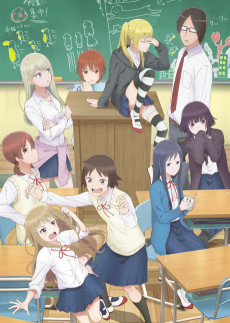
Wasteful Days of High School Girls
Tanaka Nozomu isn’t exactly brilliant. But, given that her only goal for high school was to get a boyfriend, who else would fail to realize that attending an all-girls school was a bad idea? Well, there’s always the fallback plan of getting other girls to introduce her to boys they know.
Too bad that Tanaka’s “bright” idea of giving her classmates nicknames based on less attractive character traits has caused her un-flattered friends “Robo” (for her apparent lack of emotions) and “Wota” (a reference to a creepy otaku types), as well as not-friends like “Loli” (who’s hypersensitive about her petite size,) to “reward” Tanaka with the special nickname of “Baka” (“idiot”), which is quickly adopted by the entire student body. Well, maybe the second week of school will be better.
(Source: Sentai Filmworks)
📺Anime Details
📝Editorial Analysis
Tanaka Nozomu’s hand hovers over her notebook as she scribbles “Robo” beside a classmate’s name—then pauses, pen hovering, because the girl just blinked. Slowly. Deliberately. Like a robot recalibrating after receiving an input it wasn’t designed to parse. That pause—half a second of shared, absurd awareness—is the show’s heartbeat: not punchlines, not plot, but the weight of a misfire in human connection, rendered with the tactile awkwardness of eraser shavings and cheap ballpoint ink.
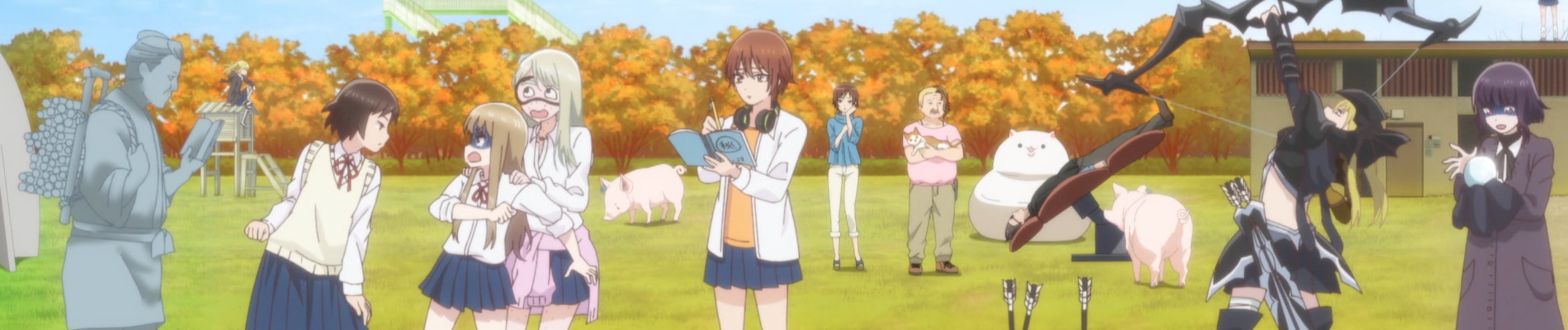
This isn’t warmth. It’s static—the low hum of a fluorescent light buzzing just off-key in an empty classroom at 3:15 p.m., when everyone’s supposed to be doing something meaningful but instead is folding paper cranes out of old math quizzes. Wasteful Days of High School Girls makes you feel the quiet, almost shameful relief of failure that doesn’t ruin anything—just hangs there, unremarkable and oddly generous. It’s the emotional texture of adolescence stripped of aspiration: no grand romances, no hidden talents surfacing, no tragic backstories. Just girls naming each other after perceived flaws (“Wota”, “Robo”) and then immediately forgetting why they started—and why it mattered. It’s surreal not because things warp physically, but because social logic itself keeps slipping sideways, like trying to grip wet soap in a locker room shower. You don’t laugh at the characters—you laugh with the sheer, exhausting effort of maintaining coherence in a world that refuses to stay lined up.
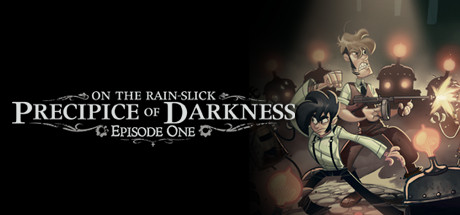
That same friction lives in Precipice of Darkness, Episode One, where the description frames it as “an RPG-Adventure game series based on the web comic Penny Arcade” and emphasizes its Comedy & Parody DNA—not satire, not irony, but parody as structural breathing room. The player review nails it: “Fun as hell, especially if you enjoy the Penny Arcade style of humor though you don’t need to know much about the comics since this is an AU…” That “AU” is key—it’s not fidelity to source, but permission to misfire gloriously, to build a JRPG framework only to subvert its own gravity with cartoonish timing and tonal whiplash. Like Tanaka naming someone “Robo” and then spending ten minutes debating whether robots blink, the game treats narrative weight like a prop—it’s there to be dropped, reassembled wrong, or used as a paperweight for a half-eaten sandwich.
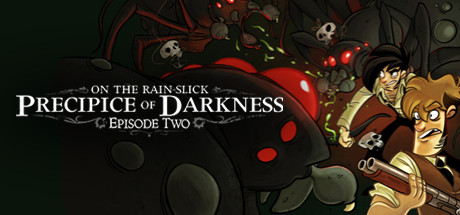
Then there’s Precipice of Darkness, Episode Two, whose description mirrors the first but adds the detail: “the special attack minigame seems to have some input delay because I swear I am pressing the buttons at the right time…” That complaint isn’t frustration—it’s recognition. It’s the exact feeling of watching Tanaka try to execute her “boyfriend acquisition plan” by whispering into a classmate’s ear while standing exactly three inches too close, her voice cracking mid-sentence—not because she’s nervous, but because the scene’s internal physics demand it. The delay isn’t broken code; it’s character. Both the anime and the game treat mechanical imperfection—not as flaw, but as texture. A missed button press echoes Tanaka’s nickname blunder: not catastrophic, just there, humming with the same gentle, undeniable wrongness that makes everything feel weirdly, tenderly real.
Who loves this? Not the person who needs catharsis or closure. Not the one craving growth arcs or earned victories. It’s the viewer who watches Tanaka stare blankly at a vending machine for forty seconds, wondering aloud if soda machines judge your life choices—and feels seen. It’s the player who, after missing the minigame window again, leans back, snorts, and mutters, “Yeah, fair,” before reloading—not to win, but to watch the glitch bloom again, soft and stupid and utterly theirs. These pairings belong to people who find solace in systems that refuse to optimize—where failure isn’t a checkpoint, but the ground you stand on. Where awkwardness isn’t a barrier to connection—it’s the language.
🎮7 Games That Match the Vibe


Match Dimensions Explained
❓Frequently Asked Questions
Why does Precipice of Darkness feel so similar to Wasteful Days of High School Girls despite having no school setting?
It’s all about the tonal whiplash and character-driven absurdity—like how Wasteful Days uses deadpan delivery from characters like Miu during chaotic classroom hijinks, Precipice of Darkness leans hard into Penny Arcade’s signature snarky, fourth-wall-breaking banter (e.g., Gabe and Tycho riffing mid-battle) while wrapping it in a JRPG narrative structure. Both games use comedy as scaffolding for surprisingly sincere emotional beats—think Miu’s quiet vulnerability after a ridiculous prank versus Episode One’s unexpectedly tender moment when your custom avatar shares a beer with Tycho in the rain-soaked alley behind The Pit.
Is there an anime or manga adaptation of Precipice of Darkness?
Nope—no official anime, manga, or live-action adaptation exists for Precipice of Darkness, even though it’s based on the hugely popular Penny Arcade web comic. Unlike Wasteful Days (which got a manga spin-off), the games remain the *only* canonical adaptations of the Rain-Slick Precipice storyline, and both Episode One and Episode Two were developed exclusively as indie JRPG-adventures by Hothead Games with direct input from the comic’s creators.
Precipice of Darkness vs. Wasteful Days: which one nails chaotic group banter better?
Wasteful Days wins for tightly choreographed, slice-of-life ensemble chaos—like the infamous ‘lunchbox sabotage’ scene where Miu, Riko, and Aya talk over each other while stealing mayo packets—but Precipice of Darkness delivers sharper, more self-aware *dialogue-driven* chaos, especially in Episode Two’s special attack minigame where Gabe yells nonsense commands while you frantically mash buttons (and yes, that input delay players complained about makes the chaos feel weirdly intentional). Both are hilarious, but Wasteful Days feels like eavesdropping on real teens; Precipice feels like being dragged into a nerdy improv troupe’s fever dream.
What if I love Wasteful Days’ mix of cringe humor and heartfelt moments but hate turn-based combat?
You’ll still vibe with Precipice of Darkness—Episode One and Two use simple, joke-forward combat (think timed button presses for ‘Special Attacks’) that’s more rhythm-game than strategy, and the real meat is in the branching dialogue, environmental gags (like arguing with a sentient vending machine in Episode One), and character chemistry. Neither game forces deep tactical engagement—you’re here for Tycho roasting your party’s fashion choices or Miu sighing at her friends’ nonsense, not for optimizing skill trees.