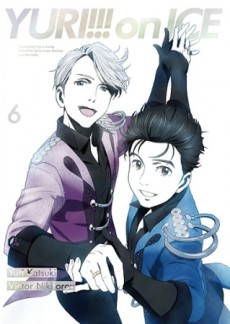
Yuri on Ice Side Story: Welcome to The Madness
At the GPF exhibition event, Yuri P. performs a skating routine with Otabek.
Note: Short special included in the 6th BD/DVD volume.
📺Anime Details
📝Editorial Analysis
The lights dim—not to black, but to a soft, breath-held indigo. Yuri P. glides forward, blades carving silence into the ice, and then Otabek meets him: no handshake, no nod—just a shared center of gravity, a tilt of the head, a synchronized breath before the first note hits. There’s no voiceover, no internal monologue, no crowd roar bleeding in. Just the scrape-hiss of steel, the faint creak of leather, the way their shoulders align like two compass needles finding true north. In that first five seconds, before the choreography unfolds, you feel it: intensity, not as aggression, but as presence—two adults holding space so completely that time doesn’t slow—it thickens.

What makes Yuri on Ice Side Story: Welcome to The Madness singular isn’t its lack of dialogue—it’s how that silence becomes sonic architecture. Without words, every gesture is weighted: a wrist flick isn’t just movement—it’s intention made visible; a sustained eye contact isn’t flirtation—it’s recognition, mutual and unflinching. This isn’t about storytelling through exposition or character arcs. It’s about embodied resonance: two skaters translating discipline, history, rivalry, and quiet trust into motion that vibrates at the same frequency as your own pulse. You don’t watch it—you sync to it. It makes you think about how much we communicate when we stop speaking—how devotion lives in muscle memory, how competition can be tender, how artistry blooms most fiercely when stripped down to rhythm, risk, and shared breath.
That same resonance hums in AudioSurf—not because it’s about skating, but because it turns your music into a physical path you ride with total bodily commitment. Its description says you “ride your music,” and that’s exactly what Yuri P. and Otabek do: their bodies are vehicles for the score, each jump and glide shaped by tempo, swell, and silence. The player review calls it “superior” despite its flaws—crashes, flashbangs, clunky UI—because the core experience overrides friction. Like the anime’s 12-minute runtime, AudioSurf doesn’t ask for patience with polish; it demands surrender to the flow. When the game’s rails rise and fall with the bassline of your playlist, and you lean into turns with instinct instead of instruction, you’re not playing—you’re performing, just as Yuri and Otabek perform without script, without safety net, without anything but the music and each other.
Then there’s Strong Bad's Cool Game for Attractive People: Season 1, which at first glance feels like tonal whiplash—cartoon chaos versus icy precision. But look closer: its description frames it as “wacky comedic adventures over 5 full episodes,” and the player review longs for its return not for nostalgia, but for its unapologetic rhythm. Strong Bad doesn’t explain his logic—he enacts it, fast and certain, turning absurdity into ritual. That’s the energy of the GPF exhibition: no backstory, no stakes beyond the moment, no justification needed for why these two men—one stoic, one radiant—choose this routine, this synchronicity, this heat. Both works operate on the same principle: confidence as choreography. They trust the audience to feel the beat before they understand the lyrics—or, in this case, to feel the meaning before a single word is spoken.
Who would love this pairing? Not just fans of sports anime or rhythm games—but people who crave economy of expression: the dancer who knows a raised eyebrow can land harder than a monologue; the musician who edits a track down to three perfect bars and leaves the rest as negative space; the player who restarts a level not to win, but to nail the timing of one airborne spin. They’re the ones who pause mid-game to watch how light catches a character’s shoulder in a cutscene, or who replay a skating sequence not to study footwork, but to re-live the weight of a held pose—the way Otabek’s hand rests, palm-up, just above Yuri’s back, not touching, not retreating, holding the possibility. That’s the heart of it: art as shared breath, as mutual calibration, as madness that feels, unmistakably, like home.
🎮3 Games That Match the Vibe

Match Dimensions Explained
❓Frequently Asked Questions
Why does the 'Ice Dance Off' scene in Yuri on Ice Side Story feel so much like Audiosurf?
Because both hinge on syncing movement to music’s emotional peaks—like when Yuuri nails that soaring violin crescendo in the final routine, mirroring how Audiosurf dynamically generates rails and blocks based on your song’s tempo and intensity. Players even report getting chills during high-score runs on tracks like 'Yuri on Ice OP' because the rhythm-driven flow and visual feedback (flashing lights, color surges) echo the show’s choreographed tension.
Is there a Yuri on Ice Side Story anime or visual novel adaptation?
No—'Welcome to The Madness' is exclusively a fan-made interactive side story inspired by the anime, not an official adaptation. That said, Strong Bad's Cool Game for Attractive People nails the same offbeat, character-driven energy: think Viktor’s playful teasing meets Strong Bad’s fourth-wall-breaking banter across its five episodic chapters, all wrapped in choice-driven comedy.
How is Strong Bad's Cool Game for Attractive People different from Yuri on Ice Side Story in terms of storytelling?
While both thrive on charismatic leads and competitive banter, Strong Bad leans into absurdist, dialogue-first interactivity—like choosing whether to roast Homestar or flirt with Marzipan during a 'wrestling match' minigame—whereas Yuri on Ice Side Story focuses on intimate, emotionally grounded moments (e.g., Yuuri rehearsing alone in the rink at night). The former scores 84 for 'Music & Idol, Competitive Spirit' thanks to its rapid-fire writing; the latter channels that same spirit through quieter, more atmospheric pacing.
What’s the best game like Yuri on Ice Side Story if I want something uplifting but slightly chaotic?
Strong Bad's Cool Game for Attractive People is your perfect match—it’s got the same infectious energy as Viktor’s impromptu dance-offs, but dialed up to eleven with slapstick timing, branching jokes, and mini-games that go gloriously off-rails (like trying to win a 'laser tag' showdown using only a toaster). Fans love how it balances heartfelt character beats—like Coach Bubs’ surprisingly tender advice—with total nonsense, just like the Side Story’s blend of skating drama and surreal locker-room shenanigans.