
Beyblade
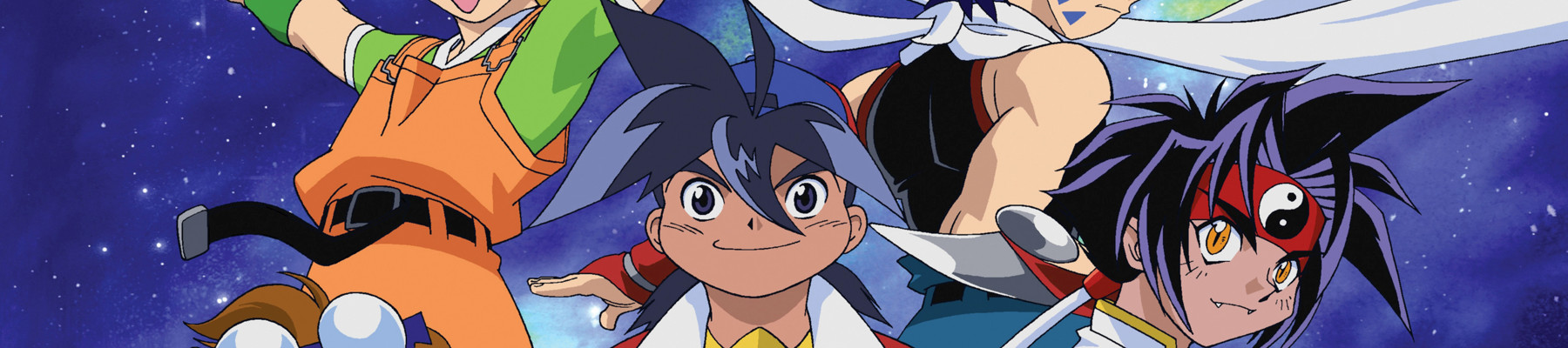
Thirteen-year-old Tyson Granger (Takao Kinomiya), along with his fellow teammates, Kai Hiwatari, Max Tate (Max Mizuhura), and Ray Kon (Rei Kon), strive to become the greatest Beybladers in the world. With the technical help of the team's resident genius, Kenny (Kyouju), and with the powerful strength of their BitBeasts, the Bladebreakers armed with their tops (AKA: Blades) attempt to reach their goal.
(Source: Anime News Network)
📺Anime Details
📝Editorial Analysis
The roar of the stadium lights snapping on—blinding white, humming with electricity—as Tyson Granger’s Drigger spins into the Beyblade stadium, wobbling violently before locking in with a metallic shink! that vibrates up your ribs. His knuckles are white on the launcher. Kai watches from the stands, arms crossed, jaw tight—not indifferent, but waiting. Not for victory, exactly. For proof. That something real can hold its shape in the chaos.
That’s Beyblade’s heartbeat: not just competition, but ritualized gravity. Every launch is a defiance of entropy. Every BitBeast’s emergence—a flash of light, a gust of wind, a voice echoing from somewhere ancient and unnameable—is less magic than memory made kinetic. It’s kids hurling themselves, literally and emotionally, into a world where physics bends just enough to let belief take physical form. The show doesn’t ask you to suspend disbelief—it asks you to lean in, to feel the weight of the plastic top in your palm, the sting of a failed launch, the dizzying lift when your spin holds. It’s earnest, not naive. Fierce, not flashy. There’s no irony in Tyson yelling “Let it rip!”—because the phrase isn’t a catchphrase. It’s a prayer.
What makes Beyblade’s atmosphere singular isn’t its sports framing or sci-fi gloss—it’s how it treats struggle as sacred space. The conspiracy isn’t shadowy villains plotting in boardrooms; it’s buried in rusted gyros and corrupted BitBeast data, revealed through Kenny’s frantic scrolling, Ray’s quiet suspicion after a match gone too clean. The travel isn’t scenic tourism—it’s bus rides with duffel bags, sleeping on gym floors, the exhaustion settling behind the eyes after three back-to-back tournaments. This is melancholic exploration: the ache of growth, the loneliness inside a team, the way ambition hums beneath every laugh. And the competitive spirit? It’s never zero-sum. It’s Kai turning away mid-victory to watch Tyson’s recovery spin. It’s Max offering his launcher grip to a rival whose string snapped. Competition here is relational, not transactional.
That same emotional DNA thrums in DARK SOULS™ III, where player reviews ask: “Why Do We Still Reach for the Fire When It Is Dying?” That question lives in Beyblade’s marrow—Tyson launching Drigger again after Kai shatters it, not because he expects to win, but because to stop is to forget what fire feels like. The game’s melancholic exploration mirrors the anime’s quiet moments: Tyson staring at his cracked launcher at dawn, the stadium empty except for the echo of last night’s cheers. Both treat exhaustion as texture, not obstacle. Victory isn’t triumph—it’s continuance.
Then there’s EVE Online, where players describe flying T2 Navy Megathrons across a massive living universe of danger and opportunity. That phrase—living universe—is pure Beyblade: the World Championships aren’t just arenas; they’re shifting ecosystems—crowds swelling like tides, rival teams forming temporary alliances over shared repair kits, underground bladers trading forbidden gyro weights in alleyways behind convention centers. The competitive spirit isn’t leaderboard-chasing; it’s the weight of reputation earned across continents, the way Ray’s name carries different meaning in Shanghai versus Buenos Aires. And melancholic exploration? It’s the solo flight across null-sec, yes—but also Tyson walking alone through Tokyo Station at midnight, backpack heavy with spare parts, listening to the distant, muffled clack-clack-clack of street performers’ spinning tops.
Even Garry's Mod, with its physics sandbox and lack of predefined goals, resonates—not in structure, but in spirit. Its player review laments S&Box’s “unoptimized and Ai filled release,” longing for raw, tactile play. That’s Beyblade’s core: no AI, no cutscenes explaining why tops spin this way. Just Kenny’s schematics scrawled on napkins, Max testing friction coefficients with rubber bands and tape, Ray balancing a top on his fingertip for twenty minutes until it feels right. It’s competitive spirit rooted in making, not consuming. The melancholy isn’t sadness—it’s the quiet focus of creation, the hush before the launch, the world narrowing to one spinning point of light.
This pairing speaks to the kid who still keeps their old Beyblade launcher in a drawer—not as nostalgia, but as calibration. To the player who replays Dark Souls’ Kiln of the First Flame not for lore, but to feel that exact tremor in their hands when the bonfire flickers low. To the EVE pilot who logs in not to conquer, but to witness the slow drift of a freighter across the void, remembering how Tyson watched clouds move between matches. They don’t chase endings. They return to the spin—the fragile, defiant, alive moment where physics and heart align, just long enough to believe in the lift.
🎮7 Games That Match the Vibe



Match Dimensions Explained
❓Frequently Asked Questions
Why do people compare Beyblade battles to Dark Souls III boss fights?
It’s all about that high-stakes, rhythm-driven tension—like when you’re dodging Siegward’s hammer swings in Dark Souls III and have to time your parry just right, mirroring how Beyblade spinners read their opponent’s launch angle and stamina drop. Both demand split-second reads, pattern recognition, and that electric 'one more try' feeling after a narrow loss—especially in the Ash Lake or Irithyll arenas where every dodge feels earned.
Is there a Beyblade anime game adaptation I can actually play on PC?
No official Beyblade anime tie-in games exist on PC—but Garry's Mod fills that void *brilliantly* with community-made Beyblade physics mods where you can build custom stadiums, tweak gyroscopic spin decay, and even recreate iconic matches like Gingka vs. Kyoya using ragdoll torque and joint constraints. It’s not licensed, but it’s the closest thing to launching a real Metal Fury blade in a sandbox.
EVE Online vs. Beyblade: which is more about reading your opponent’s strategy in real time?
Both hinge on psychological anticipation—but EVE Online takes it deeper in fleet combat, like when you’re piloting a Navy Megathron and must predict whether the enemy tackle frigate will commit to scram range *before* you commit capacitor for a full volley. That mirrors Beyblade’s ‘launch timing war’ where one millisecond early or late changes everything—just swap gyroscopes for warp drives and stadium walls for asteroid belts.
What’s the best Beyblade-like game if I want that melancholic, lonely-but-focused vibe of spinning alone in a basement at midnight?
Dark Souls III nails that exact mood—think wandering the desolate, ash-choked ruins of Lothric, where every clink of your weapon echoes like a Beyblade slowing down in an empty arena. The dim lighting, slow-burn stamina management, and quiet weight of each swing (or spin) mirror that solitary, meditative focus—plus the player review’s line ‘Why Do We Still Reach for the Fire When It Is Dying?’ hits the same emotional resonance as winding up your first blade before your first real battle.