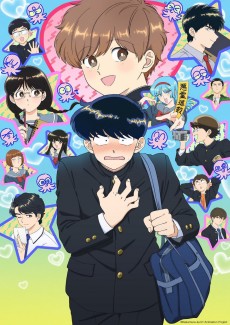
Go For It, Nakamura-kun!!
Love at first sight is no myth—just ask Okuto Nakamura. Whenever his dreamy classmate Aiki Hirose enters the room, his heart skips a beat, despite the fact that they’ve never actually spoken. Not to mention, Nakamura is a complete klutz with zero friends. Will he ruin his chance at love before it even begins?
(Source: Crunchyroll)
Note: The series streamed a week in advance on Hulu Japan starting with episode 2 released alongside episode 1.
📺Anime Details
📝Editorial Analysis
The pencil snaps in Nakamura’s fingers—again—as Aiki Hirose walks past his desk. Not even a glance. Just the soft rustle of uniform fabric, the faint scent of shampoo cutting through chalk dust and lunchroom steam, and Nakamura’s own breath hitching like a dial-up modem failing mid-connect. His heart doesn’t race. It stutters. A physical, almost painful pause—like time itself blinks to accommodate the sheer, unmediated presence of someone he’s never spoken to but already knows by the angle of their jaw when they yawn, the way their pen rolls off the desk during homeroom, the quiet rhythm of their footsteps echoing down the hallway long after they’ve turned the corner.

That’s the atmosphere: tremulous intimacy. Not grand confessions or dramatic confrontations—but the unbearable weight and sweetness of proximity without permission. It’s the emotional architecture of adolescence distilled into silence, blushes, and accidental eye contact that lasts 1.7 seconds too long. You don’t feel hopeful watching Go For It, Nakamura-kun!!—you feel vulnerable, like your own pulse is being broadcast over a faulty PA system. It’s comedy born from self-aware awkwardness, romance built on absence rather than contact, and slice-of-life so tender it aches—not because anything happens, but because so much is held inside, trembling behind every failed attempt at casual conversation, every misstep tripping over a stray eraser, every time Nakamura rehearses a greeting in his head while staring at a potted fern in the classroom window.
Which makes Prince of Persia shockingly resonant—not the acrobatics or sand magic, but the romance & shoujo and comedy & parody dimensions flagged in its match. That description calls it “an all-new epic journey” with “a new prince, new lands and a brand new story completely separate from the sands…” — and yes, it’s a reboot, but what sticks is the tonal echo: the Prince stumbles, falters, misreads signals, swings wildly (literally and emotionally), and yet his yearning is rendered with sincerity and softness. Like Nakamura, he’s perpetually one misstep from grace, and the game’s humor lives in that gap between aspiration and execution—the same gap where Nakamura’s heart skips and his shoelace unties exactly as Aiki passes.
Then there’s The Sims™ 4, whose description invites you to “Play with life and discover the possibilities… create a world of Sims that’s wholly unique.” That’s Nakamura’s inner world exactly: a meticulously imagined social ecosystem where every interaction is rehearsed, every outfit chosen for maximum non-threatening approachability, every idle moment spent constructing hypothetical futures with Aiki in them. The player review complains about DLC dependency and bugs—but the raw, unpolished playfulness of simming—building relationships one awkward gift, one failed cooking attempt, one accidental dance move at a party at a time—mirrors how Nakamura navigates love: not as destiny, but as iterative, fragile simulation. He’s running his own private, low-stakes life sim in real time, full of glitches and charm.
Even Thrillville®: Off the Rails™, with its “20 death-defying rides” and coasters that “leap from one track to another,” fits—not through scale, but rhythm. Its description celebrates physics-defying leaps and airborne launches; its player review recalls childhood joy, smooth performance, and enduring fun. That’s Nakamura’s emotional pacing: sudden, breathless surges—Aiki’s laugh carrying across the gymnasium, the shared glance during roll call, the way sunlight hits his hair in third period—followed by long, quiet stretches of recalibration. The coaster doesn’t run constantly; it builds, climbs, pauses at the crest… then drops. So does Nakamura’s composure. So does his hope. The game’s cheerful, kinetic absurdity mirrors the anime’s refusal to pathologize that volatility—it’s just how the body feels when love hasn’t landed yet.
This pairing sings for the person who cries at cafeteria seating charts, who saves screenshots of text messages they didn’t send, who finds profound poetry in a boy adjusting his glasses while looking away. It’s for the quiet observer who knows the difference between liking someone and loving the idea of being liked back—and who treasures both, equally, tenderly.
🎮7 Games That Match the Vibe




Match Dimensions Explained
❓Frequently Asked Questions
Why does Prince of Persia keep showing up in 'Games Like Go For It, Nakamura-kun!!' lists when it’s an action-adventure game?
Great question—it’s all about the shared *Romance & Shoujo* and *Comedy & Parody* dimensions, not combat. Think of the Prince’s flustered banter with Zahra, the over-the-top romantic tension during rooftop chases, and how the whole reboot leans into playful, self-aware melodrama—very Nakamura-kun energy. That’s why it scores an 83 here, same as TS4, despite the swordplay.
Is there an anime or manga adaptation of Thrillville: Off the Rails?
Nope—Thrillville: Off the Rails is purely a game (and a delightfully chaotic one at that). It’s got zero anime/manga ties, but its vibe totally fits the 'Go For It, Nakamura-kun!!' crowd: think goofy park management, over-the-top coaster stunts like launching Sims through flaming hoops, and that warm, nostalgic Wii-era charm fans love. The PC port still runs smoothly, just like your memory of building that impossible corkscrew loop in 2011.
How does The Sims 4 compare to Disco Elysium for someone who loves Nakamura-kun’s romantic comedy tone?
Totally different beasts—but both hit the *Romance & Shoujo* and *Comedy & Parody* dimensions (hence their matching 82 and 65 scores). TS4 lets you craft Nakamura-style rom-com scenarios—think ‘accidentally locking yourself in a closet with your crush’ or ‘awkwardly gifting a bento box while blushing’—all via whimsical, player-driven storytelling. Disco Elysium? It’s more like if Nakamura-kun had existential dread, political theory flashbacks, and a drunk detective narrator instead of a school festival committee.
What’s the best 'Go For It, Nakamura-kun!!'-like game if I’m in the mood for lighthearted, nostalgic fun—not deep lore or heavy themes?
Go straight for Thrillville: Off the Rails. It’s pure, unapologetic whimsy: building absurd coasters, pranking guests with silly gadgets, and watching your park explode in joyful chaos—all with that same warm, slightly goofy energy as Nakamura-kun’s classroom shenanigans. Player reviews even call it ‘aged really well,’ and yeah—it’s the kind of game where you’ll spend 20 minutes just making a rollercoaster launch a hot dog vendor into orbit. Perfect mood reset.