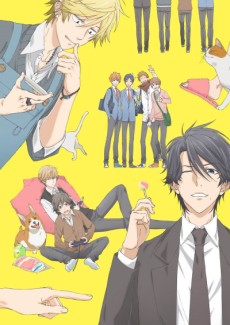
Hitorijime My Hero
High schooler Masahiro Setagawa is a fairly helpless delinquent, so much so that the neighborhood bullies use him to run their errands. His life changes when he meets high school teacher Kousuke Oshiba, a man whose fighting abilities have earned him a powerful reputation on the streets. Oshiba finds himself with a desire to protect Setagawa, and despite swearing that he's not interested in men, Setagawa finds himself getting more involved in Oshiba's affairs...
(Source: Sentai Filmworks)
📺Anime Details
📝Editorial Analysis
The first time Kousuke Oshiba catches Masahiro Setagawa mid-stumble—hand outstretched not to scold, but to steady him—the air doesn’t crackle with drama. It settles. A quiet, warm weight in the chest. No grand speech, no flash of violence, just the low hum of a Tokyo afternoon, the soft rustle of Oshiba’s blazer sleeve brushing Masahiro’s wrist as he pulls him upright. That moment isn’t about rescue. It’s about recognition: two people seeing each other—not as role or reputation—but as real, tender, slightly unsteady human beings.

That’s the feeling Hitorijime My Hero lives inside: safety found in proximity. Not safety as absence of danger—there is danger, real and grounded: neighborhood bullies, gang tensions, the quiet threat of adult consequences—but safety as intentional softness. It’s in how Masahiro, usually all flustered bravado, lets his shoulders drop when Oshiba walks into the room. It’s in how Oshiba, whose fists have silenced streets, folds laundry for Masahiro without being asked. This isn’t idealized romance—it’s domestic gravity: love as shared silence over tea, as borrowed hoodies, as the slow, unspoken recalibration of two lives learning how to hold space for each other’s contradictions. You don’t watch it to escape. You watch it to breathe deeper.
That emotional DNA—tenderness as resistance, intimacy as quiet rebellion against harsher systems—resonates sharply with certain games. Take Persona 5 Royal: its description promises “build relations” while exploring Tokyo, and players praise its “seamless transition between daily life…” That rhythm—school days bleeding into late-night confessions, cram school giving way to rooftop talks under neon glow—is exactly the pulse of Hitorijime My Hero. Both treat ordinary time as sacred ground where relationships deepen not through spectacle, but through consistency: choosing to show up, again and again, even when nothing dramatic is happening. The warmth isn’t in the heist or the classroom—it’s in the pause, the shared glance across a crowded train platform, the unspoken understanding that this person matters enough to rearrange your schedule for.
Then there’s Jade Empire™: Special Edition, described as stepping “into the role of an aspiring martial-arts master” who follows “the path of the open palm or the closed fist.” That duality—strength wielded not for domination but for protection, discipline channeled into care—mirrors Oshiba’s entire presence. His reputation isn’t just backstory; it’s texture. When he steps between Masahiro and a threat, it’s not machismo—it’s containment, like a wall built not to keep others out, but to hold something fragile in. The player review’s technical frustration (“had to follow these instructions…”) ironically echoes the anime’s own subtle friction: both ask you to lean into the system—whether it’s Steam’s quirks or high school hierarchy—to access something deeply humane beneath.
And Dragon Age: Origins, with its legacy-defining choice—“Determine your legacy and fight for Thedas”—lands with surprising resonance. Because Masahiro is forging a legacy, too—not on a battlefield, but in small, defiant acts: refusing to run errands, speaking up in class, letting himself be seen by someone who sees him, not the delinquent label. The player review notes the “pause attack mechanic… help a lot to strategist your tactic”—and that’s the quiet power of Hitorijime My Hero: every meaningful choice is made in real time, with real stakes. Masahiro doesn’t level up—he learns to pause, to choose kindness over reflex, vulnerability over performance. His growth isn’t quantified. It’s felt: in the way his voice steadies, the way he meets Oshiba’s eyes without looking away.
This pairing isn’t for fans of grand declarations or explosive confessions. It’s for the person who cries when a character finally eats breakfast with someone else, who feels their throat tighten when a gruff mentor remembers how they take their coffee, who understands that love isn’t always a lightning strike—it’s the slow, deliberate turning of a key in a lock you didn’t know was keeping you safe. It’s for those who find courage in holding hands on a crowded street, revolution in saying “I’m here” without shouting, and heroism in choosing gentleness—again and again—in a world that rarely rewards it.
🎮11 Games That Match the Vibe







Match Dimensions Explained
❓Frequently Asked Questions
Why does Dragon Age: Origins feel so much like Hitorijime My Hero despite being a fantasy RPG?
It’s all about the emotional weight and slow-burn intimacy—like when you’re alone with Alistair in the Frostback camp, sharing quiet jokes before a battle, or choosing how deeply to let him into your guard. The game nails that same tender, character-driven vulnerability you love in Hitorijime My Hero, especially in romance scenes where trust builds through small choices—not grand gestures. Plus, its pause-and-plan combat mirrors how Hitorijime My Hero lets you savor moments, not rush them.
Is there an anime or manga adaptation of Persona 5 Royal?
No official anime or manga adaptation of *Persona 5 Royal* exists—but the original *Persona 5* got both: the *Persona 5: The Animation* series (2018) and the *Persona 5: Mementos Mission* manga, which dive deep into Ann Takamaki’s arc and the Phantom Thieves’ bond. While Royal’s new content (like Kasumi Yoshizawa’s story and the Third Semester) hasn’t been adapted yet, fans often say her rooftop confession scene feels *exactly* like the quiet, charged intimacy of Hitorijime My Hero’s early train station moments.
How is Jade Empire: Special Edition different from Mass Effect (2007) for romance-focused players?
Jade Empire leans into poetic, culturally grounded emotional restraint—think silent glances during martial arts training with Master Li, or choosing whether to comfort or challenge your mentor in morally grey dialogue trees. Mass Effect (2007), meanwhile, gives you bold, cinematic romance options like flirting with Liara in the Prothean ruins or sharing vulnerable backstory over drinks on the Normandy—more direct, but just as heartfelt. Both score 79 in Romance & Shoujo, but Jade Empire’s vibe is ‘slow-burn ink painting,’ while Mass Effect’s is ‘starlit confessional.’
What’s the best game like Hitorijime My Hero if I want that bittersweet, rain-soaked emotional clarity feeling?
Disco Elysium — The Final Cut is your match. Picture standing on the rain-slicked docks of Revachol at 3 a.m., your detective’s inner voices arguing while you choose whether to confess your failures to Kim Kitsuragi—or just sit beside him in silence. That raw, melancholic intimacy, layered with self-reflection and quiet tenderness? It’s the same emotional texture as Hitorijime My Hero’s rooftop confessions or rainy-day walks home with Yuu. Even its review quote about ‘cruel irony’ echoes the show’s themes of love tangled with guilt and growth.