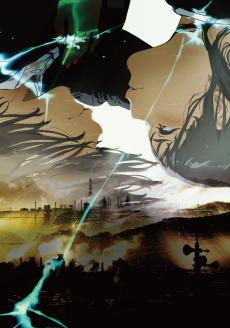
maboroshi
Masamune, a third-year middle school student, lives in a town where all the exits have been sealed off due to a sudden explosion at a steel mill, causing time to stand still. Residents are forbidden from making any changes and spend their suffocating days in the hopes of returning to normalcy someday.
One day, Masamune's mysterious classmate Mutsumi guides him to the fifth furnace of the steel mill, where they encounter a girl who cannot speak and resembles a wild wolf. The meeting between the two girls and Masamune disrupts the balance of the world, and the unstoppable "impulse of love" from boys and girls tired of their daily lives begins to destroy the world.
📺Anime Details
📝Editorial Analysis
The air in Masamune’s town doesn’t just feel still—it tastes metallic, thick with the ghost of furnace heat and the low, unbroken hum of suspended time. You feel it in the way his school hallway echoes too cleanly when he walks alone, how dust hangs midair near a cracked window, how the train tracks outside town don’t carry a single whistle—just rust blooming like slow blood on iron rails. That silence isn’t empty. It’s charged, waiting—not for rescue, but for permission to grieve.

What makes maboroshi ache so uniquely isn’t its isekai framing or its gods or even the steel mill’s sealed exits. It’s the suffocation of almostness: almost freedom, almost speech, almost love, almost time moving again. This isn’t fantasy as escape—it’s fantasy as pressure chamber. Every glance at Mutsumi’s unreadable eyes, every time Masamune hesitates before touching the girl who looks like a wild wolf—those moments aren’t about plot mechanics. They’re about the body remembering how to tremble when choice has been outlawed. You don’t watch this anime—you hold your breath with it. And when the tragedy arrives—not as spectacle, but as quiet erosion—you feel it in your molars, your throat, the hollow behind your ribs. It’s heavy. Not dramatic. Not cathartic. Just there, like humidity before rain that never falls.
That emotional gravity finds resonance in Jade Empire™: Special Edition, where the player steps into a martial-arts world bound by rigid philosophies—the open palm or the closed fist—not as abstract choices, but as bodily stances that shape identity under unspoken divine law. The description says nothing about steel mills or time loops, but the emotional narrative dimension aligns: both force you to move through a world where moral motion is constrained, where romance isn’t flirtation but risk, where every decision carries the weight of inherited silence. A player review mentions needing to “copy and paste ‘steam.dll’” to launch—a tiny, absurd bureaucratic hurdle mirroring Masamune’s own impossible gatekeeping: rules without reason, systems that demand compliance before meaning.
Then there’s Dragon Age: Origins, where the Fifth Blight isn’t just war—it’s entropic stasis. The darkspawn corrupt time itself, turning forests into petrified groves, villages into frozen ruins where survivors whisper prayers to gods who stopped answering. Its description names legacy and nobility, but the player review reveals the real texture: “pause attack mechanic… help a lot to strategize your tactic.” That pause—the literal freezing of action to weigh consequence—is maboroshi’s heartbeat made interactive. You don’t rush. You hold. You watch your party breathe in the firelight, knowing each dialogue choice could collapse a fragile truce—or a fragile heart. Like Masamune learning to read Mutsumi’s silences, you learn to read the weight behind a dwarf’s clenched jaw or an elf’s delayed nod.
And Persona 5 Royal, with its Tokyo streets pulsing under neon and existential dread, shares something quieter but deeper: the urban coming-of-age under divine surveillance. The Phantom Thieves don’t fight monsters—they confront cognitive distortions installed by authority figures who’ve rewritten reality to suit their power. The description mentions “building relations,” but the review highlights the “seamless transition between daily life”—that same suffocating rhythm Masamune endures: school bells, train schedules, the ritual of pretending normalcy while the world holds its breath. Romance here isn’t confession—it’s co-conspiracy, two people recognizing the same fracture in the air. Like Masamune and Mutsumi walking past the fifth furnace, neither speaking, both knowing the walls are thinner than they look.
This pairing isn’t for fans of grand battles or tidy resolutions. It’s for the person who rewatched the scene where Masamune drops his lunchbox and watches rice grains hang in the air for three seconds—and felt their own pulse sync to that suspension. It’s for the player who paused Disco Elysium not to plan a skill check, but because Harry’s internal monologue echoed their own spiraling thoughts about capital, memory, and the cruelty of systems that call themselves neutral. It’s for anyone who’s ever loved someone in the cracks—not despite the silence, but through it. Who understands that the most devastating romances aren’t built on declarations, but on shared glances across a frozen train platform, knowing the next stop might never come—and loving anyway.
🎮12 Games That Match the Vibe







Match Dimensions Explained
❓Frequently Asked Questions
Why does Jade Empire feel so much like maboroshi despite being set in a martial arts world?
It’s all about that quiet, emotionally charged intimacy—like when you’re choosing between the Open Palm and Closed Fist paths, and every dialogue with Master Li or Dawn Star carries weighty, unspoken longing. The Romance & Shoujo dimension (shared with maboroshi) shines through slow-burn character moments and melancholic worldbuilding—not flashy combat, but how silence between characters speaks louder than action.
Is there a manga or anime adaptation of maboroshi that explains the story better?
No official manga or anime adaptation exists—but fans often reach for Persona 5 Royal when they want that same layered emotional rhythm: think Ann Takamaki’s arc unfolding over rainy Tokyo days, or the way your Confidant choices deepen relationships like turning pages in a visual novel. It’s not an adaptation, but it *feels* like one—thanks to its tight blend of daily life, romance, and narrative gravity.
How is Dragon Age: Origins different from Mass Effect (2007) for someone who loves maboroshi’s tone?
Mass Effect leans into galactic scale and heroic certainty—even its quiet moments (like talking to Liara in the Normandy lounge) shimmer with romantic idealism. Dragon Age: Origins digs deeper into moral ambiguity and grief, like when you confront Loghain after the Battle of Ostagar: no easy answers, just raw, pause-and-reflect tension. Both score 80/70 on Emotional Narrative, but DA:O matches maboroshi’s weightier, more somber cadence.
What’s the best game like maboroshi if I want something deeply atmospheric and introspective, not action-heavy?
Disco Elysium — hands down. Forget combat; it’s all about wandering rain-slicked streets of Revachol, hearing your own thoughts argue in real time, and having conversations that land like quiet heartbreak—just like maboroshi’s most resonant scenes. Its Romance & Shoujo and Emotional Narrative dimensions align tightly, and that Reddit review quote about capital’s cruel irony? That’s the same kind of layered, literary ache you’re after.