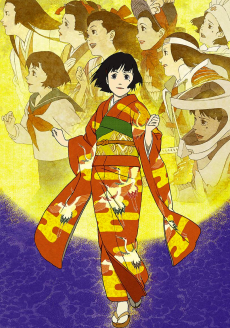
Millennium Actress
Millennium Actress blurs the lines between the past and the present, and truth and fiction, when a documentary filmmaker fulfills his quest to find the legendary actress Chiyoko Fujiwara, and learn why she mysteriously vanished at the height of her brilliant career. When Chiyoko grants the filmmaker’s request, he, in turn, presents her with a token – a key she had lost and thought was gone forever. The filmmaker could not have imagined that the key would not only unlock the long-held secrets of Chiyoko’s life, but also his own.
(Source: Dreamworks)
Note: The film received an early premiere at the Fantasia Film Festival on July 28, 2001.
📺Anime Details
📝Editorial Analysis
The key is cold in Chiyoko’s palm—not the kind that bites, but the quiet, dense chill of something long buried and suddenly unearthed. Her breath hitches—not in shock, but in recognition, as if her fingers remember its weight before her mind does. The documentary filmmaker watches, stunned, as the line between his present-day interview and her 1940s Kyoto studio dissolves—not with a smash-cut or a dissolve, but with the soft, inevitable sigh of film stock slipping through a projector gate. One second she’s in a sunlit tatami room, frail and silver-haired; the next, she’s sprinting barefoot across a snow-dusted bridge in a silk kimono, chasing a silhouette that flickers like damaged celluloid. There is no “cut.” There is only continuity—emotional, not chronological.
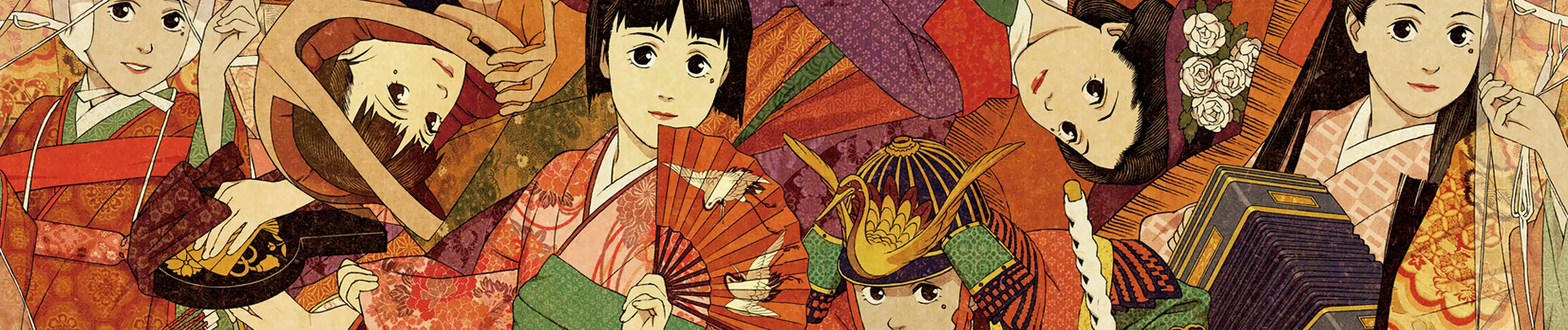
That’s the atmosphere: haunting continuity. Not nostalgia—not quite—but the vertigo of memory as a living, breathing medium. You don’t watch Millennium Actress; you step into the splice. It makes you feel the ache of time not as loss, but as layering: every era Chiyoko inhabits—wartime Osaka, postwar Tokyo, Showa-era film sets—overlaps, bleeds, echoes. Truth isn’t buried under fiction here; it circulates through it, like light through a prism. You think about how devotion can outlive its object, how love becomes less about a person and more about the motion of pursuit—the chase itself becoming the anchor, the compass, the script. The film doesn’t ask Did it happen? It asks What did it feel like to believe it did?
Prince of Persia, for all its sandstorms and acrobatics, shares that same kinetic yearning. Its description calls it “an all-new epic journey” built by Ubisoft Montreal—a reboot, yes, but one that “introduces us to a new prince, new lands and a brand new story completely separate from the sands…” Yet the player review nails it: it’s about renewal through repetition, about stepping into a myth already half-remembered. Like Chiyoko’s chases across eras, the Prince’s time-bending dashes aren’t just mechanics—they’re embodied persistence. You rewind not to fix error, but to honor motion—to keep the leap alive, even when the ground vanishes beneath you. That’s the same emotional DNA: love as relentless physical grammar.
The Sims™ 4, at first glance, seems galaxies away—until you read the player review complaining it’s “no fun without DLC… you can barely do a…” That frustration is oddly reverent. Because what The Sims™ 4 offers, per its description, is the power to “Play with life and discover the possibilities”—to build worlds where romance, ambition, failure, and quiet domesticity coexist without hierarchy. Like Chiyoko’s life, which unfolds across soundstages, war zones, and empty apartments, a Sim’s story isn’t linear—it’s modular, emotionally associative. A single key (a promotion, a breakup, a garden gnome) can trigger a cascade of memories, moods, timelines. The game doesn’t simulate realism—it simulates resonance. And when players grumble about broken packs, they’re mourning not bugs, but fractured continuity—the very thing Millennium Actress treats as sacred.
Even Disco Elysium - The Final Cut, with its bleak political monologues and detective work, pulses with the same core tension: identity as palimpsest. Its description calls it “a groundbreaking role playing game” where you “interrogate unforgettable characters” with a “unique skill system”—but the player review quotes a line about capital subsuming critique. That’s Chiyoko’s entire arc: her unrequited love isn’t just personal—it’s historical, folded into Japan’s postwar erasure, studio politics, the commodification of female stardom. Like Harry Du Bois parsing his own shattered psyche through skill checks, Chiyoko parses her life through film reels—each genre shift (melodrama, spy thriller, sci-fi) a different voice arguing inside her head. Both works treat memory as dialogue, not monologue.
This pairing sings for the viewer who cries not at endings, but at transitions: the person who rewinds a scene not to see it again, but to feel the weight of the cut between frames—the player who builds a Sim’s dream house then watches them stare out the window for three in-game days, wondering what’s just off-screen. For those who know that the most profound romances are never consummated—they’re performed, over and over, in the quiet space between what was filmed and what was felt.
🎮7 Games That Match the Vibe






Match Dimensions Explained
❓Frequently Asked Questions
Why does Prince of Persia keep showing up in 'Games Like Millennium Actress' lists?
Because both lean hard into romantic, dreamlike storytelling where memory and reality blur—like when the Prince races across crumbling sandscapes while flashbacks of his lover unfold mid-air, mirroring Chiyoko’s fragmented, emotionally charged recollections. It’s not just the romance & shoujo dimension (scored 84), but how the game uses time-bending mechanics and lyrical visual pacing to evoke the same wistful, cinematic yearning.
Is there a Disco Elysium anime adaptation like Millennium Actress?
No—Disco Elysium has no anime adaptation, and it’s unlikely: its dense, philosophical detective work (like interrogating the haunted cop Kim Kitsuragi or debating capitalism with your own inner voices) is deeply text-driven and tonally opposite to Millennium Actress’s poetic, flowing montage style. That said, fans who love Chiyoko’s layered identity exploration often find resonance in Elysium’s psychological depth—even if the vibe is grittier and more sardonic.
How does The Sims 4 compare to Millennium Actress in terms of storytelling?
It’s apples and origami cranes: TS4 doesn’t tell one story—it lets *you* build Chiyoko-like arcs through relationships, careers, and life milestones (e.g., guiding a Sim from wide-eyed actress aspirant to reclusive legend, complete with moodlets that shift like her emotional states). While it lacks scripted narrative, its romance & shoujo dimension (scored 82) and open-ended emotional simulation let players recreate the film’s themes—just without voice acting or a fixed timeline.
What’s the best game like Millennium Actress for that bittersweet, nostalgic, ‘life-in-reverse’ feeling?
Prince of Persia is your strongest match—especially during its rewind sequences, where you literally reverse time mid-fall or mid-leap, echoing how Millennium Actress loops back through Chiyoko’s past with tender, melancholic precision. That 84-scored blend of romance & shoujo isn’t just thematic; it’s baked into how the Prince’s bond with Elika unfolds in layered, non-linear reveals—like remembering a kiss while scaling a collapsing tower.