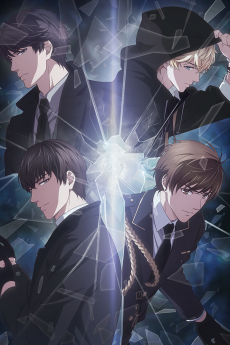
Mr Love: Queen's Choice
📺Anime Details
📝Editorial Analysis
Rain slicks the neon-drenched pavement of Neo-Shanghai, and she stands motionless beneath a flickering holographic ad—her reflection fractured across ten cracked panes of glass. Not crying. Not shouting. Just breathing, slow and deliberate, as a suppressed pistol clicks softly in her coat pocket and the city’s surveillance drones hum overhead like indifferent wasps. That silence—not emptiness, but pressure—is where Mr Love: Queen's Choice lives.
It doesn’t pulse with teenage yearning or glittering confession scenes. It breathes in the low, resonant frequency of adult consequence: the weight of a classified file left open on a laptop, the way a kuudere’s gaze holds just half a second too long before turning away, the quiet exhaustion in a woman’s shoulders after negotiating a merger and disarming a biotech sabotage plot before lunch. This is romance folded into conspiracy like origami—precise, sharp-edged, deceptively delicate. You don’t fall in love here; you align. Loyalties calcify under duress. Affection isn’t confessed—it’s demonstrated in a bullet deflected, a server hacked at 3 a.m., a lie told to protect someone else’s cover. The urban landscape isn’t backdrop—it’s architecture of control. Every alleyway has clearance protocols. Every coffee shop has embedded microphones. And every man in her orbit carries a weapon—not as costume, but as credential.
That emotional DNA—the taut interplay of trust, tactical restraint, and political intimacy—resonates sharply with certain games, not because they share aesthetics or romance systems, but because they share moral texture. Take Assassin's Creed™: Director's Cut Edition: its description calls it “a next-gen game that redefines the action genre” through political thriller stakes and tactical warfare execution—and the player review admits its dated models “no issues with me.” That’s the key: the substance outweighs the surface. Like Mr Love: Queen's Choice, it asks you to move through power structures where ideology is weaponized, where loyalty is tested in silent corridors and rooftop chases, where your protagonist’s stillness is as loaded as their blade. You don’t cheer for kills—you calculate angles, weigh allegiances, feel the grit of ancient stone beneath boots just as you feel the cold metal of a sidearm against thigh in Neo-Shanghai.
Then there’s Kingdom Come: Deliverance II, also scoring 83 in political thriller and tactical warfare. No magic. No fantasy armor. Just mud, medieval bureaucracy, and the suffocating reality of feudal hierarchy—where a single misstep in diplomacy can ignite war, and romance is negotiated over sealed letters and land deeds. Its realism mirrors the anime’s grounded tension: no superpower here overrides consequence. A character’s ability to read micro-expressions or disarm a rival mid-conversation matters more than pyrokinesis—just as in Mr Love: Queen's Choice, where emotional intelligence is the superpower, and every glance carries tactical weight.
And Grand Theft Auto: Vice City—79, tagged music & idol, tactical warfare—lands with surprising fidelity. Its description drops you into “the 1980s… a story of one man’s rise to the top of the criminal pile,” drenched in pastel suits and big hair. But read between the lines: it’s about performance as survival, image as armor, charisma as leverage. The player review calls it “hilarious to play”—but the humor is dark, edged with irony, much like the dry, almost clinical banter between the protagonist and her male leads when discussing asset acquisition or assassination windows. Both use stylized excess to expose how power seduces, corrupts, and performs—and how love, in that world, becomes another kind of high-stakes negotiation.
Who lives for this? Not the casual rom-com browser. Not the power-fantasy escapist. It’s the viewer who replays a scene not for the kiss—but for the pause before it, where a character’s hand hovers near a holster, eyes scanning the room, heart rate steady, voice calm—choosing vulnerability like it’s a tactical deployment. It’s the player who lingers in Act of War: Direct Action’s “geopolitical military conflict,” savoring the cringe in its dialogue not as flaw but as authentic bureaucratic absurdity—because real conspiracies aren’t sleek; they’re messy, ego-driven, and threaded with awkward silences. It’s the person who finds beauty in precision: in a perfectly timed dodge, a withheld confession, a contract signed in blood-red ink on recycled paper. They don’t want escape. They want alignment. They want to feel the city breathe—and know, deep in their ribs, that they’re breathing with it.
🎮8 Games That Match the Vibe



Match Dimensions Explained
❓Frequently Asked Questions
Why does Mr Love: Queen's Choice feel so different from Kingdom Come: Deliverance II even though both have Political Thriller vibes?
Great question — it’s all about *how* that tension plays out. Mr Love leans into romantic political intrigue (think late-night embassy negotiations with Yan, or choosing between loyalty to the President and your own moral compass), while Kingdom Come: Deliverance II grounds its Political Thriller dimension in gritty, consequence-driven feudal power struggles — like navigating rival noble factions in Rattay where one wrong word can get you exiled or executed. They share the 'Political Thriller' dimension, but Mr Love wraps it in soft lighting and character-driven choices; Kingdom Come delivers it via historically researched dialogue trees and reputation-altering quests.
Is there an anime or live-action adaptation of Mr Love: Queen's Choice?
No official anime or live-action adaptation exists yet — unlike games like Grand Theft Auto: Vice City, which inspired countless fan edits, memes, and even unofficial musical tributes thanks to its iconic 80s soundtrack and over-the-top idol-adjacent energy (think Tommy Vercetti strutting to 'Billie Jean' in a pastel suit). Mr Love stays firmly in mobile visual novel territory, with no announced adaptations — though fans *do* constantly ship Yan and Xiu into fan comics and AMVs set to synthwave tracks, kinda echoing Vice City’s vibe.
How does Mr Love: Queen's Choice compare to Assassin's Creed™: Director's Cut Edition in terms of story pacing and romance?
Totally different beasts! Mr Love drops you straight into emotional intimacy — think slow-burn texts with Yan after a tense gala scene, or choosing whether to comfort or challenge him during a political crisis. Assassin's Creed, meanwhile, prioritizes epic historical momentum: you’re Altair racing across Jerusalem rooftops, uncovering Templar conspiracies, with zero romance mechanics — just intense political thriller stakes and tactical stealth takedowns. Both score 83 and share 'Political Thriller', but Mr Love builds connection through dialogue choices and relationship meters; Assassin’s Creed builds immersion through world-scale stakes and parkour rhythm.
What’s the best game like Mr Love: Queen's Choice if I want that dreamy, nostalgic '80s idol fantasy' vibe?
Go straight for Grand Theft Auto: Vice City — seriously! It’s got that same glittering, larger-than-life idol energy: Tommy Vercetti’s rise mirrors a pop star’s ascent, complete with neon-lit nightclubs, yacht parties, and a killer synth-heavy soundtrack that makes every drive feel like a music video. While Mr Love gives you Yan’s heartfelt voice notes and backstage dressing room moments, Vice City gives you the *aesthetic* and *mood*: big hair, bold fashion, and that intoxicating blend of ambition and charm — plus it’s got actual in-universe radio DJs who hype you up like your personal fan club.