
PUNCH LINE
When your day begins with being held hostage in a hijacking, can things get much worse? How about being kicked out of your own body? Or learning that if you can't re-possess your physical shell, you'll trigger a panty-fueled apocalypse that will wipe out all life on the planet? For Yuta Iridatsu, it's just the start of the worst out-of-body experience ever. Now, if his dissed disembodied spirit doesn't pursue the persuasions of a porn-obsessed paranormal pussycat and purloin a missing mystical manual, a meteor will collide with Earth! And to stack the odds even further, the book is hidden somewhere in the boarding house Yuta shares with a bevy of beautiful babes, but if he gets an eyeful of his ravishing co-renters in their unmentionables before he's back in himself, it's flash-forward to Doomsday! Will the literal end of the world be wearing briefs, a bikini, or a thong? Find out when panties, possessions and extinction level events have the ultimate rear-end collision in PUNCH LINE!
(Source: Sentai Filmworks)
📺Anime Details
📝Editorial Analysis
The air in the apartment hallway is thick with the static buzz of a dying fluorescent light—yellow, flickering, humming like a trapped wasp. Yuta Iridatsu’s bare feet hover inches above the linoleum, toes curling in panic as his own body walks away without him, eyes vacant, limbs moving on autopilot while he screams silently into the void between life and afterlife. That split-second dissonance—the visceral horror of watching your hands gesture, your mouth form words, your breath rise and fall… while you’re outside, untethered, unfelt—is where PUNCH LINE lives. Not in the panty jokes (though they’re there), not in the apocalypse stakes (though they’re real), but in that gut-lurching, physical betrayal of self.
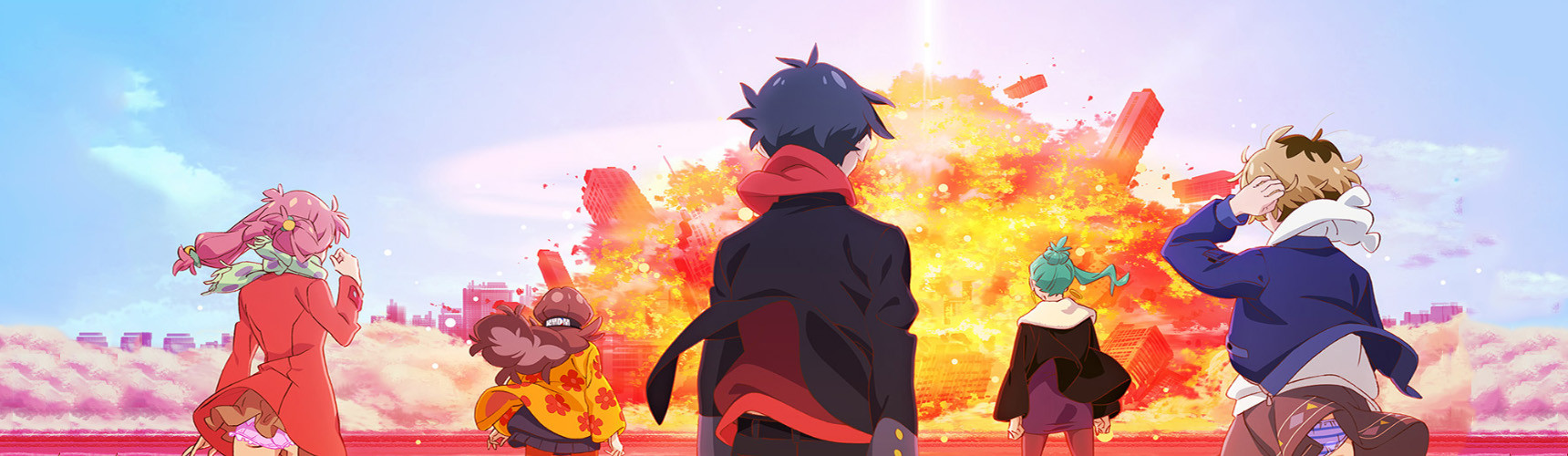
What makes PUNCH LINE’s atmosphere singular isn’t its genre salad—it’s the weightlessness laced with dread. It’s the way time doesn’t just loop; it stutters, fraying at the edges like rewound VHS tape, each reset carrying the quiet shame of failure, the exhaustion of repetition, the gnawing fear that this time, the ghost won’t slip back in before the underwear threshold triggers annihilation. It’s urban fantasy with vertigo: Tokyo’s cramped apartments, laundry lines strung like tripwires, tatami floors that smell faintly of dust and old rice—grounded, tactile, lived-in—while the rules of existence keep dissolving. You don’t laugh at the absurdity; you laugh because the absurdity is the only thing holding back the nausea of being unmoored—not just from your body, but from causality itself. It makes you feel fragile, replaceable, temporal.
That same trembling instability pulses through BioShock Infinite. Its description names Booker DeWitt as “indebted… with his life on the line,” hunted across fractured realities—not by a Dahaka, but by consequences made flesh. The player review admits bitterness about “the Bioshock Infinite we could have gotten,” echoing PUNCH LINE’s own tonal tightrope: both works flirt with tonal whiplash—absurdity brushing up against existential collapse—yet land on something raw and human. When Elizabeth tears open a tear and reality bleeds, it’s not spectacle; it’s violation—like Yuta watching his own hand reach for a doorknob while his soul hovers behind it, helpless. Both weaponize memory as unstable ground: what’s remembered, what’s erased, what’s rewritten—and who pays the cost in flesh or spirit.
Then there’s TimeShift™, where Dr. Aiden Krone’s “reckless” Time Jump births a “disturbing alternate reality.” The description doesn’t say how disturbing—just that it is. That vagueness mirrors PUNCH LINE’s refusal to explain the logic behind its apocalypse trigger: no grand prophecy, no ancient curse—just panties, physics, and panic. The player review calls it “a blast, but it takes a little work to get it into a playable state”—a perfect echo of the anime’s own friction: you must lean in, adjust expectations, accept the jank (the awkward cuts, the sudden tonal swerves) to feel the pulse beneath. Both treat time not as a river but as scrap metal: bent, welded, dangerously conductive.
And Prince of Persia: Warrior Within, where the Prince is “hunted by Dahaka, an immortal incarnation of Fate.” The review’s reverence—“Dahaka chase is still as goated as it was before”—lands because that pursuit feels bodily, relentless, inescapable. Like Yuta sprinting down those same narrow hallways, heart hammering, knowing the clock isn’t ticking—it’s twitching, skipping frames, glitching toward doom. Body horror here isn’t gore; it’s the Prince’s sand-worn skin cracking under temporal strain, Yuta’s translucent fingers passing through his own coffee cup. Both are men whose bodies are battlegrounds—not for power, but for continuity.
This pairing sings for the viewer who keeps rewatching the third episode—not for the fan service, but for the two-second shot where Yuta blinks into his body mid-fall, pupils snapping into focus just as gravity reasserts itself. For the player who replays the final Dahaka chase not for mastery, but to feel that rush of near-miss survival, that breathless, trembling return to the skin you almost lost. They’re drawn to stories where the most terrifying thing isn’t death—but the quiet, humiliating terror of not quite fitting back in. Where every jump, every loop, every possession is less about saving the world, and more about whispering, “Is this still me?”—and needing, desperately, for the answer to be yes.
🎮4 Games That Match the Vibe
Match Dimensions Explained
❓Frequently Asked Questions
Why does Prince of Persia: Warrior Within feel so much like PUNCH LINE despite being an action game?
Because both lean hard into the 'Time & Memory' and 'Body Horror & Occult' dimensions—like when the Dahaka hunts the Prince across shifting time-ruined ruins, echoing PUNCH LINE’s reality-bending climax where characters literally fracture and reassemble across timelines. The Prince’s sand-warping mechanics and grotesque transformations (e.g., the 'Sand Wraith' form) mirror the show’s visceral, physics-defying body horror—no clean cuts, just raw, squelchy consequences.
Is there a PUNCH LINE anime adaptation of BioShock Infinite?
No—but the *reverse* is what’s fascinating: BioShock Infinite’s Columbia feels like a full-blown PUNCH LINE-style anime adaptation *of itself*. Think Elizabeth’s tear-manipulation scenes—where she rips open realities to reveal alternate versions of Booker—as direct parallels to PUNCH LINE’s fourth-wall-shattering, dimension-hopping finale. Even the player review nods to that layered unreality: 'the Bioshock Infinite we could have gotten' hints at the same meta, self-aware ambiguity fans love in PUNCH LINE.
How does TimeShift™ compare to Prince of Persia: Warrior Within for time-manipulation horror?
TimeShift™ goes full clinical-body-horror: Dr. Krone’s time-jump leaves his body decaying mid-air, limbs stretching and snapping as he rewinds—like a glitchy, gory stop-motion reel. Warrior Within’s time powers are more visceral and personal: you *feel* the Dahaka’s breath on your neck during chases, and every rewind risks turning the Prince into a sand-covered corpse. Both hit 83 on the match score, but TimeShift™ leans into sterile sci-fi dread while Warrior Within leans into mythic, bloody pursuit.
What’s the best game like PUNCH LINE if I want that chaotic, darkly funny, reality-collapsing vibe?
Go straight to TimeShift™—it’s got that same whiplash energy: one minute you’re dodging bullets in slow-mo, the next you’re watching your own severed arm crawl away while the world glitches into fractal static. The community tip about needing mods to get it running smoothly? That’s part of the charm—it *feels* like wrestling with unstable reality, just like PUNCH LINE’s tonal whiplash between slapstick and existential dread. And yes, that ‘4-hour blast’ review? Pure PUNCH LINE pacing: tight, wild, and unapologetically weird.