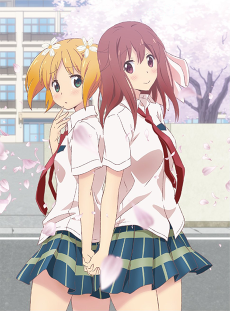
Sakura Trick
Haruka and Yuu have been best friends forever and they've always sat next to each other in class since… well, since they were just girls in junior high anyway. But on their first day of high school, they're stunned to learn that the new seating plan has them on opposite sides of the classroom! So, since everyone knows that long distance relationships won't work unless the parties involved put extra effort into it, they decide they need to do something extra special to permanently seal their friendship. However, deciding to kiss each other awakens a whole new level of feelings, and it doesn't help that some of their classmates seem to be 'involved" in similar circumstances. So what's a girl to do when her best girl friend suddenly seems more like a girlfriend? It's a life lesson that the school curriculum isn't normally prepared to teach, except maybe in French class, and our two young heroines are about to get a private education you'll never forget!
(Source: Sentai Filmworks)
📺Anime Details
📝Editorial Analysis
The chalk dust hangs in the afternoon light, catching gold as Haruka leans across her desk—not to pass a note, but to press her forehead gently against Yuu’s. Their eyes are closed. The classroom hums with distant chatter and the scratch of pens, but here, in that suspended half-second, time softens at the edges. No confession, no grand declaration—just warmth, proximity, the quiet weight of a habit suddenly made precious because it’s been threatened. That’s the heartbeat of Sakura Trick: not romance as destination, but as repetition made sacred.
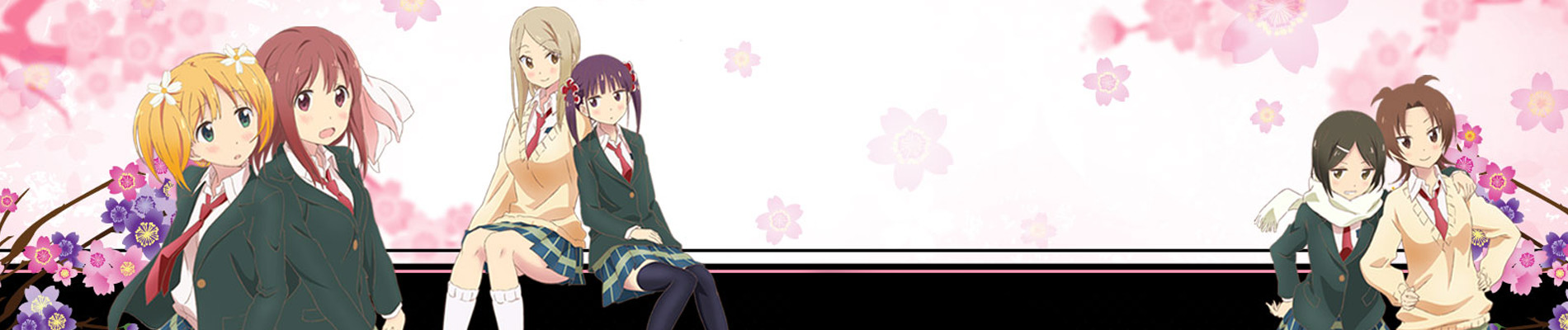
What makes Sakura Trick vibrate so distinctly isn’t its yuri label or school setting—it’s how it treats intimacy like oxygen: ordinary, necessary, and quietly urgent. It doesn’t dramatize longing; it stretches it across shared glances, stolen hand-holds under desks, the way Yuu’s kuudere stillness melts just slightly when Haruka’s fingers brush her wrist. You don’t watch it to see love happen—you watch to feel how love settles, how it nests in routine until even sitting apart feels like weathering a small storm. It’s tender, yes—but also restorative, grounded, unhurried. It asks you to notice the pulse beneath the mundane: the relief in a sigh after a successful secret touch, the quiet pride in relearning how to be close again, the way affection blooms not in fireworks, but in the steady, sunlit rhythm of two girls walking home together, shoulders almost touching.
That same emotional resonance flickers in The Sims™ 4, not despite its flaws—but through them. The player review calls it “no fun without DLC,” yet the core loop remains: building tiny, deliberate lives, tending relationships one interaction at a time, watching bonds deepen over coffee dates, shared hobbies, quiet evenings on a porch swing. Like Haruka and Yuu rearranging their world just to sit side-by-side again, Sims players choose slowness—they plant crops they won’t harvest for days, they linger in conversations instead of rushing to goals. The game’s healing power isn’t in polish, but in permission: to live small, to prioritize presence over plot. Its “Romance & Shoujo” dimension isn’t about grand gestures—it’s about the texture of closeness, the way a Sim’s mood brightens just from holding hands in the park—exactly how Haruka’s face lights up when Yuu finally lets her hold her pinky.
Then there’s Stardew Valley, where the player review confesses exhaustion—“Days upon days of constantly running around”—yet keeps playing. Why? Because beneath the frantic early-game scramble lies something deeply familiar to Sakura Trick: the slow, satisfying accrual of meaningful proximity. You don’t win by rushing to marry; you win by showing up—watering crops, giving gifts, sitting on the bus stop bench with Emily while she sketches, learning the cadence of someone else’s quiet. The “Healing & Slow Life” dimension isn’t passive—it’s active care, measured in seasons, in saved rainbows, in the way you learn exactly when Leah leaves her cottage door open just a crack. Like Yuu learning to read Haruka’s smallest shifts—the tilt of her head, the pause before a laugh—Stardew teaches you to cherish the rhythm of another person’s life, not just their presence.
Even Prince of Persia, with its “new prince, new lands, brand new story,” carries an echo—not in its acrobatics, but in its emotional pacing. The description positions it as an “epic journey,” yet the score ties it to “Romance & Shoujo” and “Healing & Slow Life.” That dissonance is telling: it suggests the game’s power lies not in scale, but in intimacy within motion. Just as Haruka and Yuu navigate hallways, stairwells, and crowded festivals—not as obstacles, but as stages for fleeting, breath-held closeness—the Prince’s journey likely unfolds through moments where speed gives way to stillness: a shared glance across a crumbling bridge, a hand offered not for combat, but for balance. The review notes it’s “completely separate” from past lore—like Sakura Trick’s high school reset, it’s about beginning again, tenderly, with someone beside you.
This pairing sings for the person who cries when their Sim finally adopts a pet cat together, who replants the same flower bed in Stardew just to watch their partner’s reaction, who rewinds a Prince of Persia cutscene to savor the exact second their character’s fingers interlace. It’s for the one who knows love isn’t always loud—it’s the warmth of a shared desk, the relief of a familiar silence, the courage in choosing slowness, again and again.
🎮5 Games That Match the Vibe



Match Dimensions Explained
❓Frequently Asked Questions
Why does Stardew Valley feel so much like Sakura Trick even though it's a farming sim?
Because both center on gentle, slice-of-life romance unfolding through quiet moments—like watching Leah blush while sharing coffee at the Stardew Valley community center, or seeing Maru quietly fix your broken sprinkler while teasing you about your 'terrible engineering skills.' The healing, slow-life pacing and shoujo-tinged romantic subtext (especially with bachelorettes like Emily or Haley) mirror Sakura Trick’s tender, low-stakes emotional intimacy.
Is there an anime or visual novel adaptation of The Sims 4 that captures Sakura Trick’s vibe?
No—TS4 has no official anime or visual novel adaptation. But fans *have* used its Create-a-Sim and Build Mode to recreate Sakura Trick’s iconic scenes: Yū and Haruka holding hands in a cherry-blossom park lot, or the girls sharing a tiny dorm room with pastel bedding and framed photos. It’s fan-made, not official, but that DIY shoujo energy is exactly why players still reach for TS4 despite the DLC fatigue.
Stardew Valley vs. Prince of Persia: which one better captures Sakura Trick’s soft romantic tension?
Stardew Valley wins hands-down—it’s built for lingering glances and meaningful small gestures, like giving Abigail moonstone jewelry and watching her fidget with it while whispering 'you remembered my favorite rock?' Prince of Persia has romance elements (e.g., the Prince and Elika’s bond in older entries), but the new reboot leans into action and mythic scale—not the quiet, blush-heavy, everyday intimacy Sakura Trick lives in.
What’s the best game like Sakura Trick if I just want to feel calm, hopeful, and gently loved?
Stardew Valley is your perfect match—its healing & slow life core means you’ll spend peaceful mornings watering crops, chatting with villagers who remember your name and favorite pie, and slowly building trust with someone like Robin as she teaches you carpentry. That warm, unhurried sense of being seen and cherished? Exactly what Sakura Trick delivers—and Stardew nails it without a single battle or timer pressure.