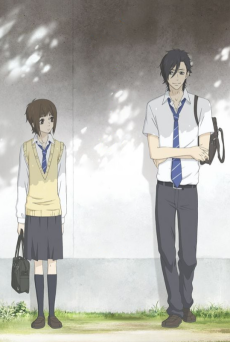
Say "I love you".
To trust is to set yourself up for failure. That’s the lesson Mei Tachibana learned when her heart was broken. She found a solution: never make any more friends. It’s not as easy as it sounds, but it works for Mei. At least it did until handsome and charming Yamato Kurosawa showed up to complicate everything. Mei’s not looking for a white knight. So why did he have to kiss her and ruin everything? Between heartbeats and behind trembling lips the specter of betrayals past, future, and present haunt them both in Say "I Love You"!
(Source: Hulu)
📺Anime Details
📝Editorial Analysis
The first time Mei Tachibana flinches—not from pain, but from anticipation—as Yamato Kurosawa leans in, her breath catching like a snagged thread in cold air. Her eyes don’t close. They lock, wide and unblinking, as if bracing for impact before the kiss even lands. That hesitation isn’t shyness. It’s muscle memory: the body remembering betrayal before the mind catches up. You feel it in your own ribs—the way trust doesn’t dissolve; it fractures, leaving jagged edges that catch on every new gesture, every soft word, every unguarded smile.

What makes Say "I love you". ache so precisely is how it treats emotion not as escalation, but as rehabilitation. Not healing as erasure—no grand catharsis, no sudden amnesia—but as daily, trembling recalibration. Mei doesn’t “get over” her past; she learns, scene by quiet scene, how to hold space for vulnerability without collapsing into it. The school hallway isn’t just setting—it’s a minefield of glances, where silence speaks louder than shouting, and kindness feels dangerous because it asks something back: attention, reciprocity, risk. This isn’t teenage romance as fantasy. It’s romance as recovery—slow, non-linear, laced with the quiet terror of believing someone might stay.
That same emotional DNA pulses through Persona 5 Royal, where building relationships—Confidants—isn’t optional flavor, but structural necessity. You don’t just “date” Ann or Makoto; you sit with them in cramped apartments, parse half-spoken regrets, watch their defenses soften over weeks of shared lunches and rainy train rides. The player review nails it: “The seamless transition between daily life…” — that’s the core. Like Mei counting heartbeats before speaking, the game forces you to inhabit time between big moments: the weight of a pause, the significance of choosing which friend to call after class, the exhaustion of showing up when you’re still raw. Romance here isn’t fireworks—it’s showing up, again and again, until the other person stops waiting for you to disappear.
Then there’s Dragon Age: Origins, where love isn’t a reward unlocked at level 20, but a fragile, often painful negotiation shaped by trauma, duty, and irreconcilable loyalties. The description asks: “What will be said about the hero who turned the tide?”—but the real question lives in the silences between dialogue options: Can you love someone while still carrying the weight of what you’ve done? Can they love you back without flinching? The player review mentions the pause attack mechanic—a literal, tactical breathing space mid-battle. That’s Mei’s entire existence: pausing before the kiss, before the confession, before saying “yes”—not out of coyness, but because consent, here, means choosing safety in real time. Both works treat intimacy as strategy: not manipulation, but survival calculus made tender.
And Disco Elysium - The Final Cut, though tonally grittier, shares that same forensic attention to emotional residue. Its description calls it “a groundbreaking role playing game” where you carve a path across a city—but the path is internal. Every skill check is a confrontation with your own ghosts. The player review quotes theory about capital subsuming critique—but what resonates with Mei is the game’s refusal to let you outrun your history. Your failures aren’t plot points; they’re physiology: shaking hands, dissociative episodes, the way your own thoughts betray you mid-sentence. Like Mei avoiding eye contact not from shyness but from recognition—that her own nervous system still reads kindness as threat—Disco Elysium makes trauma tactile, not tragic backstory.
This pairing sings for the viewer who cries not at weddings, but at grocery store parking lots—when a stranger holds the door a beat too long and your throat tightens. For the player who replays the same quiet campfire scene three times, not to optimize choices, but to sit longer in the warmth of being seen without being fixed. For anyone who knows love isn’t the absence of fear—it’s the courage to whisper “I’m still here” while your hands tremble, and trusting, just for now, that the other person hears it.
🎮11 Games That Match the Vibe






Match Dimensions Explained
❓Frequently Asked Questions
Why does Persona 5 Royal keep showing up in 'Games Like Say "I Love You"' lists?
Because its romantic Social Links—like bonding with Ann Takamaki at the batting cage or helping Futaba overcome her isolation—mirror the intimate, emotionally layered relationship-building in 'Say "I Love You"'. The game’s daily life rhythm, heartfelt confessions during rainy-day walks, and emphasis on emotional vulnerability (especially in the third term) hit the same shoujo-tinged, character-driven notes.
Is there a visual novel adaptation of Dragon Age: Origins that focuses on romance like Say "I Love You"?
No—it’s a full RPG with real-time-with-pause combat and party management, not a visual novel. But if you love the slow-burn, emotionally weighty romances in 'Say "I Love You"', you’ll feel that same resonance in Dragon Age: Origins’ companion arcs—like Leliana’s quiet devotion or Morrigan’s morally complex intimacy—especially during campfire conversations and personal quest resolutions.
How is Disco Elysium different from Mass Effect (2007) when it comes to emotional storytelling?
Mass Effect leans into heroic, galaxy-spanning romance with clear-cut affection points (think Ashley’s loyalty mission or Liara’s first kiss on the Citadel), while Disco Elysium burrows inward—your detective’s fractured psyche, failed relationships, and raw, unfiltered inner monologues (like the 'Shivers' skill checks revealing buried longing) make romance feel fragile and human, not cinematic. Both score 71 and prioritize Emotional Narrative, but one builds love through action, the other through self-reckoning.
What’s the best game like Say "I Love You" for late-night, melancholy, rain-soaked introspection?
Jade Empire™: Special Edition—especially if you choose the Open Palm path. Its poetic dialogue, quiet moments like meditating by the Whispering Jade Pond, and understated romance options (e.g., developing trust with Master Li over tea and shared silence) evoke that same tender, wistful mood. Players consistently praise its emotional pacing and atmospheric stillness—no flashy combat needed to feel deeply seen.