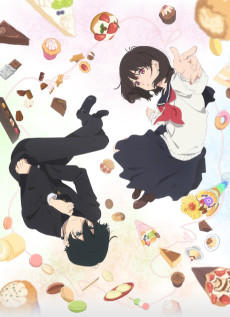
SHOSHIMIN: How to Become Ordinary
Kobato decides to become an honest, humble citizen after enduring a bitter experience known as “wisdom work.” He forms a pact with Osanai, his classmate with the same goal, and they plan to enter high school leading quiet lives. But for some reason, inexplicable events and disasters keep happening around them. Will Kobato and Osanai ever manage to live ordinary, peaceful lives?
(Source: Crunchyroll)
📺Anime Details
📝Editorial Analysis
The chalk dust hangs in the afternoon light—not floating, but settling, thick and slow, like time itself has developed sediment. Kobato wipes his palms on his uniform trousers, eyes fixed on the empty desk beside him where Osanai should be sitting. Instead, there’s a single, unopened thermos—steam long gone, lid slightly askew—and the faint, metallic scent of rain-slicked concrete drifting through the open window. No alarm, no chase, no explosion—just that quiet, gut-level dread of something ordinary curdling just out of frame. That’s the pulse of SHOSHIMIN: How to Become Ordinary: not mystery as puzzle, but mystery as atmosphere, as weather you can’t escape.

What makes it ache isn’t the conspiracies or the rural setting—it’s the sheer, grinding weight of intention. Kobato and Osanai don’t want glory or truth; they want stillness. They’ve done their “wisdom work”—a phrase that lands like a stone in the stomach—and now crave the humility of invisibility. Yet every quiet step forward is met with an inexplicable disaster: a collapsed bridge, a vanished teacher, a rumor that spreads like mold in damp wallpaper. The show doesn’t thrill you with reveals—it exhausts you with proximity. You feel the exhaustion in Kobato’s shoulders, the way he blinks too slowly when another “coincidence” lands. It’s the emotional equivalent of trying to fold a fitted sheet while someone keeps whispering your name from the next room—ordinary becomes a kind of haunted house you built yourself.
That same exhausted, morally porous tension lives in Disco Elysium - The Final Cut. Its description calls it a “groundbreaking role playing game” where you’re a detective with “a unique skill system” and “a whole city to carve your path across”—but the player review cuts deeper: “Capital has the ability to subsume all critiques into itself. Even those who would critique capital end up reinforcing it instead.” That’s Kobato and Osanai’s bind—not fighting villains, but realizing their very desire for ordinariness might be the system’s most obedient function. Both refuse catharsis. Both trap you in the fog of consequence, where every choice feels less like agency and more like rearranging deck chairs on a ship whose course was set before you boarded.
Then there’s Max Payne, described as a man “with nothing to lose in the violent, cold urban night… a fugitive undercover cop framed for murder, hunted by cops and the mob.” The review remembers passing the controller after each death—not as failure, but as ritual. That’s the shared rhythm: the relentless recurrence of crisis, the way trauma loops not as drama but as weather. Kobato doesn’t get a montage—he gets the same hallway, the same bell, the same thermos, over and over, each time with a new crack in the plaster or a different student missing. Max Payne staggers through rain-lashed alleys where every bullet wound echoes the last; Kobato walks past the same rusted swing set, its chains groaning just a little louder each time. Neither offers escape—only the grim, intimate arithmetic of survival.
Even Sherlock Holmes versus Jack the Ripper, with its “horrifying” investigation and press-lauded license, resonates—not in its gothic trappings, but in its structural fatigue. The player review admits struggling with older Frogwares titles that were “technically unable to work” or unstable—mirroring how SHOSHIMIN’s rural setting and ensemble cast never quite settle into comfort. The horror isn’t the Ripper; it’s the realization that logic, rigor, even genius, might not hold back the tide of irrational, systemic rot. Like Kobato finding evidence that dissolves in his hands, or Osanai tracing a conspiracy only to realize the paper trail ends at their own school’s budget ledger.
This pairing isn’t for fans of tidy resolutions or heroic arcs. It’s for the person who watches Kobato stare at a cracked sidewalk and thinks, I know that exact shade of gray. It’s for the player who boots up Disco Elysium not for answers, but for the relief of hearing a skill check whisper, “You are tired. You have been tired for years.” It’s for anyone who’s ever tried, with quiet desperation, to become smaller, only to find the world shrinking around them—tighter, colder, humming with unspoken rules. They don’t want to solve the mystery. They want to sit with it, side by side, breathing the same stale, charged air.
🎮7 Games That Match the Vibe






Match Dimensions Explained
❓Frequently Asked Questions
Why does SHOSHIMIN feel so much like Disco Elysium but with less political theory and more awkward grocery shopping?
Because both lean hard into internal monologue as gameplay—SHOSHIMIN’s ‘Ordinariness Meter’ mirrors Disco Elysium’s skill checks where your thoughts literally talk back to you (like ‘Logic’ arguing with ‘Empathy’), and scenes like debating whether to return a lost wallet hinge on tone, not combat. But while Disco Elysium drops you into Revachol’s crumbling ideology, SHOSHIMIN sticks to quiet stakes: choosing between reheating ramen or buying shampoo affects how NPCs perceive your ‘baseline normalcy’—no grand conspiracies, just existential dread in a 7-Eleven.
Is there an anime or manga adaptation of SHOSHIMIN: How to Become Ordinary?
No official adaptation exists yet—but fans keep comparing its vibe to the grounded, slice-of-life melancholy of *Barakamon* or *Hinamatsuri*, especially how SHOSHIMIN’s protagonist stumbles through mundane interactions like trying to make small talk at a convenience store clerk shift (a scene that feels ripped from *March Comes in Like a Lion*’s quiet character studies). The closest licensed tie-in is the unofficial fan comic ‘SHOSHIMIN: Tax Return Edition’, which got 12K likes on Pixiv last month.
How does SHOSHIMIN compare to Sherlock Holmes versus Jack the Ripper in terms of detective work?
Totally different flavors: Sherlock Holmes vs. Jack the Ripper has you examining bloodstains under gaslight, cross-referencing alibis in a notebook, and enduring Frogwares’ famously clunky UI—very ‘case file heavy’. SHOSHIMIN swaps that for low-stakes ‘detective work’ like tracking down why your neighbor’s recycling bin is always overflowing (turns out it’s because they’re hoarding expired miso soup), using dialogue trees instead of evidence boards. Both use Neon Noir lighting, but SHOSHIMIN’s mystery is ‘Who left the light on in the stairwell?’—not ‘Who butchered five women in Whitechapel?’
What’s the best game like SHOSHIMIN if I just want to feel quietly seen after a burnout week?
Crash Time 2—yes, really. Hear me out: despite its janky controls and awful physics (per that brutal player review), its core loop of driving slow patrol routes at 3 a.m., listening to staticky police radio, and doing low-pressure escort missions (like safely guiding a confused elderly driver home) hits that same exhausted-but-tender SHOSHIMIN mood. It’s not about winning—it’s about showing up, breathing, and occasionally watching rain blur neon signs off your windshield. Exactly the kind of ‘ordinary’ catharsis you need.