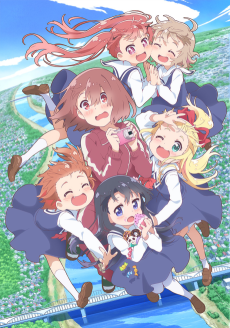
WATATEN!: an Angel Flew Down to Me
Miyako is a shy college student who is also an otaku. One day she happens to meet some angelic grade school kids! When Miyako sees her little sister's new friend Hana-chan, Miyako's heart won't stop racing! Miyako tries to get along with them but struggles... A sketch comedy all about trying to get along with the super cute girl is about to begin!
(Source: Crunchyroll)
📺Anime Details
📝Editorial Analysis
The first time Miyako’s hand trembles while adjusting Hana-chan’s tiny angel wings—fabric soft, slightly crooked, held together with safety pins and quiet hope—you feel it in your collarbone. Not laughter, not embarrassment, but that warm, suspended breath right before a confession you’re too shy to name: the sheer, fragile weight of wanting to be enough for someone who sees you not as a hikikomori college student, but as a guardian angel in sweatpants.

That’s the atmosphere: tender, not saccharine; intimate, not intrusive; slow, not stagnant. WATATEN! doesn’t chase plot—it leans into pauses: the rustle of a grade-schooler’s cosplay skirt as she tiptoes into Miyako’s dim apartment; the way silence settles not as emptiness, but as shared oxygen between two people learning how close is safe, how much care is allowed. It’s slice-of-life not as backdrop, but as breathing rhythm: the emotional arithmetic of small gestures—making onigiri just right, retying a shoelace without being asked, letting a child nap against your shoulder while you scroll through doujin sites with one hand. There’s no grand catharsis, only the quiet accumulation of being seen, and seeing back, across an age gap that feels less like distance and more like a bridge built plank by plank from glitter glue and nervous smiles.
Which is why The Sims™ 4 resonates—not as a simulation of realism, but as a sandbox for healing intention. Its description promises “Play with life and discover the possibilities”—and in WATATEN!, Miyako plays at adulthood, at caregiving, at romance she barely understands, precisely because the game-like structure of daily routines (make breakfast → go to class → return to find Hana waiting with crayon-drawn angels) gives her agency without demand. The player review complains about DLC bloat and broken systems—but that friction mirrors Miyako’s own struggles: the game works when stripped down, when you focus on one Sim’s morning tea ritual, their slow friendship with a neighbor-child, the way they redecorate a room just to make someone feel welcome. It’s healing because it’s modifiable, forgiving, and centered on micro-acts of tenderness—exactly how Miyako learns love isn’t declared, but lived, one awkward, wing-adjusting moment at a time.
Then there’s Stardew Valley, where inherited land becomes inherited softness. Its description begins: “You’ve inherited your grandfather’s old farm plot… set out to begin your new life.” That inheritance echoes Miyako inheriting responsibility—not through obligation, but through proximity: Hana appears, then Miu, then Aya, and suddenly Miyako’s apartment isn’t just hers—it’s a shared ecosystem. The player review confesses exhaustion—“Spent the first 2 years trying to do everything and never having enough time”—but that frantic energy transforms in WATATEN!: Miyako’s early panic (“I can’t cook! I don’t know kids! What if I say the wrong thing?!”) isn’t mocked—it’s honored. The anime treats her overwhelm as sacred ground. Like Stardew’s seasonal cycles, WATATEN! measures time in school festivals, summer vacations, costume fittings—rituals that don’t fix anything, but hold space for growth to happen off-screen, in the margins of frames.
Even Prince of Persia, despite its desert vistas and acrobatic spectacle, shares this DNA—not in action, but in return. Its description calls it “an all-new epic journey” built by the same studio, yet the player review notes it’s “the 3rd reboot… completely separate from the sands…” That deliberate restarting, that insistence on beginning again with fresh eyes and unburdened mythos—that’s Miyako, too. She doesn’t “get over” her hikikomori habits; she re-enters the world sideways, through a child’s gaze, rewriting her own story not as recovery, but as reorientation. The prince doesn’t reclaim a throne—he rediscovers what “home” means when memory is fractured. So does Miyako, every time she opens her door to a girl holding a handmade halo.
This pairing is for the person who cries when someone refills their teacup without asking. For the player who names their first Sim “Miyako” and spends three in-game days just walking them to the bus stop, watching the light change. For the viewer who rewinds the scene where Hana tucks a stray hair behind Miyako’s ear—not for fanservice, but for the weight of that touch: small, certain, and utterly unhurried. They don’t want escape. They want permission—to be tender, to be clumsy, to build worlds where love isn’t earned in grand gestures, but stitched, patiently, into the seams of everyday life.
🎮5 Games That Match the Vibe



Match Dimensions Explained
❓Frequently Asked Questions
Why does Stardew Valley feel so much like WATATEN! even though it's a farming sim?
It’s all about the gentle pacing and heartfelt character moments—like bonding with Marnie at the animal shop or sharing quiet rainy-day tea with Leah in her cozy cottage, which mirrors how WATATEN! builds warmth through small, sincere interactions. The Romance & Shoujo dimension (83 score) and Healing & Slow Life focus make it click: you’re not rushing to win, but slowly deepening relationships—just like Hikari learning to open up to Miu and the others.
Is there an anime adaptation of The Sims 4 like there is for WATATEN!?
Nope—The Sims 4 has zero official anime adaptation (and honestly, it wouldn’t quite fit: imagine Simlish voice acting over dramatic confession scenes!). Unlike WATATEN!, which got a full TV anime with expressive character arcs and romantic tension, TS4 stays firmly in sandbox territory—even its highest-rated packs (like 'City Living') only add apartments and festivals, not story-driven arcs.
Stardew Valley vs. Prince of Persia: which one captures WATATEN!’s vibe better?
Stardew Valley wins hands-down for WATATEN!’s cozy, slice-of-life heart—it’s got that same slow-burn emotional intimacy, like gifting Emily handmade jewelry and watching her blush while reading your letter. Prince of Persia (85 score in Healing & Slow Life *and* Romance & Shoujo) leans more into stylized, almost fairy-tale romance—think the Prince and Elika’s charged, gravity-defying duets—but lacks the grounded, everyday tenderness of WATATEN!’s classroom glances and shared bento boxes.
What’s the best game like WATATEN! if I just want to relax and feel emotionally safe?
Stardew Valley is your go-to—it’s literally built for healing: tending crops at dawn, chatting with villagers under cherry blossoms, or napping in the mine elevator after a long day. Its 83-score Healing & Slow Life dimension isn’t just marketing fluff; players describe ‘days upon days of constantly running around’ turning into peaceful routines, exactly like how WATATEN! wraps you in softness during scenes like Hikari and Miu stargazing on the school roof.