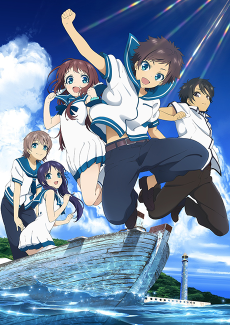
A Lull in the Sea
Since long ago, human civilization had lived on the ocean floor. However, there were many humans who wanted to live above the surface and they moved to land creating a fundamental separation between the two. After their school closes down, four 14-year-old middle school students from the sea village, Shioshishio, have to attend Mihama Middle School on the surface. What follows is their struggles to adjust to a new environment and the relationships between the sea and land people, while dealing with their own newfound feelings that have just started appearing with the end of their childhood.
(Source: Wikipedia)
📺Anime Details
📝Editorial Analysis
The salt hangs thick in the air—not just on the skin, but in the throat. You feel it when Hikari stands barefoot on the sun-bleached dock at dawn, staring up at the surface world he’s just breached, his breath shallow, his gills fluttering faintly beneath his collar. The water behind him is alive—shimmering, breathing, humming with memory—while the land ahead feels brittle, silent, almost unforgiving in its dryness. That moment isn’t about arrival. It’s about displacement so deep it lives in the body before the mind catches up.

What makes A Lull in the Sea ache like no other is how it treats longing as atmosphere—not plot device, not metaphor, but ambient pressure. It’s the weight of a time skip that doesn’t heal, only deepens; the quiet tragedy of unrequited love that never shouts, only settles like silt; the way the coastal setting isn’t backdrop but character, breathing in tidal rhythms that human hearts can’t quite sync to. You don’t watch it to escape. You watch it to remember how it feels to stand between two worlds and realize neither will ever fully hold you—melancholic, yes, but also tender, patient, resonant in its restraint.
That emotional DNA pulses strongest in Prince of Persia, where the melancholic exploration isn’t just aesthetic—it’s structural. Like Hikari navigating Mihama’s sterile hallways or Manaka floating listlessly above Shioshishio’s ruins, the Prince moves through spaces heavy with lost time and fractured identity. The player review notes it’s “a new prince, new lands and a brand new story completely separate”—mirroring how the sea kids’ migration fractures lineage, severing them from inherited meaning without erasing its pull. Both ask: what do you carry when your home becomes myth?
Then there’s Jade Empire™: Special Edition, whose mythology & folklore dimension echoes the anime’s submerged cosmology—not as spectacle, but as lived tension. The sea people’s biology, their rituals around tides and silence, their taboo against surface names—all function like Jade Empire’s open palm/closed fist duality: systems of meaning that govern intimacy, duty, and grief. The player review mentions needing Reddit instructions to launch—a telling echo of how both works demand embodied engagement: you don’t just learn the rules; you fumble, adapt, and internalize them through failure. Neither offers lore dumps. They let belief settle in the bones.
And Persona 5 Royal, with its emotional narrative woven into daily rhythm, shares A Lull in the Sea’s genius for making time feel—not count. The anime’s time skip isn’t montage; it’s hollow space between heartbeats, where relationships calcify or crumble unseen. So does P5R’s calendar: every rainy Tuesday, every missed confessional, every unspoken glance in Shibuya Station carries the same quiet gravity as Chisaki turning away from Hikari on the beach. The player review praises the “seamless transition between daily life and extraordinary stakes”—exactly how A Lull in the Sea frames a first kiss beside a crumbling lighthouse, or a funeral under bioluminescent plankton. Nothing is heightened. Everything matters.
This isn’t for the viewer who wants catharsis in explosions or confessionals. It’s for the one who keeps a half-finished letter in their coat pocket, who replays a three-second glance years later, who feels the ocean’s pull even in a landlocked city. It’s for the player who pauses mid-combat in Disco Elysium not to strategize—but because a line about capital subsuming critique hits too close to how love, in both the anime and the game, gets metabolized by systems larger than the self. Who would love these pairings? Someone who cries at tide charts. Someone who saves games not to win, but to linger. Someone who knows the most devastating romance isn’t the one that ends—it’s the one that keeps breathing, quietly, beneath the surface.
🎮15 Games That Match the Vibe



Match Dimensions Explained
❓Frequently Asked Questions
Why does Prince of Persia keep showing up in 'Games Like A Lull in the Sea' lists?
Because its 'Melancholic Exploration' dimension hits the same quiet, wave-lapped longing as *A Lull in the Sea*—think wandering sun-drenched ruins alone, like when the Prince pauses on a cliff overlooking the sea, just breathing. The romance isn’t loud or comedic; it’s tender and restrained, mirroring Manaka and Hikari’s unspoken tension, and that 83 score reflects how deeply players feel that atmospheric intimacy.
Is there an anime adaptation of Jade Empire?
Nope—Jade Empire is purely a game (the 2005 BioWare classic, now Special Edition), though its DNA *feels* like a shoujo-tinged anime: you play as a martial arts student torn between the Open Palm and Closed Fist paths, with romance options like Dawn Star that unfold with the emotional weight and mythic texture of *Lull*’s oceanic folklore. Fans often wish it *had* an anime—its ‘Mythology & Folklore’ + ‘Romance & Shoujo’ dimensions are *that* evocative.
How is Persona 5 Royal different from Dragon Age: Origins for someone who loved *A Lull in the Sea*’s mood?
Both nail ‘Emotional Narrative’, but *Persona 5 Royal* leans into stylized, rhythmic daily life—like building bonds with Ann or Ryuji over late-night ramen, echoing *Lull*’s school-and-seaside rhythm—while *Dragon Age: Origins* goes darker and more grounded, with romance unfolding amid war-torn Thedas (think Alistair’s gentle humor softening heavy choices). If you want *Lull*’s warmth and structure, go P5R; if you crave its melancholy depth with grittier stakes, DAO’s your match.
What’s the best game like *A Lull in the Sea* for feeling quietly heartbroken but hopeful?
Disco Elysium — seriously. Its ‘Melancholic Exploration’ dimension mirrors *Lull*’s hushed emotional tides: you wander rain-slicked Revachol alone, piecing together identity like Manaka pieces together memory, and even small interactions—like talking to the grieving fisherman by the docks—carry that same fragile, poetic ache. With a 73 score and reviews calling it ‘a cruel irony’ wrapped in empathy, it’s the most emotionally resonant match when you need beauty in the sorrow.