Akiba's Trip the Animation
📺Anime Details
📝Editorial Analysis
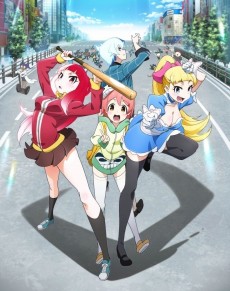
The neon bleed of Akihabara at midnight—cheap plastic signage flickering over damp pavement, the bass thump of a maid café’s J-pop loop bleeding into alleyway steam, and suddenly: a shirtless guy mid-air, twisting sideways as he rips a rival’s jacket clean off with one hand while shouting something about “fashion-based combat ethics.” That’s not a punchline. That’s the opening beat of Akiba's Trip the Animation, where every fight is a chaotic, sweat-slicked, ridiculously earnest tug-of-war over fabric—and dignity.
This isn’t urban fantasy as mythic allegory or brooding metaphor. It’s urban fantasy as shared delusion, thick with the humidity of crowded arcades and the static buzz of bargain-bin electronics. You don’t feel awe here—you feel recognition. The anime pulses with the low-grade euphoria of being deeply, unapologetically in on the joke—not because it’s mocking otaku culture, but because it’s built from its scraps: idol posters taped crookedly to apartment walls, wrestling moves named after limited-edition ramen flavors, supernatural threats that manifest as overheated cosplay wigs. It makes you nostalgic for a place you’ve never been—but somehow remember. Not wistful. Not cynical. Just alive in the absurd.
That feeling—the giddy, communal, slightly sweaty joy of parody that loves its subject too much to let it be serious—is exactly why Hextech Mayhem: A League of Legends Story™ hits like a confetti cannon full of synthwave. Its Music & Idol and Comedy & Parody dimensions aren’t just tags—they’re the engine. Like Akiba's Trip the Animation, it treats spectacle as sacred ritual: a rock concert isn’t background; it’s the battlefield, the plot, the emotional climax. You don’t watch Zeri shred guitar strings—you feel the feedback vibrating in your molars, same way you feel the rip of polyester when a character yanks off a villain’s vest mid-argument about proper USB-C cable etiquette. Both run on the same voltage: joyful commitment to nonsense that somehow matters.
Then there’s Hi-Fi RUSH, another 85-score match anchored in Music & Idol and Comedy & Parody—but layered with Mecha & Military Sci-Fi. That last tag sounds jarring until you see Chai dodging laser fire while moonwalking up a collapsing skyscraper, his entire body synced to a drum solo. Just like Akiba's Trip the Animation, it weaponizes rhythm, timing, and sheer audacity as narrative logic. No exposition needed—just a beat drop, a spin kick, and suddenly you understand the stakes better than any monologue could. And both treat their worlds as tactile, sticky: grease on arcade cabinets, scuffed vinyl floors, the faint smell of burnt sugar from a nearby crepe stand. This isn’t satire—it’s embodied affection, rendered in syncopated motion.
Even Team Fortress 2, with its 83 score and Mecha & Military Sci-Fi/Comedy & Parody overlap, shares that same DNA—not in setting, but in spirit. Its nine classes don’t just have roles; they have personalities so loud they override physics. A Heavy’s minigun spins up with the same joyful, borderline-unhinged energy as a Akiba's Trip the Animation character executing a “Cosplay Crusher” suplex onto a pachinko parlor roof. And that player review—“The community is gay, racist, sexist, gay, artistic, gay, furries, and love men”—isn’t noise. It’s proof of the same ecosystem: messy, contradictory, wildly creative, and held together by inside jokes so dense they become theology. Like Akiba’s streets, TF2’s maps are playgrounds built on shared, evolving folklore—not rules.
Who lives for this? Not just fans of ecchi or idols or wrestling. It’s the person who rewatches the exact same 12-second clip of a character tripping over a kotatsu table because the timing of the background music hit just right. It’s the player who spends 40 minutes customizing a hat in Team Fortress 2, not for stats, but because the sheen on the felt matches their memory of a real-life Don Quijote store sign at 2 a.m. It’s the kind of viewer who doesn’t want escapism—they want recognition, rhythm, and the electric thrill of seeing their own ridiculous, loving, obsessive world reflected back—not polished, but pulsing, glitching, and utterly, uniquely alive.
🎮9 Games That Match the Vibe

Match Dimensions Explained
❓Frequently Asked Questions
Why does Hi-Fi RUSH feel so similar to Akiba's Trip the Animation?
Because both lean hard into rhythmic, music-driven combat with over-the-top anime flair—Hi-Fi RUSH’s Chai literally syncs her attacks to the beat like Akiba’s Trip’s ‘Strip Battle’ system, and both revel in absurd parody (think Chai’s robot dance-offs vs. Akiba’s neon-lit Akihabara chaos). Plus, Hi-Fi RUSH nails that same blend of idol energy and mecha-tinged action you get from Akiba’s Trip’s electric city vibe.
Is there an anime adaptation of Team Fortress 2 like Akiba's Trip the Animation?
No—Team Fortress 2 has never gotten an official anime adaptation, unlike Akiba’s Trip (which got *The Animation* series). But TF2’s chaotic, class-based comedy and ever-evolving lore (like the iconic Scout vs. Spy slapstick or Heavy’s ‘LOVE!’ moments) absolutely share that same irreverent, character-driven parody DNA—and its constant hat updates and community memes feel just as cultishly beloved.
How does Hextech Mayhem compare to Akiba's Trip the Animation?
Hextech Mayhem is more rhythm-platformer than strip-fighting RPG—it swaps Akiba’s urban satire and costume mechanics for a high-speed, guitar-slinging League of Legends origin story starring Vi and Jinx. But both deliver explosive idol-energy, sharp parody (Jinx’s manic charm mirrors Akiba’s Otaku-kun), and a killer soundtrack that drives every action—just swap neon Akihabara for Zaun’s grimy bass drops.
What’s the best game like Akiba's Trip the Animation if I want something chaotic, funny, and full of personality?
Strong Bad’s Cool Game for Attractive People is your jam—it’s pure, unhinged comedic chaos with five self-aware episodes where Strong Bad breaks the fourth wall while juggling wrestling, dating sims, and cereal-based heists. Like Akiba’s Trip, it’s packed with niche fandom humor, rapid-fire parody, and characters who know exactly how ridiculous they are—and that player review begging for its return? Yeah, it’s *that* kind of cult favorite.