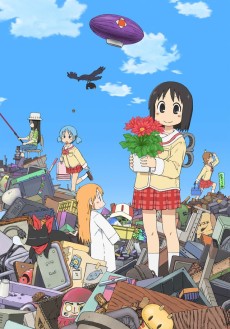
Nichijou - My Ordinary Life: Episode 0
While the title suggests a story of simple, everyday school life, the contents are more the opposite. The setting is a strange school where you may see the principal wrestle a deer or a robot's arm hide a rollcake. However there are still normal stories, like making a card castle or taking a test you didn't study for.
📺Anime Details
📝Editorial Analysis
The principal’s fist connects with the deer’s antlers—thwump—and the creature staggers backward across the sun-dappled asphalt, hooves skittering, tail flicking in pure, unironic indignation. No music swells. No cutaway to a reaction shot. Just silence, then the distant, ordinary clack-clack-clack of a passing train. That’s the heartbeat of Nichijou - My Ordinary Life: Episode 0: not chaos as spectacle, but absurdity as atmosphere—so baked into the air it feels less like a joke and more like weather.

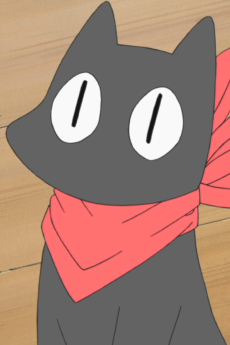



What makes this episode’s feeling so singular isn’t its surrealism—it’s how utterly unfussed it is by its own impossibility. A robot’s arm vanishes inside a rollcake like it’s just another lunchbox quirk; a girl builds a card castle with the same quiet focus she’d use to solve a quadratic equation; someone fails a test, and the despair is real, tender, and completely undimmed by the fact that her classmate just levitated three centimeters off her chair. There’s no winking at the audience, no narrative scaffolding to explain why physics frays at the edges. It’s not satire, not parody—it’s recognition. A deep, warm, slightly dazed acknowledgment that life, even (especially) in its most banal stretches—trains, tests, fishing poles, classroom chalk dust—is already laced with gentle, illogical magic. You don’t laugh at the world here. You laugh with it, breath catching on the sheer, soft strangeness of being alive.
That emotional DNA—the quiet reverence for small things, the refusal to separate the mundane from the miraculous—pulses through Prince of Persia’s return. Its description promises “an all-new epic journey” built by Ubisoft Montreal, but what resonates isn’t the scale—it’s the healing & slow life dimension tagged alongside comedy & parody. Like Nichijou, this Prince doesn’t rage against time’s absurdity; he dances with it, flips over collapsing architecture, and treats gravity like a suggestion you can politely decline. A player review notes it’s “the 3rd reboot… completely separate from the sands”—echoing Nichijou’s own quiet rebellion against expectation: no legacy, no lore-heavy preamble, just presence, motion, and the lightness of movement as its own kind of logic.
Then there’s The Sims™ 4, whose description invites you to “Play with life and discover the possibilities”—a phrase that lands with uncanny precision beside Nichijou’s ethos. The game’s core loop—making coffee, arranging furniture, watching a Sim stare blankly out a window while rain streaks the glass—isn’t simulation as control, but as witnessing. Even the player review’s frustration (“TS4 has become awful… packs are insanely expensive”) accidentally underscores the point: the soul of the thing lives in the unscripted, unmonetized moments—the Sim who insists on gardening barefoot, or the one who cries softly after a promotion. That’s the same sacred, unremarkable space where Nichijou places its characters: not as avatars of plot, but as beings whose joy in a perfectly balanced card tower matters as much as any deer-wrestling climax.
And though tonally wilder, Precipice of Darkness, Episode One shares that same comedy & parody nerve—rooted not in mockery, but in affectionate exaggeration. Its description positions it as an RPG-adventure “based on the web comic Penny Arcade,” yet the player review clarifies: “Fun as hell… though you don’t need to know much about the comics since this is an AU.” That “AU”—an alternate universe built not to erase canon but to play freely within its spirit—mirrors Nichijou’s entire posture. It takes familiar archetypes (schoolgirl, robot, principal) and lets them breathe, stumble, hide pastries, and exist without justification. The review’s mention of “Penny Arcade style of humor” is key: that humor thrives on the collision of the hyper-literal and the deeply human—exactly like watching a sentient robot fret over whether her hand belongs in a cake or on her hip.
This pairing sings for the person who saves screenshots of pigeons mid-takeoff, who replays the same five minutes of a game just to watch light shift across a floorboard, who finds profound comfort in the clack-clack-clack of trains—not as background noise, but as proof the world keeps turning, beautifully, nonsensically, together.
🎮17 Games That Match the Vibe









Match Dimensions Explained
❓Frequently Asked Questions
Why does Prince of Persia keep showing up in 'Games Like Nichijou' lists when it’s an action-adventure game?
Great question—it’s all about the *tone*, not the genre. Nichijou’s absurd, deadpan comedy and surreal 'ordinary life' moments (like Yuko’s gravity-defying tantrums or the cat’s silent, judgmental stares) line up perfectly with Prince of Persia’s self-aware parody of heroic tropes—especially how the Prince constantly groans at his own melodrama or gets hilariously scolded by Elika. The Healing & Slow Life + Comedy & Parody dimension match (both scored 84/83 there) is what makes it resonate, not swordplay.
Is there a Nichijou anime-to-game adaptation like My Ordinary Life: Episode 0?
Nope—'My Ordinary Life: Episode 0' isn’t an official Nichijou adaptation; it’s a fan-made title referencing the anime’s iconic cold open (the cat walking upright, then freezing mid-step). There’s no licensed Nichijou game, which is why lists lean into *vibe matches* instead—like The Sims™ 4, where you can recreate Yuko’s chaotic morning routines, Mio’s exaggerated stress animations, or even build the school rooftop set and stage your own 'gravity fails' using custom content and mods.
How does Precipice of Darkness compare to The Sims 4 for Nichijou-style humor?
Precipice of Darkness leans hard into rapid-fire, fourth-wall-breaking satire (think Gantz’s snarky narrator or Tycho’s sarcastic inner monologue), while The Sims 4 delivers Nichijou’s brand of physical, situational absurdity—like watching a Sim trip over their own feet for 90 seconds straight, or trying (and failing) to make coffee while sleepwalking. Both nail Comedy & Parody, but only TS4 shares Nichijou’s Healing & Slow Life dimension—making it better for low-stakes, slice-of-life silliness over RPG combat gags.
What’s the best game like Nichijou if I just want that warm, unhurried, slightly ridiculous everyday feeling?
The Sims™ 4 is your top pick—especially with base-game features like 'Slow Life' mode (via mods) and vanilla interactions that mirror Nichijou’s charm: Sims getting stuck in chairs, misreading social cues, or attempting yoga and collapsing in slow motion—just like Mai’s clumsy yet earnest attempts to be 'normal'. Its 83 score in both Healing & Slow Life *and* Comedy & Parody (same as Prince of Persia’s dual-dimension strength) proves it nails that cozy, gently absurd rhythm better than the more plot-driven Precipice games.