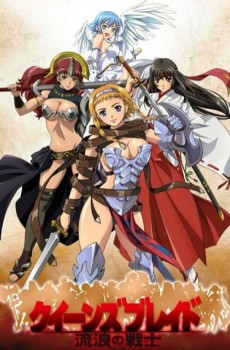
Queen's Blade: The Exiled Virgin
📺Anime Details
📝Editorial Analysis
The scent of rain on sun-baked stone. A lone figure—barefoot, breath ragged—kneels at the edge of a cliff overlooking a valley choked with mist and thorned vines, her shrine maiden robes torn at the shoulder, hair clinging to sweat-slicked skin. She doesn’t draw her sword. Not yet. She watches the horizon where the last light bleeds into violet, fingers brushing the chipped amulet at her throat—not as prayer, but as recognition: this exile isn’t punishment. It’s the first real breath she’s taken in years.
That stillness before violence—that suspended, almost sacred tension—is Queen's Blade: The Exiled Virgin’s true heartbeat. It’s not about the number of battles or how many times a strap snaps—it’s about the weight of solitude carried across unfamiliar roads, the quiet dread of being seen too clearly, the ache of dignity preserved even when stripped bare—not just physically, but emotionally, socially, spiritually. You don’t feel adrenaline here so much as resonance: the way shame and strength coil together like braided rope, how vulnerability becomes armor when no one’s watching, how every step forward is both defiance and mourning. It’s melancholic exploration, yes—but not passive. It’s active remembering, walking through landscapes that mirror internal fractures.
Which makes Prince of Persia an uncanny twin—not because of sand or acrobatics, but because of that same melancholic exploration dimension scoring 83. The description calls it “an all-new epic journey” built by Ubisoft Montreal, and the player review confirms it’s “completely separate” from past iterations—like Queen's Blade: The Exiled Virgin, it’s a reboot rooted in erasure and rediscovery. Both protagonists move through worlds that feel ancient and indifferent, their bodies constantly negotiating space—leaping, falling, recovering—with a physicality that reads as ritual. The prince’s rewind mechanic mirrors the shrine maiden’s repeated, near-silent recalibrations after each humiliation or loss: not erasing the moment, but reclaiming its meaning. That shared emotional DNA isn’t spectacle—it’s the tremor in the hand before the leap, the pause before the blade leaves the scabbard.
Then there’s The Sims™ 4, scoring 79 on Romance & Shoujo and Survival & Crafting. Its description invites you to “Play with life and discover the possibilities”—and while the player review bitterly notes how “you can barely do a…” without DLC, that very limitation echoes the anime’s core tension: survival isn’t heroic. It’s mundane, iterative, deeply personal. The shrine maiden doesn’t win tournaments; she mends her sandals, re-strings her bow, chooses who to trust with her name—tiny acts of self-crafting in a world that insists on defining her. Like Sims players arranging furniture or adjusting relationships in quiet, unscripted moments, her power lives in micro-decisions: where to sleep, what to eat, whether to speak—or stay silent. Both are about building identity from fragments, one pixel at a time.
And FINAL FANTASY XIV Online, scoring 58 on Survival & Crafting and Melancholic Exploration, lands with quiet precision. Its vast world isn’t just backdrop—it’s memory made geography. Player reviews don’t mention raids or gear; they talk about “aging well,” about returning to places that hold emotional residue. So does Queen's Blade: The Exiled Virgin: every village she passes feels haunted—not by ghosts, but by versions of herself she’s had to abandon. The shrine, the battlefield, the roadside inn—they’re waypoints in an internal cartography. Like logging into FFXIV and walking familiar streets in Limsa Lominsa, knowing exactly which bench holds which conversation, the anime’s travel isn’t linear progress. It’s circling back to old wounds with new eyes.
This pairing sings for the viewer who watches fight scenes not for choreography, but for the flicker of exhaustion in the eyes afterward—who replays a Sim’s failed romance not to fix it, but to understand why it mattered—and who logs into FFXIV not for loot, but to stand, quietly, where grief and grace once collided. They don’t crave victory. They crave witnessing. The kind of person who saves a screenshot of rain on stone—and knows exactly why.
🎮12 Games That Match the Vibe






Match Dimensions Explained
❓Frequently Asked Questions
Why does Prince of Persia keep coming up in Queen's Blade: The Exiled Virgin comparisons?
Because both lean hard into Romance & Shoujo *and* Action Spectacle—think Leina’s emotional exile arc mirrored by the Prince’s melancholic journey through ruined palaces and shifting sands. The combat has that same fluid, acrobatic flair (dodge-roll-parry combos), and scenes like the Prince’s rooftop chases echo Queen’s Blade’s arena entrances and slow-motion victory poses.
Is there a Queen's Blade anime or game adaptation I should play instead?
No official Queen’s Blade game adaptation exists—but fans often pivot to *Prince of Persia* (83 score) for its lush shoujo-tinged storytelling and swordplay, or *The Sims 4* (79 score) if they want to craft their own warrior-heroine narratives with romance sims and custom outfits. Neither is a direct port, but both hit those core vibes better than anything officially branded.
How does The Sims 4 compare to Queen's Blade: The Exiled Virgin for building romantic storylines?
Great for slow-burn, player-driven romance—like crafting a shy, exiled noblewoman who rebuilds her reputation through relationships and skill-building—but lacks Queen’s Blade’s structured rivalries and tournament stakes. You’ll get deeper relationship mechanics (friendship/mood/ambition systems) than *Thrillville®: Off the Rails™*, which focuses on coaster-building over character arcs.
What’s the best game like Queen’s Blade if I just want melancholic exploration and strong female leads?
Go straight to *Prince of Persia* (83 score)—its dim 'Melancholic Exploration' matches Queen’s Blade’s tone of lost kingdoms and personal redemption, especially in sequences where the Prince walks alone through crumbling ziggurats, echoing Leina’s solitary forest wanderings. *FINAL FANTASY XIV Online* (58 score) also fits, but its open-world grind dilutes that intimate, story-first sorrow.