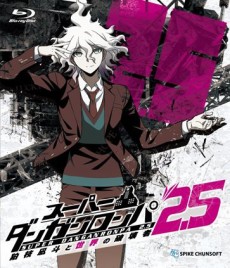
Super Danganronpa 2.5 Komaeda Nagito to Sekai no Hakaimono
Nagito Komaeda wakes up after experiencing death in the Neo World Program. What kind of world is he seeing and why did he wake up?
Nagito appears to be in a strange world, including students who have been seen before as well as people who never existed. He is an ordinary boy with no Ultimate Luck, attending an ordinary school. Constrained by being the protagonist, he thinks that having a big talent would interrupt his happiness. He believes that living an ordinary life, being moderately happy, while watching his classmates have a normal youth is what's wonderful.
However, one day, a boy calling himself "The Destroyer of the World" appears, having the form of red-eyed Hajime Hinata. He begins the destruction of Nagito's world...
(Source: Danganronpa Wikia)
📺Anime Details
📝Editorial Analysis
The fluorescent hum of a classroom ceiling—too bright, too steady—wakes Nagito before the bell rings. He blinks at his own hands: unmarked, unscarred, ordinary. No blood on his sleeves. No echo of Monokuma’s laugh in the hallway. Just the scent of dry-erase markers and the low murmur of students he knows—but shouldn’t. Chiaki’s quiet smile flickers past the door; Hajime sits two rows ahead, pen poised, unaware Nagito is watching him like a ghost staring at his own reflection. And then—the gut-lurch realization: he remembers dying. Not metaphorically. Not symbolically. He died, and now he’s breathing in a world that insists he never was special. That insistence hurts.

This isn’t disorientation—it’s grief dressed as normalcy. Super Danganronpa 2.5 Komaeda Nagito to Sekai no Hakaimono doesn’t trade in jump scares or exposition dumps. It lives in the hollow between heartbeats: the way Nagito flinches when someone calls him “hero,” how his fingers tighten around a pencil like it might vanish if he grips too hard. The world is saturated with recognition without permission—familiar faces wearing unfamiliar names, classrooms echoing with syllables that almost rhyme with tragedy. It makes you feel vertiginous, not from action, but from the sheer weight of memory refusing to settle. You don’t question what happened—you question why remembering feels like trespassing. It’s psychological not because of mind games, but because every hallway corner holds a silent argument between who he was and who he’s forbidden to be. Ordinary isn’t safe here—it’s a cage lined with velvet and barbed wire.
That same ache pulses through BioShock Infinite. Its description nails it: Booker DeWitt, “indebted to the wrong people, with his life on the line,” chasing redemption through fractured realities. Like Nagito, Booker walks worlds where faces recur but meanings warp—Elizabeth isn’t just a girl; she’s a wound he keeps reopening. A player review confesses, “I know that some people are still bitter about the Bioshock Infinite we could have gotten…”—that longing for an alternate version of truth? That’s Nagito staring at Hajime’s back, wondering which timeline let them both survive without becoming monsters. Both stories weaponize recognition: the horror isn’t the unknown—it’s seeing your own face in the mirror of another world and realizing the reflection has already chosen its side.
Then there’s the Prince of Persia trilogy—each entry vibrating with the same temporal vertigo. Prince of Persia: Warrior Within, described as plunging the Prince into “the dark underworld” while hunted by Dahaka, an “immortal incarnation of Fate,” mirrors Nagito’s dread of inevitability. A player writes, “Dahaka chase is still as goated as it was before”—that relentless, inescapable pursuit? It’s Nagito’s luck curdling into curse, his very existence triggering collapse. In The Two Thrones, the Prince returns home only to find “his homeland ravaged by war”—a direct echo of Nagito stepping into a school that looks intact but breathes like a tomb. And The Sands of Time, where “a young Prince is drawn to the dark powers of a magic dagger,” shares that fatal seduction: Nagito doesn’t want power—but he craves meaning, and meaning, in these worlds, always comes with a blade hidden in the gift. All three games share the anime’s core tension: time isn’t linear—it’s recursive, punishing, and deeply personal.
This is for the person who replays a game not for trophies, but to sit with the silence after the final boss falls—who watches an anime frame twice because the way light hits a character’s eye says more than ten monologues. It’s for those who’ve ever whispered “What if I’d chosen differently?” and felt their chest tighten—not out of regret, but recognition. Not the kind that comforts, but the kind that says: you remember the fall, even when the ground feels solid. They’ll love this pairing because it refuses to let memory be passive. It makes remembrance physical: a tremor in the hand, a pause before a door, the exact shade of blue in a hallway light that matches the sky over a dead world. That is where Nagito lives—and where Booker, the Prince, and anyone who’s ever woken up wondering which version of me is real?—all stand, breathing the same thin, haunted air.
🎮5 Games That Match the Vibe
Match Dimensions Explained
❓Frequently Asked Questions
Why is BioShock Infinite listed as similar to Super Danganronpa 2.5?
Because both hinge on gut-punch revelations tied to time, memory, and fractured identity—like Booker realizing he *is* Comstock just as Nagito’s ‘hope’ logic unravels into self-sabotage. The Columbia skyline’s shifting architecture mirrors the class trial’s reality-warping breakdowns, and Elizabeth’s tears echo how 2.5 bends narrative certainty—neither game lets you trust what you’ve seen or who you thought you were.
Is there an anime or manga adaptation of Super Danganronpa 2.5?
No—unlike the main Danganronpa trilogy, 2.5 has never been adapted into anime, manga, or stage play. It’s a Japan-exclusive visual novel spin-off with no official localization or media expansion, so fans looking for animated versions are out of luck—though its themes of despair-as-performance do echo in Prince of Persia: Warrior Within’s Dahaka chase scenes, where the past literally hunts you down corridors that shift like corrupted memories.
How does Prince of Persia: Warrior Within compare to Super Danganronpa 2.5 in tone and pacing?
Both trade hope for claustrophobic dread: Warrior Within’s Dahaka chase sequences—where you sprint through collapsing, blood-slicked ruins while time itself feels hostile—mirror 2.5’s trial scenes where Nagito’s monologues spiral into psychological ambushes. Neither gives you breathing room; it’s all tight corridors, ticking clocks, and characters whose trauma weaponizes time itself—just swap Kaileena’s dagger for Nagito’s knife and you’re in the same dark-seinen headspace.
What’s the best game like Super Danganronpa 2.5 if I want that oppressive, time-bent despair vibe?
Go straight to Prince of Persia: The Two Thrones—it’s got the same suffocating duality: the Prince’s split personality (Light/Dark) plays out like Nagito’s ‘hope vs. despair’ schism made physical, especially during those tense palace infiltration sequences where your own shadow attacks you. And when the Dark Prince mutates mid-fight? That’s the exact same visceral, identity-eroding unease as watching Nagito calmly slice his own hand open to ‘prove’ hope’s validity.