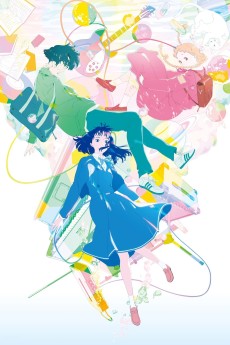
The Colors Within
Totsuko is a high school student with the ability to see the 'colors' of others. Colors of bliss, excitement, and serenity, plus a color she treasures as her favorite. Kimi, a classmate at her school, gives off the most beautiful color of all. Although she doesn’t play an instrument, Totsuko forms a band with Kimi and Rui, a quiet music enthusiast they meet at a used bookstore in a far corner of town. As they practice at an old church on a remote island, music brings them together, forming friendships and stirring affections. Will they discover their true 'colors'?
(Source: GKIDS)
📺Anime Details
📝Editorial Analysis
The first time Totsuko sees Kimi’s color—not as light, not as pigment, but as a slow unfurling, like breath held too long then released into warm air—she stops walking mid-step on the rain-slicked stone path leading to the old church. Her fingers tighten around the strap of her worn canvas bag. No sound except the distant chime of wind bells and the low hum of the island’s tide. That color isn’t loud. It doesn’t shout. It settles. And in that stillness, something inside Totsuko cracks open—not with pain, but with quiet, terrifying recognition.

What makes The Colors Within singular isn’t its boarding school or nuns or even the rock band—it’s how it treats time as sacred texture. Not plot-time, not deadline-time, but the weight of a shared glance across a dusty practice room; the way silence between chords feels like holding your hand over a candle flame—not to burn, but to feel the heat linger. This is iyashikei not as background ambiance, but as active, tactile healing: the kind that happens when you’re tuning a guitar with someone who doesn’t speak much, and the act itself becomes prayer. The religion here isn’t dogma—it’s ritual made visible through color, through repetition, through showing up, again and again, at that weathered church door. You don’t watch this anime to chase resolution. You stay for the thickness of being present—when Rui adjusts a mic stand for the third time, when Totsuko traces the grain of the old wooden floor with her thumb, when Kimi closes her eyes mid-chorus and her color deepens, just slightly, like dusk folding into violet.
That same thickness lives in Stardew Valley, where player reviews confess to “days upon days of constantly running around trying to find the town…”—not out of frustration, but because the game refuses to rush you. Like Totsuko learning to hear harmony before she can play a note, Stardew asks you to memorize seasons, to notice how Leah’s hair catches light differently in spring rain, to sit on the bus stop bench just to watch the sky change. Its healing isn’t passive—it’s earned in the rhythm of planting, watering, waiting, harvesting—not for profit, but for the quiet pride of watching something grow because you showed up.
Then there’s AudioSurf, where you “ride your music” and “the shape, the speed, and the mood of each ride is determined by the song you choose.” No scripted story, no cutscenes—just you, your playlist, and a track that bends to your pulse. Just like Totsuko doesn’t need an instrument to feel the band’s resonance, AudioSurf doesn’t ask you to master mechanics to access emotion. A player admits it’s “superior… despite its godawful UI, unskippable menu animations, crashing”—because what survives the glitches is feeling first, structure second. The joy isn’t in perfection, but in syncing your breath to the rise of a chorus, just as Totsuko syncs her awareness to Kimi’s shifting hue during rehearsal.
Even Prince of Persia, described as “an all-new epic journey” built by Ubisoft Montreal, carries that same tender slowness beneath its action. A reviewer notes it’s “completely separate from the sands timeline”—a deliberate break, a return to intimacy over legacy. Its healing dimension isn’t in combat, but in traversal: the way the Prince moves through space—leaping, pausing, catching himself on a ledge—not to escape, but to reorient. Like Totsuko stepping onto the ferry to the island each week, heart thudding not from fear, but from the sheer vulnerability of choosing to return to a place where feelings have color and weight.
This isn’t for players who want mastery, or viewers who crave escalation. It’s for the person who rewinds a 12-second clip of Kimi laughing mid-rehearsal—not to analyze, but to re-inhabit the warmth. For the one who plants parsnips at 5 a.m. in Stardew not to max stats, but to watch the mist lift off the pond while Harvey walks by, waving. For the one who loads AudioSurf not to beat high scores, but to let “Landslide” warp the grid into something soft and silver, just for five minutes. These pairings belong to those who understand that serenity isn’t emptiness—it’s the fullness of attention, held gently, without demand. Who know that the most radical act in a noisy world is to sit in a sunlit church, strum one chord, and wait—not for the next thing—but for the color to deepen.
🎮6 Games That Match the Vibe




Match Dimensions Explained
❓Frequently Asked Questions
Why does The Sims 4 show up in 'Games Like The Colors Within' matches when it's so buggy and expensive?
It matches on Healing & Slow Life *and* Romance & Shoujo—just like The Colors Within—thanks to its deep relationship-building, quiet daily rhythms (baking, gardening, stargazing), and emotional storytelling through Sim interactions. Players who loved the gentle pacing and romantic intimacy of The Colors Within often find that same warmth in TS4’s base-game romance systems—even if the DLC bloat and bugs frustrate them later.
Is there an anime or visual novel adaptation of AudioSurf, since it feels so emotionally resonant like The Colors Within?
No—it’s purely a music-driven puzzle racer with no narrative adaptation. But fans of The Colors Within’s mood-first design love how AudioSurf mirrors its emotional arc: riding a melancholic song like 'Breathe Me' creates slow, reflective descents and sudden bursts of light—just like the game’s 'healing' dimension—and that wordless, music-led catharsis hits the same nerve as The Colors Within’s silent, expressive storytelling.
How is Stardew Valley similar to Prince of Persia when both are in the 'Games Like The Colors Within' list?
They share Healing & Slow Life *and* Romance & Shoujo—but in totally different ways: Stardew gives you Emily’s quiet tea dates and the soft glow of the Stardew Valley Fair, while Prince of Persia (2023) delivers tender, grounded romance with Elika—like sharing bread under lantern light or her hand resting gently on your shoulder during still moments between combat. Both prioritize emotional slowness over speed, even if one’s farming and the other’s acrobatic.
What’s the best game like The Colors Within if I want something deeply calming but with zero pressure or time limits?
AudioSurf—especially version 1—is your best bet. You pick a soothing track (think Ludovico Einaudi or early Sufjan Stevens), and the game flows *with* your tempo: long glides, gentle rises, no fail states, no timers. Unlike Stardew Valley’s ‘Days upon days of constantly running around’ stress or TS4’s relationship grind, AudioSurf lets you just *breathe* through color, rhythm, and motion—exactly the kind of pressure-free healing The Colors Within offers.