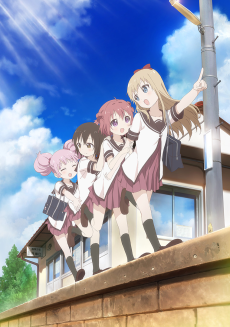
YuruYuri Nachuyachumi!
📺Anime Details
📝Editorial Analysis
The smell of damp earth and crushed mint rises as Akari leans over the campfire, stirring a pot of miso soup with a wooden spoon that’s slightly too big for her hand. Her hair falls forward, catching the amber light; Yui reaches out—not to fix it, but to gently tuck a stray leaf behind Akari’s ear. No dialogue. Just the crackle of kindling, the distant chirp of cicadas, and the quiet weight of being together in a space where nothing has to be solved, proven, or earned.
That’s YuruYuri Nachuyachumi!—not as genre exercise, but as breathing room. It doesn’t chase stakes or arcs. It holds stillness like a practiced art: the way fingers brush while passing chopsticks, how laughter lingers just past the punchline, how sunlight pools on tatami mats during club meetings that never really do anything except exist together. It makes you feel safe, not because danger is absent, but because safety is built—brick by brick—out of shared glances, inside jokes that need no explanation, and the unspoken certainty that your presence is already enough. It asks nothing of you but attention—and rewards it with warmth so tactile you almost taste it.
Prince of Persia (score: 84) shares that same tactile calm, buried beneath its desert spectacle. The description calls it “an all-new epic journey” built by Ubisoft Montreal—but the player review hints at something quieter: “a new prince, new lands and a brand new story completely separate from the sands…” That separation matters. Like YuruYuri Nachuyachumi!, it’s not about legacy or repetition—it’s about renewal as ritual. The Prince doesn’t conquer terrain; he flows across it, parkouring with grace that feels less like skill and more like trust in the world’s rhythm. You don’t win by force—you land softly, adjust your footing, keep moving. That’s the same energy as Akari stumbling over tent poles only to dissolve into giggles with Yui beside her: failure isn’t a break in continuity—it’s part of the texture.
The Sims™ 4, despite its fractured player reception (“TS4 has become awful… packs are insanely expensive and often broken”), carries an undeniable emotional core in its stated purpose: “Play with life and discover the possibilities.” Not optimize. Not win. Play. That phrase echoes YuruYuri Nachuyachumi!’s entire ethos—the way the Light Music Club rehearses a song they’ll never perform, or how the girls spend an entire episode arranging snacks just to watch clouds. The anime doesn’t simulate productivity; it simulates presence. So does TS4—at its best—when you pause mid-day to watch your Sim sip tea on the porch, barefoot, humming off-key. The bugs, the DLC grind? Real. But so is the moment when your Sim leans into another Sim’s shoulder without prompting—and for three seconds, everything else blurs.
Stardew Valley (score: 70) lands closest in temporal honesty. Its description invites you to “learn to live off the land”—not dominate it. And the player review confesses raw vulnerability: “Spent the first 2 years trying to do everything and never having enough time.” That exhaustion isn’t failure—it’s recognition. Like watching Kyoko try (and fail) to bake mochi for the cultural festival, then laugh as flour coats her nose and Yui wipes it away with her thumb. Stardew’s magic isn’t in harvest yields—it’s in the slow accrual of small trust: the way Linus starts leaving wild vegetables at your door, or how Haley finally looks up from her book when you sit beside her on the bus stop bench. No grand confession needed. Just showing up, season after season—just like the girls returning to the clubhouse, year after year, folding paper cranes nobody asks them to fold.
This pairing isn’t for people who want lore dumps or power fantasies. It’s for the ones who reread a text message from a friend just to feel the shape of the words again. For those who’ve sat on a porch swing at dusk, silent, and called it perfect. For anyone who’s ever held a warm mug and thought, this is enough. They’re for viewers who recognize love not as climax, but as continuity—in the way Akari always saves the last dango for Yui, in the way your Sim chooses to water roses instead of rushing to work, in the way you let your Stardew character sleep in just to hear the rain on the roof. Not escape. Arrival.
🎮11 Games That Match the Vibe







Match Dimensions Explained
❓Frequently Asked Questions
Why does Prince of Persia show up in 'Games Like YuruYuri Nachuyachumi!' matches when it’s an action-adventure game?
Great question—it’s not about genre overlap, but shared emotional dimensions: Prince of Persia scores high in Romance & Shoujo (think the Prince’s gentle, earnest dynamic with Zahra), Comedy & Parody (those over-the-top acrobatic fails and fourth-wall winks), and Healing & Slow Life (the lush, sun-drenched world-building and quiet moments between set pieces). It’s the *tone*—playful, warm, character-driven absurdity—that aligns with YuruYuri’s vibe, not the sword-swinging.
Is there an anime or visual novel adaptation of VA-11 Hall-A that captures the same slice-of-life charm as YuruYuri?
No official anime adaptation exists—but VA-11 Hall-A *is* a visual novel, and its charm lives in how you serve drinks to characters like Dorothy (a stressed-out android nurse) or Jill (your sarcastic, whiskey-swilling coworker) while their personal dramas unfold in cozy, rain-slicked bar scenes. The slow-burn friendships, gentle humor, and low-stakes emotional warmth mirror YuruYuri’s ‘after-school club’ energy—just swapped for neon-lit cyberpunk stools.
How does Stardew Valley compare to The Sims 4 for YuruYuri fans who want lighthearted romance and daily silliness?
Stardew Valley leans into heartfelt, grounded charm—like befriending grumpy old Gus at the saloon or watching Sebastian blush when you gift him a cupcake—while TS4 (despite its bugs) offers wilder, more chaotic parody: think marrying a sentient toaster via mod or hosting a 'mochi-making' party where your Sim slips on soy sauce. Both hit Romance & Shoujo + Healing & Slow Life, but Stardew’s sincerity vs. TS4’s absurdist sandbox makes them complementary, not identical.
What’s the best game like YuruYuri Nachuyachumi! if I just want that cozy, giggly, after-school club feeling without any stress or grinding?
Go straight to VA-11 Hall-A—it’s got zero time pressure, no resource management, and every ‘shift’ feels like hanging out with your funniest friends at the local dive bar. You’ll hear Jill crack jokes while mixing a ‘Dorothy Special’, listen to Dorothy vent about her latest robot malfunction, and slowly uncover sweet, understated bonds—all in bite-sized, emotionally warm scenes. No farming schedules, no broken DLC packs—just vibes, banter, and boba tea metaphors.