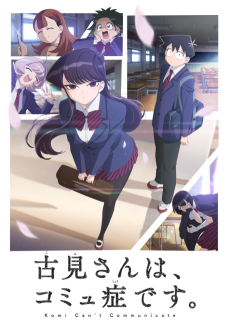
Komi Can’t Communicate
Timid Tadano is a total wallflower, and that’s just the way he likes it. But all that changes when he finds himself alone in a classroom on the first day of high school with the legendary Komi. He quickly realizes she isn’t aloof—she’s just super awkward. Now he’s made it his mission to help her on her quest to make 100 friends!
(Source: VIZ Media)
📺Anime Details
📝Editorial Analysis
The fluorescent hum of Classroom 2-B on the first day of high school. A silence so thick it vibrates—not empty, but charged, like holding your breath before speaking to someone whose name you’ve whispered a hundred times but never said aloud. Tadano sits frozen beside Komi, who stares straight ahead, fingers knotted in her skirt, breath shallow, eyes wide with quiet panic. Not fear of danger. Not disdain. Just the sheer, overwhelming weight of being seen—and not knowing how to be seen back. That silence isn’t absence. It’s presence, humming with unspoken intention, fragile as a held note.
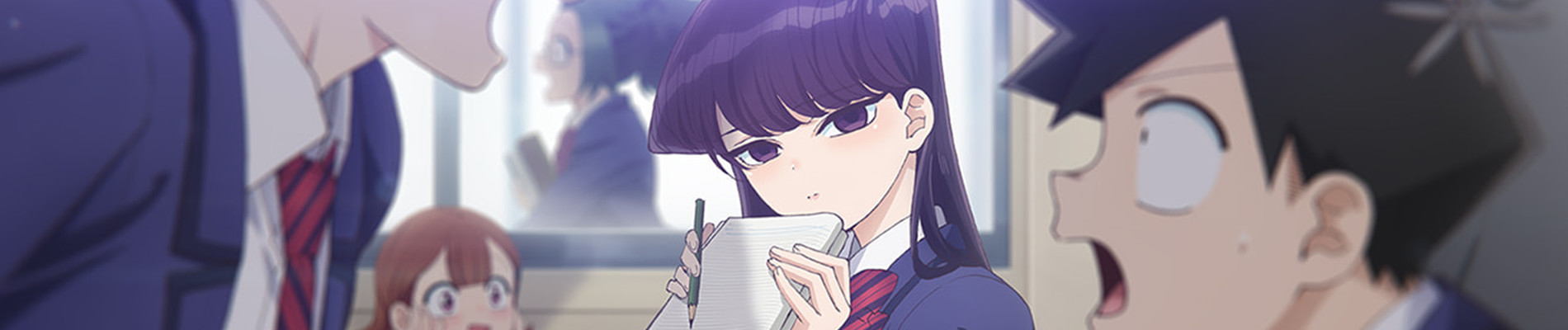
What makes Komi Can’t Communicate ache so tenderly is how it treats social anxiety not as a quirk or gag, but as terrain—a landscape of real emotional topography. You don’t just watch Komi struggle; you feel the physics of her hesitation—the way a single syllable catches like gravel in the throat, how a smile takes three seconds to unfurl, how eye contact feels like stepping onto thin ice. It’s melancholic exploration: gentle, patient, never mocking, always attentive to the small, seismic shifts inside a person learning to occupy their own voice. The comedy isn’t slapstick for its own sake—it’s the nervous laughter that bubbles up when relief finally breaks through tension. The romance isn’t grand declarations—it’s Tadano noticing exactly when Komi’s shoulders drop half an inch, and choosing, quietly, to stay beside her. It’s intimacy built in millimeters, not miles.
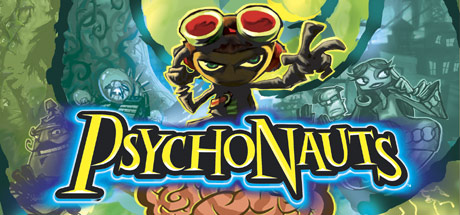
That same emotional DNA pulses in Psychonauts, where Raz explores the minds of misfits, monsters, and madmen—not as caricatures, but as people whose inner worlds are shaped by real wounds, insecurities, and unmet needs. The description calls it “A Psychic Odyssey Through the Minds of Misfits”—and isn’t Komi’s journey exactly that? Her classroom isn’t just a setting; it’s her psyche made visible: the chalkboard becomes a wall she can’t cross, the hallway a labyrinth of potential judgment. A player review notes how the game renders “utterances beautifully”—not just words, but the texture of speech emerging from silence. Like Komi’s first full sentence to Tadano, halting and luminous, Psychonauts treats every internal voice as sacred ground.
Then there’s Bully: Scholarship Edition, which tells the story of Jimmy Hopkins navigating “the hilarity and awkwardness of adolescence.” Not rebellion for spectacle, but survival through wit, observation, and quiet recalibration—just like Tadano, who watches, listens, adjusts his posture, learns when to step forward and when to simply hold space. The game’s world isn’t hostile because it’s evil—it’s overwhelming because it’s unfiltered, full of overlapping social codes and shifting hierarchies. Jimmy doesn’t conquer Bullworth Academy—he learns its rhythms, finds his footing in its chaos, earns loyalty not through dominance but through consistency. That’s Tadano’s superpower too: showing up, again and again, without fanfare, until Komi stops measuring safety in meters and starts measuring it in moments shared.
Even Prince of Persia, with its “all-new epic journey” built on melancholic exploration and comedy, echoes this. The Prince doesn’t shout his pain—he moves through ruins, solving puzzles shaped by memory and loss, his humor dry and self-aware, a shield and a bridge. Like Tadano’s deadpan narration (“She’s not cold—she’s terrified”), the Prince’s voice carries weight because it refuses melodrama. His quest isn’t about glory—it’s about repair, about reassembling something fractured. So is Komi’s. So is Tadano’s, in quieter ways—rebuilding his own sense of agency, one small act of courage at a time.
This pairing sings to the quiet observer—the teen who maps social rooms like blueprints, the adult who still feels their pulse jump before a group chat notification, the player who lingers in a game’s empty spaces just to breathe there. It’s for anyone who’s ever loved someone not despite their silence, but within it—who understands that friendship isn’t built in speeches, but in the shared, trembling space between two people learning, slowly, how to say hello.
🎮11 Games That Match the Vibe









Match Dimensions Explained
❓Frequently Asked Questions
Why does Komi Can’t Communicate feel so similar to Psychonauts despite being a manga adaptation?
Both lean hard into 'Melancholic Exploration' and 'Comedy & Parody'—like when Raz explores the emotionally cluttered mind of a bullied kid in Psychonauts, it mirrors Komi’s silent, anxiety-ridden hallway walks where every glance feels like a seismic event. The humor lands the same way too: awkward physical comedy (Raz slipping on psychic goo, Komi freezing mid-sentence) layered over real emotional weight.
Is there an anime or live-action adaptation of Bully: Scholarship Edition like there is for Komi Can’t Communicate?
Nope—Bully has stayed firmly in game form since its 2006 release, unlike Komi which got a polished anime series. That said, Jimmy Hopkins’ school-day chaos—pranking preppies, dodging jocks, saving nerds—feels like if Komi’s high school had a sarcastic, skateboarding narrator and way more firecrackers. It’s the same vibe, just no voice acting outside the game itself.
How is Prince of Persia different from Komi Can’t Communicate in terms of tone and pacing?
Prince of Persia trades Komi’s quiet, slice-of-life tension for sweeping, melancholic exploration—think long, lonely sand dunes instead of crowded hallways—and swaps social anxiety for existential dread about time and legacy. But both share that 'Comedy & Parody' spark: the Prince’s dry one-liners during platforming fails hit like Komi’s internal monologue spiraling over a misplaced pencil.
What’s the best game like Komi Can’t Communicate if I want something soothing but still funny and quietly sad?
Go with Psychonauts—it nails that exact balance: Raz’s goofy psychic acrobatics (like bouncing off a giant floating brain) soften the ache of exploring trauma-filled mental worlds, just like Komi’s silent panic attacks are undercut by her friends’ earnest, bumbling support. Both sit at 72/100 and share 'Melancholic Exploration' + 'Comedy & Parody' as core dimensions, no forced stakes, just heart.