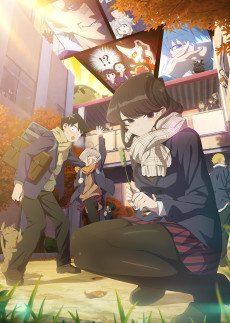
Komi Can't Communicate Part 2
The second season of Komi-san wa, Komyushou desu.
Komi and pals are back! Who else will Komi make friends with? How will her relationship with Tadano evolve?
(Source: Netflix)
📺Anime Details
📝Editorial Analysis
The silence between Komi and Tadano in the hallway—just before she finally writes her first full sentence to him on a folded note—isn’t empty. It’s thick with breath held too long, with the rustle of uniform sleeves brushing against lockers, with the distant chime of a classroom bell that somehow sounds softer than usual. Her fingers tremble not from fear alone, but from the sheer, staggering weight of intention: every millimeter her pen moves across paper is a tectonic shift. That moment isn’t about dialogue—it’s about the architecture of courage, built one hesitant stroke at a time.

What makes Komi Can't Communicate Part 2 vibrate so distinctly isn’t its school setting or its slapstick—it’s how it treats silence as sacred terrain. This isn’t quiet as absence; it’s quiet as presence. The show leans into stillness like a physical surface you can lean against: the pause after a failed greeting, the suspended second before a hand reaches out, the way laughter bubbles up not despite anxiety but through it, warm and slightly off-kilter. It makes you feel the texture of small victories—the brush of fingertips during a group handshake, the shared glance across a cafeteria table where no words are needed because recognition has already landed. You don’t just watch Komi grow—you inhabit the slow, tender recalibration of her nervous system, the way safety accumulates in increments: a nod, then a smile, then a single word spoken aloud—not as performance, but as release. It’s profoundly melancholic exploration, yes—but bathed in golden-hour light and punctuated by genuine, unguarded joy.
That emotional DNA pulses strongest in games where vulnerability isn’t hidden behind spectacle, but woven into the mechanics themselves. Prince of Persia—with its “Melancholic Exploration” core—mirrors Komi’s inner landscape: both move through beautiful, fragile worlds where every step feels weighted with unspoken history. The Prince doesn’t shout his grief; he dances through ruins, his acrobatics a physical language for what words cannot hold—just as Komi’s notebooks, her gestures, her carefully timed blinks become syntax for a self still learning its own grammar. A player review notes it’s “an all-new epic journey… completely separate from the sands,” echoing how Komi’s growth isn’t about fixing herself, but redefining what connection means on her own terms.
Then there’s Psychonauts, explicitly tagged with both “Comedy & Parody” and “Melancholic Exploration.” Its description calls it “A Psychic Odyssey Through the Minds of Misfits, Monsters, and Madmen”—and isn’t that precisely what Komi’s classroom is? Not metaphorically, but emotionally: each classmate orbits their own private gravity well of insecurity, longing, or eccentricity. Raz’s journey inside fractured psyches—where absurdity and tenderness coexist in the same surreal corridor—feels kin to Komi’s world, where Tadano’s earnestness, Najimi’s chaotic warmth, and Komi’s paralyzing self-awareness all occupy the same tender, ridiculous, deeply human space. One player review, though garbled, fixates on “utterly rendered” voices—echoing how Komi Can't Communicate Part 2 renders silence with the same care others give dialogue.
And Bully: Scholarship Edition, with its “hilarity and awkwardness of adolescence,” lands with startling precision. Its description names dodgeball, pranks, and saving nerds—not as gags, but as rituals of belonging. Jimmy Hopkins navigates social ecosystems with the same mix of clumsy empathy and accidental insight that Tadano brings to Komi’s world. The player review mentions stability on Steam Deck but crashes on PC—a perfect, unintentional metaphor: this is a game that works when given the right conditions, just as Komi thrives not when “fixed,” but when surrounded by people who adjust their rhythm to hers.
This pairing sings loudest for the viewer who cries at a perfectly timed head-tilt, who replays a five-second interaction three times to savor the micro-expression, who knows anxiety isn’t a barrier to love—it’s often the first, trembling bridge toward it. For the player who doesn’t need a boss battle to feel triumphant, but does need to see a character finally breathe freely in a sunlit hallway—and then go find the next friend, the next sentence, the next soft, steady, unhurried yes.
🎮10 Games That Match the Vibe








Match Dimensions Explained
❓Frequently Asked Questions
Why does Komi Can't Communicate Part 2 match with Prince of Persia?
It’s all about that melancholic exploration vibe—like when Komi silently walks through the empty school hallway after everyone’s left, mirroring the Prince’s lone traversal across desolate, sand-swept ruins. Both use quiet, atmospheric pacing and subtle visual storytelling instead of exposition, and Prince of Persia’s 81-scored reboot leans into emotional weight *and* dry, understated humor—just like Komi’s awkward classroom glances or Nene’s deadpan asides.
Is there an anime or live-action adaptation of Psychonauts that captures Komi’s social anxiety themes?
No official adaptation exists—but Psychonauts (72-scored) nails Komi’s inner-world metaphor better than most: Raz’s journey through other characters’ minds—like the claustrophobic, looping anxiety level inside Coach Oleander’s head—feels like stepping into Komi’s own overwhelmed thoughts during a group presentation. It’s not about dialogue-heavy scenes; it’s about visualizing paralysis, overthinking, and small acts of courage—exactly what Part 2 explores in episodes like ‘The Cafeteria Incident’ with Rumi and Komi’s silent hand-holding.
How is Bully: Scholarship Edition similar to Komi Can't Communicate Part 2?
Both use comedy & parody to soften raw adolescent vulnerability—think Jimmy Hopkins fumbling through detention or pranking bullies, just like Komi attempting (and failing) to say ‘hello’ to Tadano in the hallway outside Class 2-B. Bully’s 72-scored world lets you navigate social hierarchies (jocks, nerds, preppies) with empathy and absurdity, much like how Part 2 frames Komi’s communication struggles not as deficits, but as relatable, gently funny moments—e.g., her notebook doodles becoming full-blown internal monologues during class roll call.
What’s the best game like Komi Can’t Communicate Part 2 if I want something soothing but quietly profound?
Go for Prince of Persia (81-scored)—it’s the only match on the list with that rare blend of melancholic exploration *and* grounded emotional resonance. When you’re gliding across sun-dappled rooftops or solving quiet, reflective puzzles alone, it echoes Komi’s tender solo moments: sketching in her notebook at sunset, walking home past cherry blossoms, or that slow-motion hallway walk where every breath feels meaningful. No explosions, no pressure—just presence, poetry, and soft stakes.