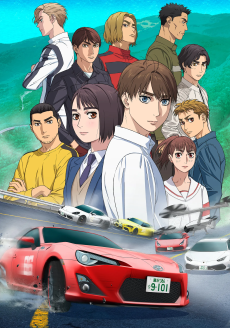
MF GHOST
202X A.D., a future beyond Initial D.
Self-driving cars are in widespread use in Japan, and public roadways are used for auto racing. In such an era, a race called MFG has become popular around the globe. Porsche, Ferrari, Lamborghini… Participants are invited to race with their fastest cars. One such participant, a British racing school graduate, Kanata Rivington, returns to Japan to achieve his goal.
(Source: Crunchyroll)
📺Anime Details
📝Editorial Analysis
The roar of a 911 GT3 RS tearing past Mount Akagi at dawn—not on a closed circuit, but on a rain-slicked public highway lined with sleeping machiya and flickering vending machines—hits before the opening credits. Kanata’s knuckles whiten on the wheel, his breath shallow, eyes locked not on a HUD or telemetry, but on the taillights of a rival vanishing into mist. No AI co-pilot. No lane assist. Just him, the car, and the unspoken weight of a father’s ghost in the rearview mirror. That’s MF GHOST: not speed as spectacle, but speed as testimony—a future where self-driving cars dominate, yet humans still race on real roads, with real consequences, because something in them refuses to be automated.
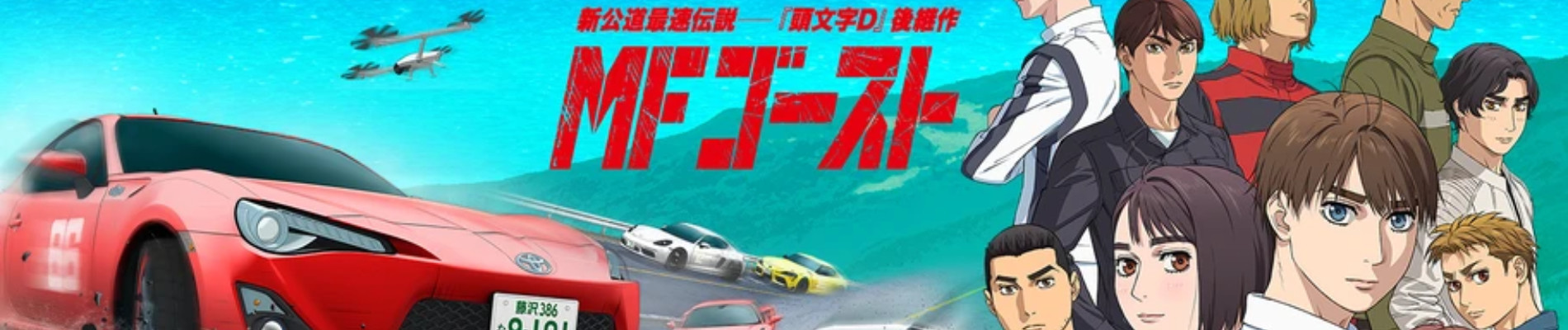
What makes MF GHOST vibrate isn’t its CGI sheen or its Porsche-Ferrari-Lamborghini parade—it’s the adult quiet beneath the engine note. This is seinen not just by age rating, but by texture: the exhaustion in Kanata’s shoulders after a qualifying run; the way silence hangs in the garage when a mechanic checks suspension geometry without speaking; the love triangle that never swells into melodrama, but lingers like exhaust smoke—present, consequential, unresolved. It’s about legacy as burden, not trophy. About racing not for virality or sponsorship, but because your hands remember what your father’s taught them—and because the road itself feels alive, dangerous, indifferent. You don’t watch it to escape adulthood. You watch it in adulthood—tired, focused, responsible, and strangely hopeful.
That same emotional DNA hums in Team Fortress Classic—not in its cartoonish classes or slapstick Spy backstabs, but in its competitive spirit forged in dial-up latency and late-night LAN parties. The player review says it outright: “simply the best nostalgic game, i have dreams about this game.” Not “fun,” not “cool”—dreams. Like Kanata dreaming of Akagi in his sleep, TF Classic lives in the muscle memory of coordination under pressure, where Medic’s Ubercharge isn’t just a buff—it’s a vow made mid-firefight. Both demand presence, not perfection. Both reward reading intent over reflex alone. And both carry that adult & dark seinen gravity—the knowledge that every match ends, every lap finishes, and what remains is the echo of how you showed up.
Then there’s Quake III Arena, summoned not for its alien lore, but for its ruthless combat stripped bare: no cover system, no regenerating health, just movement, prediction, and consequence. Its description nails it: “The greatest warriors… summoned to battle for the amusement of an ancient alien race.” That’s MF GHOST’s MFG series refracted—gladiatorial, global, mythic. And the player review? “There are still internet mp game servers out there as of typeing this…” That stubborn, unkillable persistence mirrors Kanata’s return to Japan—not for glory, but because the race still runs, the road still exists, and the stakes haven’t softened with time. Both are rituals maintained by believers who refuse to let the form die, even when the world has moved on.
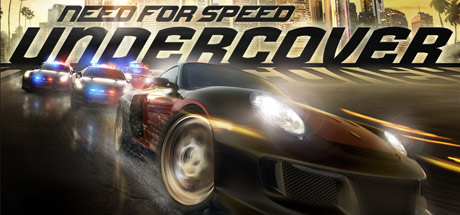
And Need for Speed Undercover—yes, the one players call “very mid” and blame on “yearly releases”—holds a quieter resonance. Its description frames racing as duality: “You’re the hunted. And the hunter.” That tension—of being pursued while pursuing—is MF GHOST’s heartbeat. Kanata isn’t chasing a podium; he’s chasing lineage, identity, a reckoning. The player review’s weariness (“Black Box was gassed out”) echoes the anime’s fatigue—not of racing, but of carrying expectation. Undercover’s neon-lit chases through Miami’s sprawl feel like MF GHOST’s night runs on the Tomei Expressway: lawless, personal, morally blurred. Both treat the car not as toy or tool, but as witness.
This pairing isn’t for the teen who races to level up or unlock skins. It’s for the 28-year-old who still checks tire temps before a weekend drive. For the engineer who pauses mid-repair to watch a drift clip—not for technique, but for the weight in the driver’s pause before throttle-in. For the one who’s loved and lost quietly, who knows that the most intense competition isn’t against others, but against the version of yourself that almost gave up. They’ll recognize Kanata’s silence not as emptiness, but as fullness—of memory, duty, and the rare, unautomated thrill of choosing, again and again, to steer.
🎮10 Games That Match the Vibe
Match Dimensions Explained
❓Frequently Asked Questions
Why does MF GHOST feel so intense during street races compared to other racing games?
MF GHOST’s high-stakes, rule-bending street racing vibe—where drifting isn’t just style but survival—hits hardest in games like Need for Speed Undercover, where you’re hunted by cops *and* rival crews while pulling off insane drifts on rain-slicked coastal highways. The tension mirrors Undercover’s ‘infiltration under pressure’ pacing, especially during its late-game Miami chase sequences with the Blacklist syndicate.
Is there an MF GHOST anime or game adaptation already out?
No official MF GHOST video game exists yet—but if you're craving that same adrenaline-fueled, competitive-seinen energy, Quake III Arena nails the 'ancient alien arena' intensity with its fast, skill-based combat and legacy servers still running today. It’s not a racing sim, but the same 'gladiatorial stakes + mature tone' that defines MF GHOST’s underground circuit scenes.
How does Need for Speed Undercover compare to Team Fortress Classic for competitive multiplayer vibes?
They’re totally different beasts—but both nail 'Competitive Spirit' in their own way: Undercover gives you solo, high-risk pursuit-and-escape tension (think chasing down the Blacklist crew in real-time traffic), while TFC delivers chaotic, class-based team warfare (Spy backstabs, Medic resupplies) with that raw, nostalgic 90s LAN-party energy fans call 'the best nostalgic game.' Both scored 76 and share the Adult & Dark Seinen dimension—just one’s about tires screeching, the other about rocket-jumping into chaos.
What’s the best MF GHOST-like game if I want that gritty, cinematic, 'hunted-but-hunting' mood?
Need for Speed Undercover is your go-to—it’s built around exactly that duality: you’re both the hunted (by Interpol, by the Syndicate) and the hunter (infiltrating criminal rings), with moody Miami/Caribbean visuals and Black Box’s signature 'cinematic chase' camera work. Its score (76) and 'Adult & Dark Seinen' tag line up perfectly with MF GHOST’s tone—no cartoonish cops here, just tense, grounded stakes.