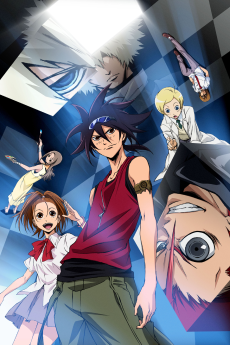
Phi Brain: Puzzle of God
📺Anime Details
📝Editorial Analysis
The air in the underground chamber hums—not with machinery, but with silence that breathes. Kaito’s fingers tremble over the puzzle board, sweat beading at his temple as the timer ticks down in red. His reflection fractures across mirrored walls—not one face, but three: the boy who remembers nothing, the boy who remembers too much, and the boy who refuses to remember anything at all. A card flips. A memory shatters. The lights flicker—not from power failure, but from identity recoil.
That’s Phi Brain: Puzzle of God’s core vibration: not adrenaline, not spectacle—but cognitive vertigo. It’s the dread of solving a puzzle only to realize the solution was you, the architect and the prisoner. The show doesn’t treat puzzles as games—it treats them as autopsies of self. Every card battle is a confrontation with unreliability: of memory, of motive, of continuity. You don’t watch to see if Kaito wins—you watch to see if he recognizes himself mid-solve. That slow, nauseous dawning—the moment a “clue” unravels into trauma—is where the show lives. It’s melancholic exploration of interior architecture, not external stakes. The orphanhood isn’t backstory—it’s structural: no origin point means no stable ground. Every “death game” isn’t about survival—it’s about reassembly under duress.
Assassin's Creed™: Director's Cut Edition shares that same melancholic exploration, not through action, but through archaeology of self. Its player review admits flaws in texture and model fidelity—but calls them irrelevant because the emotional weight persists despite aging visuals. Like Kaito tracing fragmented memories across shifting puzzle grids, Altaïr walks Jerusalem’s streets not just as an assassin, but as a man reconstructing his moral compass from ruins. Both are political thrillers where power isn’t held by villains—it’s embedded in systems that rewrite identity: the Isu’s genetic memory vs. Phi Brain’s memory manipulation protocols. Neither lets you “win” cleanly—you survive, yes, but you carry the weight of what the system made you forget you knew.
The Talos Principle 2, scoring 76 with melancholic exploration and emotional narrative baked into its DNA, mirrors Phi Brain’s obsession with dissociative identities as philosophical architecture. Here, consciousness isn’t a single flame—it’s a branching circuit, a choir of selves debating ontology while standing atop collapsing logic towers. Like Kaito’s fractured reflections in those mirrored rooms, the player in Talos 2 doesn’t solve puzzles to escape—they solve them to witness the contradictions within their own reasoning. No villain pulls strings; the tension is internal, recursive, inescapable. And just like Phi Brain’s episodic structure forces constant recalibration of truth, Talos 2’s narrative unfolds in layered revelations—not plot twists, but epistemological collapses.
CONVERGENCE: A League of Legends Story™, tagged explicitly with Time & Memory, lands with eerie precision. Its dimension isn’t magic or tech—it’s temporal dislocation as emotional inheritance. When Jinx stumbles into fractured timelines, she doesn’t just see alternate versions of herself—she sees versions of memory that refuse to cohere. That’s Kaito’s entire arc: not “who am I?” but “which version of me gets to speak first—and why does the quietest one hold the key?” Player reviews aren’t quoted here, but the tag Time & Memory isn’t decorative—it’s diagnostic. Both works treat memory not as archive, but as active battlefield, where every recollection risks rewriting the present tense.
This pairing isn’t for fans of “smart puzzles” or “cool powers.” It’s for people who feel relief when a story makes them pause mid-scene—not to process plot, but to catch their breath after realizing they’ve been holding it. It’s for players who replay a dialogue tree not to optimize outcomes, but to hear how their own voice changes depending on which memory they let surface first. It’s for viewers who don’t need catharsis—they need resonance: that quiet, electric hum when fiction names the shape of your own unspoken dissociation. Not “I relate”—but “I recognize this frequency.”
🎮24 Games That Match the Vibe








Match Dimensions Explained
❓Frequently Asked Questions
Why is The Talos Principle 2 listed as similar to Phi Brain when it’s a first-person puzzle game with robots, not anime teens solving logic puzzles?
Great question—it’s the *weight* of the puzzles and the melancholic, philosophical tone that matches Phi Brain’s vibe. Like Kaito’s ‘Puzzle of God’ trials, Talos Principle 2 forces you to confront existential questions mid-puzzle—think the ‘Cathedral of Thought’ sequence where solving a light-refraction puzzle unlocks a monologue about consciousness and free will. Both use layered logic not just as gameplay, but as narrative scaffolding—and both earned 76+ scores for blending Emotional Narrative with Melancholic Exploration.
Is there a Phi Brain anime adaptation or mobile game I can play right now?
No official Phi Brain anime adaptation or licensed mobile game exists—but CONVERGENCE: A League of Legends Story™ hits that same sweet spot: it’s a story-driven, hand-drawn adventure where memory and time-bending puzzles drive the plot (like the ‘Shattered Chronometer’ chapter where you rewind dialogue choices to uncover hidden truths). It’s the closest official release capturing Phi Brain’s blend of emotional stakes and cerebral mechanics, scoring 73 with strong Time & Memory and Melancholic Exploration dimensions.
How does FINAL FANTASY XIV Online compare to Phi Brain for puzzle-solving fans?
FFXIV isn’t built around logic puzzles like Phi Brain—but its most beloved raids (like the ‘Tower of Zot’ hard mode) demand real-time spatial reasoning, pattern recognition, and split-second coordination, echoing Kaito’s high-stakes ‘Brain Burst’ moments. Plus, its JRPG Narrative dimension (scored 72) delivers the same slow-burn emotional payoff and morally gray character arcs you love in Phi Brain—especially with characters like Alisaie and her grief-fueled arc in Shadowbringers.
What’s the best game like Phi Brain if I want that quiet, intense ‘late-night puzzle room’ mood?
Go straight to The Talos Principle 2—it nails that hushed, introspective vibe: imagine sitting alone in the ‘Sanctum of Echoes’, solving a gravity-defying cube puzzle while ambient synth hums and fragmented audio logs from past thinkers play softly in your headphones. Its Melancholic Exploration + Political Thriller dimensions (both rated highly) create exactly that contemplative, emotionally charged solitude—no flashy cutscenes, just you, the logic, and the weight of what the puzzle means.