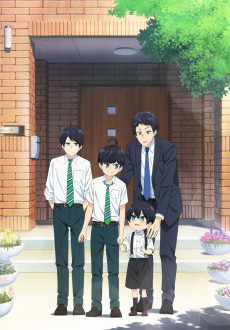
The Yuzuki Family’s Four Sons
📺Anime Details
📝Editorial Analysis
The quiet clink of a spoon against a ceramic bowl—steam rising from miso soup as the youngest son, Haruto, sits cross-legged at the low table, watching his older brothers move through the kitchen like gentle currents: one stirring rice, another folding laundry nearby, the eldest quietly wiping the counter. No grand speeches, no dramatic music—just the soft scrape of slippers on tatami, the distant chime of a bicycle bell passing the gate, and the unspoken weight of carrying on after loss.
That’s the heart of The Yuzuki Family’s Four Sons: not healing as recovery, but healing as continuance. It doesn’t ask how to get over grief—it asks how to fold it into daily life without breaking stride. The atmosphere isn’t warm in the way of sunlit rom-coms; it’s tender, like worn cotton, like the slight give in a wooden floorboard under years of footsteps. You feel the absence—not as a void, but as a shape the family moves around, fills with shared chores, school reports left open on the kotatsu, the careful way the middle brother checks Haruto’s homework before bed. There’s no villain, no ticking clock—just time, measured in seasons, meals, and the slow, quiet unfurling of boyhood into responsibility. It makes you think about how love isn’t always spoken—it’s done: in the extra slice of tamagoyaki slipped onto someone’s plate, in the way a brother pauses mid-sentence to listen, really listen, when the youngest stumbles over a word about their mother.
Prince of Persia resonates because its “Melancholic Exploration” mirrors that same hushed reverence for time and memory. Like Haruto tracing his fingers over his father’s old watch, the Prince walks ruins where every crumbling arch holds a story he didn’t live—but must carry. The player review notes it’s “a new prince, new lands… completely separate”—yet the emotional core isn’t reinvention, it’s inheritance. Both the anime and game treat legacy not as burden, but as texture: something worn softly, moved through with care. That “Healing & Slow Life” dimension isn’t passive—it’s the deliberate pace of someone learning to hold space for what’s gone and what’s growing.
Stardew Valley hits with uncanny precision—not in its farming mechanics, but in its rhythm of replenishment. The description says you “inherit your grandfather’s old farm plot… set out to begin your new life.” That inheritance isn’t just land—it’s silence, expectation, the weight of starting over with hand-me-down tools and “a few coins.” The player review confesses spending “the first 2 years trying to do everything and never having enough time”—which echoes the Yuzuki brothers’ early episodes: exhausted, overextending, measuring success in completed chores and untouched homework. But both find meaning not in mastery, but in showing up: watering crops at dawn, packing bento boxes before school, choosing which neighbor to visit today, not tomorrow. It’s the same “Healing & Slow Life” pulse—life rebuilding itself, one small, stubborn act at a time.
The Sims™ 4, despite the player review’s frustration (“awful… packs insanely expensive… barely any fun without DLC”), reveals something deeper in its stated purpose: “Play with life and discover the possibilities.” That phrase—play with life—is startlingly close to what The Yuzuki Family’s Four Sons does. Not dramatize life, not optimize it—but play it: experiment with roles (big brother, cook, student), test boundaries (who stays home when someone’s sick?), improvise rituals (Sunday bath time, shared manga reading). The anime’s episodic structure mirrors TS4’s sandbox: no fixed win condition, just presence, consequence, and the quiet thrill of watching a tiny, fragile world hold together.
This pairing is for the person who cries when their Sim finally cooks a meal without burning it—or when Haruto ties his own shoelaces for the first time, fingers fumbling, brothers watching without rushing to help. For the one who replays Stardew’s winter cutscene just to hear the snow crunch under boots, or walks Prince of Persia’s desert paths not to reach an end, but to feel the wind shift. They don’t seek catharsis—they seek continuity. They love stories where healing isn’t a destination, but the soft, steady sound of four pairs of slippers moving, side by side, down the same hallway—again and again.
🎮29 Games That Match the Vibe



















Match Dimensions Explained
❓Frequently Asked Questions
Why does The Yuzuki Family’s Four Sons match with Prince of Persia when they’re so different?
Great question—it’s not about surface-level genre, but shared emotional texture: both lean hard into 'Melancholic Exploration' and 'Healing & Slow Life' dimensions. Think of Prince of Persia’s quiet, rain-slicked ruins and the prince’s tender, wordless bond with Elika—very much like the Yuzukis’ hushed morning routines and unspoken care between brothers. That same bittersweet stillness shows up in scenes like climbing the crumbling Tower of Dawn or sharing tea after a long day.
Is there an anime or manga adaptation of The Yuzuki Family’s Four Sons?
No official anime or manga adaptation exists yet—but interestingly, Baldur’s Gate 3 shares that same ‘Romance & Shoujo’ + ‘JRPG Narrative’ DNA, with deep, choice-driven relationships (like Astarion’s slow-burn trust arc or Shadowheart’s guarded vulnerability) that fans of the Yuzukis’ gentle, character-first storytelling often cite as a satisfying narrative substitute.
How does Stardew Valley compare to The Yuzuki Family’s Four Sons in terms of family warmth?
Stardew Valley nails that cozy, multi-generational intimacy—especially in scenes like helping Grandpa restore his shrine, cooking with Robin, or watching your kids grow up in the farmhouse—mirroring the Yuzukis’ quiet rituals like shared baths or folding laundry together. Both score 83+ in 'Healing & Slow Life' and 'Romance & Shoujo', and players consistently praise how Stardew makes small moments (e.g., Leah’s rainy-day poetry or Sebastian’s shy smile after you gift him coffee) feel just as emotionally resonant as the Yuzukis’ tender glances.
What’s the best game like The Yuzuki Family’s Four Sons if I want something soothing but with meaningful choices?
Go straight to STORY OF SEASONS: Pioneers of Olive Town—it’s got that same healing rhythm (planting, crafting, chatting with townsfolk at the café) *and* real stakes in relationship pacing, like choosing who to invite to your first festival dinner or deciding whether to help Marnie rebuild her ranch. Unlike The Sims 4—which scores 85 in Healing & Romance but gets dinged by players for broken DLC dependencies—Pioneers delivers full, self-contained warmth without paywalls or bugs.