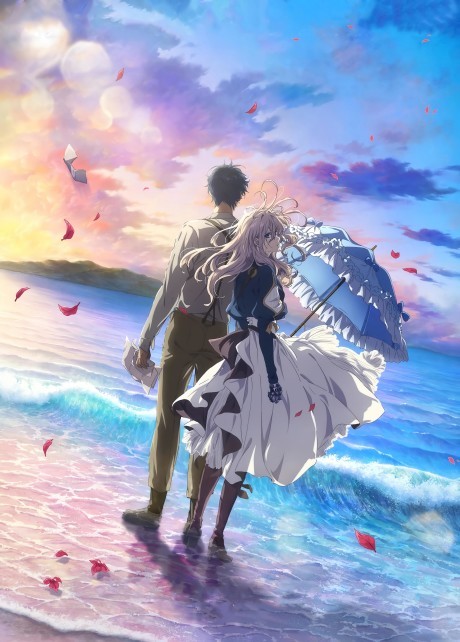
Violet Evergarden: the Movie
While writing other people’s emotions, she may have neglected her own. Violet Evergarden, the child soldier turned Auto Memory Doll, writes letters that evoke the words her clients can’t. But when a terminally ill boy requests her services for his family, her own feelings about love and loss resurface. Now she must confront her past and the death of the Major.
(Source: Funimation)
📺Anime Details
📝Editorial Analysis
The paper rustles—soft, insistent—as Violet’s pen hovers over the page. Not writing yet. Just holding the weight of the boy’s final letter in her hands, his small, trembling script already fading at the edges. She doesn’t cry. She doesn’t know how. But her fingers tighten—not on the pen, but on the folded letter from the Major, buried deep in her coat pocket, its creases worn smooth by years of silent touch. That pause—between thought and ink, between duty and grief—is where Violet Evergarden: the Movie lives. Not in grand battles or soaring declarations, but in the unbearable lightness of a breath held too long.

This isn’t melancholy dressed up as tragedy. It’s rehabilitation made tactile—the slow, unglamorous work of learning to feel after your nervous system has been rewired for obedience. The historical setting isn’t backdrop; it’s pressure—gaslight flickering over handwritten letters, train windows blurring past fields where war once tore the earth, the quiet hum of a typewriter echoing like a heartbeat learning rhythm again. You don’t watch it to escape. You watch it to settle—into the ache of unspoken love, the dignity of labor that stitches hearts back together one sentence at a time, the quiet horror of realizing you’ve spent your life translating others’ emotions while your own remained locked in a vault labeled classified. It makes you think about what language does when it fails—and what remains when words are all you have left.
Tank Universal shares that same quiet fracture between memory and loss. Its description calls it an “action FPS tank wargame,” but the player review cracks it open: “Play cool tank game with dad when you were 6… time goes on; loose access to game. Grew up dad passes away…” There’s no combat log, no mission briefing—just the visceral warmth of shared sound effects and color, then the hollow echo of absence. Like Violet tracing the Major’s handwriting, this player traces the ghost of a controller in their palm. Both works hold space where joy and grief aren’t opposites—they’re the same vibration, tuned to different frequencies.
Hollow Knight, too, breathes that same air of melancholic exploration. Its description invites you to “forge your own path” through a “vast ruined kingdom of insects and heroes”—a world built on collapse, where every cavern whispers of something beautiful, broken, and abandoned. The player review praises its “beautiful art style,” “great OST,” and “lovely story”—but never mentions victory. What lingers is atmosphere: the weight of silence in Hallownest’s ruins, the way light falls through cracked cathedral ceilings, the tenderness of a bug offering you tea in a crumbling library. Violet walks through postwar towns just like this—places still breathing, still remembering, still learning how to hold joy without flinching.
Even Tomb Raider: Legend, with its globe-trotting artifact hunt, taps into that same emotional current. Its description frames Lara’s journey as a descent “down a path of discovery” that unleashes “unwelcome figures from Lara’s mysterious past.” The player review notes “great platforming and puzzling”—but the resonance isn’t in the mechanics. It’s in the unwelcome figures: ghosts that rise not from crypts, but from memory. Violet doesn’t chase relics—she chases meaning in a single phrase: “I love you.” Lara doesn’t just climb tombs—she climbs out of her own history, stone by stone. Both move through spaces heavy with legacy, where every step forward is also a step backward into something tender and dangerous.
This pairing is for the person who cries not at funerals, but at the sight of a well-worn notebook left open on a desk. For the one who replays a childhood game not for nostalgia’s sake—but to hear that exact whirr-hum of a loading screen, just once more, before the hard drive fails. For the writer who keeps three drafts of the same sentence because the fourth word holds a truth they’re not ready to name. These aren’t stories about moving on. They’re about learning, slowly, how to carry what remains—how to let grief settle like dust on sunlit paper, how to write love without flinching, how to press forward with a hand still resting, gently, on the past.
🎮19 Games That Match the Vibe









Match Dimensions Explained
❓Frequently Asked Questions
Why does Hollow Knight keep coming up in 'games like Violet Evergarden: The Movie' lists?
Because both Hollow Knight and Violet Evergarden lean hard into quiet, emotionally resonant storytelling amid hauntingly beautiful decay—think the silent, rain-soaked ruins of Hallownest echoing Violet’s letter-writing scenes in misty, memory-drenched landscapes. Its melancholic exploration dimension (63/100) and emotional narrative depth (also 63) directly mirror the film’s tone, especially in moments like the Pale King’s archive or Violet’s solitary walks through Leiden.
Is there a Violet Evergarden game adaptation?
No official Violet Evergarden game exists—Kyoto Animation hasn’t licensed one, and none appear in our matched list. But fans often reach for games with similar emotional texture, like Dragon Age: Origins, where you build deep bonds with companions (Alistair, Morrigan) and face morally weighty choices that linger long after the credits—just like Violet’s journey to understand love through action, not exposition.
Hollow Knight vs. Tank Universal—which is better for Violet Evergarden vibes?
Hollow Knight wins hands-down for Violet Evergarden’s mood: its hand-drawn melancholy, somber pacing, and themes of loss and quiet resilience (e.g., the Dream Nail sequences or Hornet’s tragic arc) line up tightly with the film’s emotional narrative and melancholic exploration dimensions. Tank Universal, while evocative, leans into sci-fi spectacle and loud tank combat—its emotional narrative score (77) comes from nostalgic, personal player memories (like playing with a late father), not story-driven intimacy.
What’s the best game like Violet Evergarden if I want something soothing but meaningful?
Go with Hollow Knight—it’s the closest match for ‘soothing but meaningful’: its gentle piano-heavy OST, unhurried exploration of crumbling bug kingdoms, and layered lore revealed through subtle environmental storytelling (like the Abyssal Weald’s whispers or Zote’s bittersweet arc) create that same tender, reflective space Violet occupies when writing letters at dawn. No frantic combat or time pressure—just presence, patience, and poignant payoff.