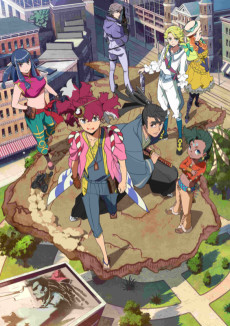
APPARE-RANMAN!
After a certain mishap, the brilliant but socially inept engineer Apare Sorano and the shrewd but cowardly samurai Kosame Isshiki find themselves drifting on a boat from Japan to America. Broke, the two decide to compete in the Trans-America Wild Race to win the prize and return to Japan. The two battle crazy rivals, outlaws, and the great outdoors itself as they race through the wild West from the starting line in Los Angeles to the finish line in New York - in the steam-powered car they built.
(Source: Anime News Network)
The first two episodes pre-aired on select platforms starting from March 21st. Regular broadcast started on April 10.
📺Anime Details
📝Editorial Analysis
The salt-stung wind whips Apare’s goggles askew as his steam-car lurches sideways down a sun-baked canyon wall—wheels spinning, brass pipes hissing, Kosame clinging to the chassis like a terrified barnacle—while a bandit’s revolver cracks somewhere behind them and the horizon bleeds into dust and heat haze. Not polished. Not heroic. Just motion, raw and unsteady, powered by desperation, ingenuity, and sheer, stubborn forward momentum.

That’s the feeling: unvarnished propulsion. Not speed for spectacle, but movement as survival, as translation—of bodies across continents, of identities across cultures, of steam and swordplay into something new. APPARE-RANMAN! doesn’t romanticize the American West; it treats it like a live wire—crackling, unpredictable, indifferent—and drops two Japanese men onto it with nothing but a jury-rigged machine and mismatched honor codes. There’s no melancholy nostalgia here, no brooding over lost eras. Instead, there’s grit, ingenuity, and laughter that bursts out mid-crisis—the kind that comes when your boiler’s about to explode and your samurai companion just tried to parry a bullet with a wooden bokken. It’s historical fiction that refuses to be solemn, steampunk that smells of hot iron and sweat, not velvet and candlelight. You don’t watch it to escape. You watch it to feel the engine vibrate in your ribs.
Which is why the Tomb Raider: Legend, Tomb Raider: Anniversary, and Tomb Raider: Underworld matches hit so precisely—not because they’re about cars or samurai, but because they share that same melancholic exploration dimension. Look at the descriptions: each centers on Lara Croft traveling “to remote, exotic locales,” “globe-trotting,” “exploring exotic locations around the world”—not as a tourist, but as someone pushing through, mapping unknown terrain while carrying private weight. The player reviews echo it: “great platforming and puzzling,” “best Tomb Raider game,” “I would recommend not ju…”—that trailing off? That’s the feeling of being immersed, slightly overwhelmed, deeply engaged in the act of passage. Like Apare recalibrating valves in a desert storm or Kosame negotiating etiquette with a grizzled stagecoach driver, Lara’s traversal isn’t seamless—it’s tactile, sometimes clunky (“a little bit annoying”), always physical. Her world, like theirs, is vast, indifferent, and demands constant adaptation—not mastery, but continuance.
Then there’s Assassin's Creed™: Director's Cut Edition, whose description calls it a game that “redefines the action genre” by merging “impressive graphics and physics” with something deeper: presence in history. The player review admits its models are “dated,” yet shrugs—“no issues with me.” That’s the same spirit: valuing embodied experience over polish. Watching Apare weld a cracked piston with soot-blackened hands feels kin to Altaïr scaling Jerusalem’s sun-bleached walls—both are acts of tactile warfare, where environment isn’t backdrop but opponent and ally. The “tactical warfare” dimension isn’t about cover-shooting or squad commands—it’s about reading wind, terrain, human behavior, and mechanical limits in real time. Apare doesn’t outgun rivals; he out-thinks their engines. Altaïr doesn’t overpower guards; he reads their patrol rhythms. Same DNA: strategy as instinct, forged in motion.
Even EVE Online, with its “massive living universe of danger and opportunity,” resonates—not through narrative, but through scale-as-character. Its description emphasizes “exploration,” “danger,” and “a universe” that feels alive, not scripted. The player review, written after 13 years away, still recalls flying “T2 Navy Megathrons” and tinkering with “planetary industrial p…”—that fragmented, reverent trailing off mirrors how APPARE-RANMAN! makes you remember not plot beats, but sensations: the groan of pistons at dawn, the smell of coal smoke mixing with sagebrush, the way Kosame’s hand hovers near his sword not for violence, but for balance on a tilting chassis.
This pairing sings for the viewer who gets goosebumps watching a character fix something broken with what’s at hand, who loves maps not as destinations but as invitations to misadventure, who finds poetry in the gap between intention and outcome—in the hiss of steam, the scrape of boots on gravel, the quiet click of a revolver’s hammer falling. Not for those who want tidy resolutions or flawless heroes—but for the ones who grin when the car stalls right as the canyon opens up ahead, because they already know: the next gear is coming. And it’ll be loud.
🎮8 Games That Match the Vibe




Match Dimensions Explained
❓Frequently Asked Questions
Why does APPARE-RANMAN! feel so similar to Tomb Raider: Legend despite being a racing anime?
It’s all about that melancholic exploration vibe—both lean hard into solitary, atmospheric journeys through evocative, almost mythic spaces. In Legend, Lara quietly navigates crumbling temples and misty ruins (like the Bolivia mine or Croft Manor’s hidden passages), mirroring how Ranman rides alone across vast, sun-baked Japanese countryside roads—silent stretches punctuated by sudden tactical intensity, like dodging debris mid-race or solving environmental puzzles on the fly.
Is there an anime or live-action adaptation of Tomb Raider: Anniversary?
No official anime or live-action adaptation exists for Anniversary—but it *does* share APPARE-RANMAN!’s DNA in tone and structure: both retrace foundational legends (Scion artifact / Meiji-era cycling revolution) with reverence and grit. Fans who loved Ranman’s nostalgic yet urgent pacing often cite Anniversary’s tight platforming sequences—like the iconic St. Francis’ Folly gauntlet—as having the same ‘quiet focus before explosive action’ rhythm.
How does Assassin’s Creed Director’s Cut compare to APPARE-RANMAN! in terms of pacing and mood?
Both thrive on melancholic exploration punctuated by bursts of tactical warfare—think Altair gliding silently over Jerusalem’s rooftops at dusk (just like Ranman coasting down a fog-draped mountain pass), then snapping into razor-focused combat or chase sequences. The player review even notes its dated textures don’t break immersion—same way APPARE-RANMAN!’s retro-anime aesthetic deepens, not distracts from, its wistful, determined vibe.
What’s the best game like APPARE-RANMAN! if I want that lonely-but-determined road-trip feeling?
Tomb Raider: Underworld is your top pick—it nails that solitary, purpose-driven journey across hauntingly beautiful locales (like the Norse underworld ruins or Thailand’s mangrove tunnels), where every traversal feels earned and introspective. Like Ranman pedaling toward Tokyo under wide, empty skies, Underworld’s Lara moves with quiet resolve, and the player review’s enthusiastic ‘Of course I am!’ recommendation mirrors how deeply fans connect with that lone-protagonist momentum.