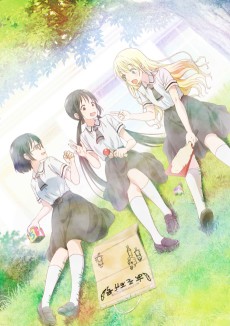
Asobi Asobase - workshop of fun -
Olivia is a blonde-haired beauty who was born and raised in Japan, but can’t speak any English. Despite always acting serious and as an intellectual, Kasumi is a bespectacled girl with short hair, who also can’t speak English. Finally, there’s the pig-tailed Hanako, who’s cheerful but can’t seem to become a normie. The three middle schoolers end up making a “Players’ Club”?! The ultimately cute, ultimately fun and hilarious teenage girls’ comedy is about to begin!
(Source: Crunchyroll)
📺Anime Details
📝Editorial Analysis
The fluorescent hum of the middle school classroom. A single dust mote spirals in a sunbeam. Olivia, deadpan, holds up a laminated card with the word “BANANA” written in thick black marker — then slowly rotates it 180 degrees to reveal “ANANAB”. Kasumi adjusts her glasses, mouth a tight line, and declares in flawless, utterly nonsensical Japanese-English hybrid: “This is not linguistic deviation. This is ontological play.” Hanako giggles, spins in her chair until she’s dizzy, and knocks over three glue sticks, two erasers, and a half-eaten melon soda. No punchline lands cleanly. No lesson is learned. Nothing resolves — and that’s the point.

What Asobi Asobase - workshop of fun - makes you feel isn’t just laughter — it’s disorientation as comfort, the giddy vertigo of logic collapsing just enough to let something tender slip through. It’s not surrealism for shock; it’s surrealism as breathing room — where English phonemes dissolve into nonsense syllables, where club rules are drafted on napkins and immediately contradicted by interpretive dance, where seriousness and silliness aren’t opposites but co-conspirators. You don’t watch it to follow a plot. You sink into its humid, slightly sticky atmosphere — like stepping barefoot onto linoleum still warm from afternoon sun. It asks nothing of you but presence, and rewards you with lightness, with the quiet thrill of watching three girls build meaning out of pure, unmoored improvisation.
That feeling echoes — unmistakably — in Prince of Persia, not in its sand-covered vistas or swordplay, but in its healing & slow life dimension paired with comedy & parody. The description calls it “an all-new epic journey,” yet player reviews highlight its deliberate, almost meditative pacing — a reboot that trades urgency for texture, where movement itself becomes lyrical, even absurd. Like Olivia mispronouncing “library” as “liberry” while solemnly citing Dewey Decimal in a voice that suggests she’s translating ancient Sumerian, the Prince stumbles, recovers, flips, pauses — not to win, but to linger in the gesture. Both invite you into a world where consequence is soft-edged, where failure is a setup for grace, and where grandeur and goofiness share the same breath.
Then there’s The Sims™ 4, whose healing & slow life and comedy & parody dimensions align with Asobi Asobase’s core rhythm — not through narrative, but through unscripted emergence. Its description promises you can “create a world of Sims that’s wholly unique,” and though the player review bitterly notes the DLC paywall and bugs, it accidentally confirms what matters: the joy lives in the glitch, the unintended collision — a Sim autonomously deciding to cry while watering a cactus, or attempting ballet mid-sneeze. That’s Kasumi trying (and failing) to teach Hanako proper tea ceremony while using a juice box as a chawan. It’s Olivia solemnly declaring a “mandatory nap protocol” — then falling asleep upright, mouth open, pencil rolling off her desk. Both thrive in the fertile mess between intention and outcome.
Even Garry's Mod, with its raw comedy & parody and melancholic exploration, resonates — not as a story, but as vibe. Its description says plainly: “There aren't any predefined aims or goals. We give you the tools and leave you to play.” That’s the Players’ Club in a sentence. No mission. No victory condition. Just duct tape, a broken fan, a rubber chicken, and three girls who treat physics like suggestion rather than law. The player review’s wistful contrast with S&Box — calling it “unoptimized and Ai filled” — only sharpens the memory of GMod’s beautiful, janky, human-made chaos: the way a ragdoll might float serenely into the sky, limbs splayed, utterly unbothered by gravity or dignity. Like Hanako, grinning mid-air after launching herself off a stack of textbooks.
These pairings aren’t for people who want clean arcs or polished worlds. They’re for the ones who’ve ever laughed until they snorted while reorganizing their spice rack by color and alphabetical order — for the quiet observers who find deep warmth in a friend’s terrible impression of a vending machine, for the players who spend an hour just watching their Sim stare out a window during rain, for the viewers who rewatch Olivia’s “banana rotation” scene not for the joke, but for the sincerity in her frown. They’re for those who know that fun isn’t always loud — sometimes it’s a shared glance across a cluttered table, a pause before the next absurd thing begins, the gentle, glorious weightlessness of not needing to mean anything at all.
🎮12 Games That Match the Vibe









Match Dimensions Explained
❓Frequently Asked Questions
Why does Prince of Persia show up in 'Games Like Asobi Asobase' lists when it’s so serious?
Great question—it’s not about tone alone! Asobi Asobase thrives on absurdist parody and surreal, emotionally off-kilter moments (like Hanako’s deadpan 'I am not a child' monologues), and Prince of Persia (2024) nails the *Comedy & Parody* + *Melancholic Exploration* combo—think the Prince’s over-the-top self-serious narration undercut by slapstick sand-surfing fails and dreamlike, crumbling palace sequences that feel oddly like the clubroom’s tonal whiplash. It’s the same kind of tonal juggling act, just with Persian rugs instead of school uniforms.
Is there an Asobi Asobase anime adaptation or game?
No official Asobi Asobase game exists—but if you're craving that same chaotic, fourth-wall-breaking energy, Garry's Mod is your closest match. Its physics sandbox lets you recreate the 'P.E. Class Chaos' scene with ragdoll teachers, slapstick grappling hooks, and student NPCs flailing mid-air like Hanako trying to do a cartwheel—exactly why it shares *Comedy & Parody* and *Melancholic Exploration* dimensions. Players even mod in chibi school uniforms and 'sweatdrop' particle effects for maximum Asobi Asobase vibes.
How does The Sims 4 compare to Asobi Asobase for chaotic school club shenanigans?
TS4 won’t give you scripted absurdity like the 'Baking Club Disaster' episode—but its *Healing & Slow Life* + *Comedy & Parody* blend lets you engineer your own: build a cursed home-ec room, assign Sims to 'overthink baking' until they set the oven on fire, then watch their exaggerated panic animations (à la Olivia’s dramatic fainting fits). Just beware—the base game’s barebones without DLC, much like how Asobi Asobase’s humor relies on layered character quirks you can’t skip.
What’s the best 'Asobi Asobase-like' game if I just want pure unhinged, low-stakes fun?
Go straight to Just Cause 2—it’s basically the video game version of Asobi Asobase’s 'Field Trip to the Abandoned Factory' episode: zero consequences, maximum physics-driven chaos (grapple onto a goat, launch it into a parade float), and that same B-movie glee in every explosion. Its *Comedy & Parody* + *Melancholic Exploration* dimensions mirror how Asobi Asobase balances silliness with sudden quiet, weirdly poignant beats—like Rico staring at a sunset after blowing up three tanks, just as Hanako stares blankly at a ceiling fan mid-philosophy rant.