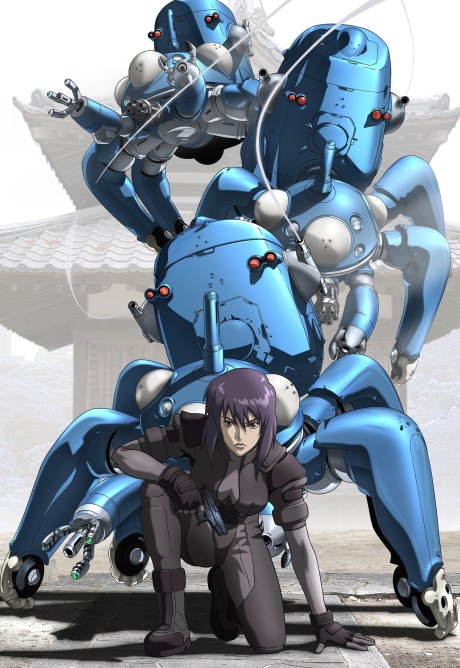
Ghost in the Shell: Stand Alone Complex
In the not so distant future, mankind has advanced to a state where complete body transplants from flesh to machine is possible. This allows for great increases in both physical and cybernetic prowess and blurring the lines between the two worlds. However, criminals can also make full use of such technology, leading to new and sometimes, very dangerous crimes. In response to such innovative new methods, the Japanese Government has established Section 9, an independently operating police unit which deals with such highly sensitive crimes.
Led by Daisuke Aramaki and Motoko Kusanagi, Section 9 deals with such crimes over the entire social spectrum, usually with success. However, when faced with a new A level hacker nicknamed “The Laughing Man”, the team is thrown into a dangerous cat and mouse game, following the hacker’s trail as it leaves its mark on Japan.
(Source: MyAnimeList)
📺Anime Details
📝Editorial Analysis
Rain slicks the neon-drenched streets of New Port City—not falling, but hanging, suspended in the humid static between tower spires, catching the fractured glow of holographic ads that flicker with half-formed faces and corporate slogans. A lone figure stands on a rooftop, coat flapping like a torn membrane, watching a drone swarm dissolve into the smog. Not chasing. Not fighting. Just observing. That silence—thick with the hum of servers, the low thrum of city-wide surveillance, the quiet weight of a question no one dares vocalize aloud—is where Ghost in the Shell: Stand Alone Complex lives. Not in the gunfights or the chases, but in the breath before the trigger is pulled, in the pause after a suspect’s neural trace dissolves into white noise.

What makes this anime ache with such stillness isn’t its cybernetics—it’s the exhaustion of cognition. It’s the feeling of being constantly overlaid: by data streams, by bureaucratic protocols, by the ghosts of past selves haunting upgraded bodies. You don’t feel heroic here. You feel indexed. Every episode opens with a cold, precise title card; every investigation loops back to systemic friction, not villainy. There’s no catharsis in catching the criminal—you catch the pattern, the stand alone complex, the emergent behavior born from too many connected minds operating without central intent. It leaves you unsettled not by horror, but by recognition: the dread of your own thoughts being statistically predictable, your dissent already logged, your identity just another node in a network that doesn’t need your consent to function. It’s lonely, yes—but more precisely, it’s unmoored. Like standing on glass over a server farm, seeing your reflection multiply across a thousand monitors, none of them blinking back.
That same unmoored melancholy pulses through Nikopol: Secrets of the Immortals. Its description places you in 2023 Paris under a “religious dictatorship,” beneath a hovering pyramid ship—immediately evoking Stand Alone Complex’s obsession with authoritarian infrastructure disguised as order. The player review calls it “melancholic exploration,” and that’s the key: not action, not escape, but slow, first-person navigation through a world where ideology has hardened into architecture, where even wonder (the pyramid) feels ominous, surveillant. Like Section 9 scanning thermal feeds across rooftops, Nikopol forces you to absorb atmosphere before meaning—every corridor, every stained-glass monitor, every whispered broadcast thick with the same quiet dread of systems that outlive their architects.
Then there’s Disco Elysium - The Final Cut, whose description names it a “political thriller” and “mystery & detective” game—and whose player review drops the line: “Capital has the ability to subsume all critiques into itself.” That’s pure Stand Alone Complex DNA. Not just thematically—the show dissects how institutions absorb dissent, how protest becomes spectacle, how even counter-surveillance tools get repurposed by the state—but structurally. Like Major Kusanagi parsing fragmented net traffic or Batou cross-referencing civilian biometrics against military logs, Disco Elysium’s skill checks force you to triangulate truth across contradictory internal voices, external lies, and institutional archives—all while your own mind frays under the weight of its own contradictions. The melancholy isn’t decorative. It’s procedural.
Even Mirror's Edge™, described as set in a city where “information is heavily monitored” and you’re hunted for carrying “sensitive data,” shares that visceral tension: movement as resistance, architecture as control, color as both camouflage and confession. The player review notes it’s “a dream to play on PC”—but what lingers isn’t the speed, it’s the emptiness of those white-walled plazas, the way every jump feels like defiance against a system designed to erase individual motion. Like Motoko’s silent ascents up service ladders, it’s not about winning—it’s about remaining unquantified, however briefly.
This isn’t for fans of clean resolutions or power fantasies. It’s for the person who pauses mid-scroll to stare at their phone’s ambient light reflecting in a window—and wonders which version of themselves is being mirrored back. For the reader who highlights passages in Haraway’s Cyborg Manifesto not as theory, but as field notes. For the player who replays a dialogue tree not to optimize outcomes, but to hear how differently the same sentence lands when spoken by a different internal voice. They don’t want answers. They want the weight of the question—held, examined, carried silently across rain-slicked rooftops, down sterile corridors, through cities built on forgotten compromises. They love the silence between transmissions.
🎮15 Games That Match the Vibe









Match Dimensions Explained
❓Frequently Asked Questions
Why does Nikopol: Secrets of the Immortals feel so much like Ghost in the Shell’s Paris arc?
Because both drop you into a visually oppressive, rain-slicked dystopia ruled by authoritarian ideology—Nikopol’s 2023 France under a religious dictatorship mirrors GitS’s bureaucratic surveillance state, especially in how the pyramid ship hovers over Paris like Section 9’s orbital assets loom over Tokyo. The melancholic exploration, slow-burn political mystery, and those gorgeous, hand-painted cutscenes (like Nikopol waking up in the derelict metro) nail GitS’s tone better than most action-heavy adaptations.
Is there a Ghost in the Shell game adaptation that actually captures the Stand Alone Complex vibe?
No official Ghost in the Shell game adapts *Stand Alone Complex* directly—but Culpa Innata comes closest in theme and structure: its World Union is a 'perfect society' built on systemic control and data opacity, just like the S.A.C. world, and its detective-driven narrative (uncovering societal lies through fragmented clues) echoes Major Kusanagi’s investigations in episodes like 'Jungle Cruise'. That said, players found its pacing grueling—lots of running between sterile locations, no combat or hacking minigames to break it up.
How does Disco Elysium compare to Mirror's Edge for Ghost in the Shell fans?
Mirror’s Edge gives you the *physical* GitS vibe—fluid parkour across gleaming, surveilled rooftops, hunted while carrying sensitive data, with that same stark red-on-white aesthetic echoing Motoko’s thermoptic camo flicker. Disco Elysium delivers the *philosophical* weight: your detective’s internal monologues dissect ideology like Batou and the Major debate consciousness, and cases like the murdered union organizer hit with the same political gravity as the Laughing Man arc—just without the cybernetics or action.
What’s the best game like Ghost in the Shell if I want that quiet, rainy, 'thinking while walking' mood?
Nikopol: Secrets of the Immortals is your pick—it’s all slow, atmospheric wandering through abandoned metro tunnels and fog-choked streets of Paris, with haunting ambient music and long silences punctuated by cryptic radio broadcasts, just like Motoko’s solo patrols in 'Solid State Society'. Even the player review calls out its 'cyberpunk atmosphere' and 'enhanced animations and cutscenes' that deepen that lonely, contemplative dread.