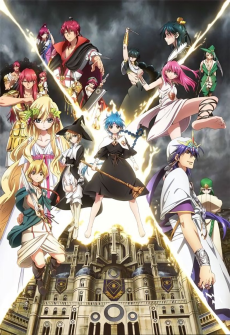
Magi: The Kingdom of Magic
After celebrating their victory against Al-Thamen, Aladdin and his friends depart the land of Sindria. With the end of the battle, however, comes the time for each of them to go their separate ways. Hakuryuu and Kougyoku are ordered to go back to their home country, the Kou Empire. Meanwhile Aladdin announces he needs to head for Magnostadt—a mysterious country ruled by magicians—to investigate the mysterious events occurring in this new kingdom and become more proficient in magic. For their part, encouraged by Aladdin's words, Alibaba and Morgiana also set off in pursuit of their own goals: training and going to her homeland, respectively.
Magi: The Kingdom of Magic follows these friends as they all go about their separate adventures, each facing their own challenges. However, a new threat begins to rise as a great war looms over the horizon...
[Written by MAL Rewrite]
📺Anime Details
📝Editorial Analysis
The desert wind doesn’t whistle in Magi: The Kingdom of Magic—it grinds. It’s the sound of sand scouring ancient stone as Aladdin stands alone at Sindria’s edge, his cloak snapping like a torn flag, watching Hakuryuu and Kougyoku vanish into the heat haze toward the Kou Empire. No fanfare. No grand speech. Just dust, distance, and the quiet, heavy weight of what comes after victory—when the battle ends but the world doesn’t reset, when alliances fracture not with betrayal but with duty, and every departure feels like a slow unraveling of something you thought was permanent.

That’s the core feeling: displacement. Not just physical—though yes, the Magi: The Kingdom of Magic world is built on shifting dunes, crumbling palaces, and borders drawn in blood and bureaucracy—but emotional, ideological, existential. This isn’t a shounen about rising power levels; it’s about characters stepping into systems they didn’t build, confronting conspiracies that predate their births, and realizing their ideals are already embedded in the architecture of oppression. The desert isn’t backdrop—it’s pressure. The criminal organization isn’t just villains—it’s infrastructure. The dystopian tilt isn’t aesthetic—it’s procedural. You don’t fight the system here—you navigate it, bargain with it, get co-opted by it, and sometimes, quietly, become it. That lingering unease—that sense of being watched by unseen magicians, governed by unspoken rules, haunted by histories erased from official records—is what makes Magi: The Kingdom of Magic vibrate with such uneasy, intelligent gravity.
Which is why BioShock™ lands like a gut punch. Its description calls it a “Political Thriller, Cyberpunk & Dystopia”—but read between the lines: “a shooter unlike any you’ve ever played… loaded with weapons and tactics never seen.” That mirrors Magi’s magic system—not flashy spells, but leverage: Aladdin’s rukh manipulation, Judar’s binding contracts, Magnostadt’s engineered hierarchies—all tools shaped by ideology, all tactics that expose how power thinks. A player review says it “genuinely changed the gaming world when it was released in 2007.” So did Magi’s second season—not with spectacle, but with its refusal to let victory feel clean. Both force you to walk through the gilded rot of a promised utopia, where every corridor hums with propaganda, and every ally might be a functionary of the very conspiracy you’re trying to dismantle.
Then there’s Uplink, described as letting you “play as a freelance hacker tackling risky contracts for corporations. Break into systems, steal data, sabotage rivals, and upgrade your gear.” That’s Hakuryuu’s arc in miniature—exiled, resource-poor, forced to operate in the shadows of the Kou Empire’s intelligence apparatus, trading loyalty for access, secrets for survival. Its player review declares, “It was hot, the night we burned Chrome.” That heat? That’s the same feverish tension as Aladdin infiltrating Magnostadt—not with a sword, but with questions, with silence, with the unbearable weight of knowing too much too soon. Both prize information asymmetry over brute force. Both make you feel like a ghost in the machine—capable, clever, and utterly exposed.
And Deus Ex: Game of the Year Edition, with its description of “an ages old conspiracy bent on world dom[ination]” amid economic collapse and grotesque inequality? That’s the Kou Empire’s spine—the way Kougyoku negotiates famine relief while her ministers divert grain, how royal decrees mask systemic extraction, how “justice” is calibrated to preserve hierarchy. A player review notes it “gives you all options with one hit of the esc key.” That’s Magi’s moral texture: no binary choices, only trade-offs—save one city and doom another, trust a magician and invite surveillance, reject the system and become irrelevant. Every decision echoes, every compromise calcifies.
Who lives for this? The viewer who watches Aladdin kneel before a council of magicians—not to beg, but to calculate—and feels their pulse quicken, not from adrenaline, but from recognition. The player who boots up BioShock™, hears Andrew Ryan’s voice crackle over intercom, and doesn’t flinch at the philosophy—they lean in, because they know ideology is the real boss fight. The person who spends hours in Uplink, not chasing points, but tracing data trails back to boardrooms where human lives are line items. They’re not chasing escapism. They’re hunting resonance: that rare, electric alignment where fiction doesn’t distract from reality—it sharpens it. Where magic feels like policy, and hacking feels like prayer. Where the desert wind doesn’t whisper—it testifies.
🎮15 Games That Match the Vibe










Match Dimensions Explained
❓Frequently Asked Questions
Why is BioShock listed as similar to Magi: The Kingdom of Magic when it’s not fantasy?
Great question—it’s the *political thriller* and *dystopian world-building* that align, not the genre. Like Magi’s intricate power hierarchies and conspiracies (think Reim’s royal court or Magnostadt’s hidden agendas), BioShock drops you into Rapture—a crumbling utopia ruled by ideology, betrayal, and moral decay. The way Atlas manipulates Jack mirrors how characters like Aladdin or Judar navigate layered loyalties, and the game’s audio logs function like Magi’s exposition-heavy council scenes—revealing truth in fragments.
Is there an anime or manga adaptation of Uplink like there is for Magi?
Nope—Uplink has *never* been adapted into anime, manga, or live-action. It’s stayed proudly niche and analog since its 2001 release: no voice acting, no cutscenes, just terminal windows, ASCII art, and that iconic ‘ping’ sound as you breach a firewall. Unlike Magi’s sprawling anime arcs, Uplink’s storytelling happens through contract briefings and hacked emails—like reading intercepted dispatches from Magnostadt’s intelligence division, but with more coffee-stained keyboard energy.
How does Deus Ex: Game of the Year Edition compare to Deus Ex: Invisible War for Magi fans who love deep lore and faction politics?
If you loved Magi’s faction diplomacy—like Alibaba balancing between the Household Heads and the Dungeon Capturers—you’ll vibe harder with the original Deus Ex (2000). Its world feels lived-in and morally tangled, like walking through Balbadd’s slums while overhearing Illuminati whispers over shortwave radio. Invisible War (2003) simplifies choices and streamlines lore—reviewers even note it ‘doesn’t compare to its predecessor,’ much like how some fans feel about post-arc Magi pacing versus the tight political chess of early Magnostadt episodes.
What’s the best game like Magi for when I want that tense, high-stakes ‘courtroom showdown’ vibe—like the Reim trial or Magnostadt hearings?
Go straight to Ricochet—it sounds unexpected, but hear me out: its ‘futuristic action’ isn’t just shooting—it’s *dramatic, arena-based confrontation* where every match feels like a televised duel of honor. Think of it as the Magi equivalent of the Royal Selection battles: one-on-one stakes, shifting alliances mid-match, and that soap-opera-meets-horror-movie tension reviewers describe. You’re not just aiming—you’re performing under pressure, just like Aladdin defending his friends before the Reim Council.