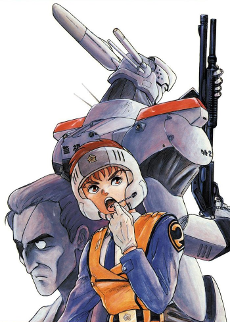
Mobile Police Patlabor
📺Anime Details
📝Editorial Analysis
Rain slicks the Tokyo streets at 3 a.m., neon bleeding into oily puddles. A Labors’ hydraulic whine cuts through the damp hush—not the roar of war machines, but the tired, rhythmic hiss-clank-hiss of maintenance crews calibrating shoulder joints under flickering sodium lamps. No sirens. No explosions. Just two officers leaning against a parked Type-4, sharing lukewarm coffee from paper cups, watching steam curl into the cold air while a distant news broadcast murmurs about a minor labor malfunction in Chiba—routine, unglamorous, deeply human.
That’s Mobile Police Patlabor: not the spectacle of titanic clashes, but the quiet weight of responsibility settling onto shoulders already stiff from paperwork and overtime. Its atmosphere isn’t built on awe or adrenaline—it’s grounded, tactile, wearily competent. You feel the grit under fingernails after cleaning a sensor array, smell the ozone tang of overloaded circuits, hear the muffled frustration in a dispatcher’s voice when yet another civilian misreports a Labors’ shadow as “a monster.” It makes you think about infrastructure—not as backdrop, but as fragile, maintained, lived-in reality. About how institutions hold together not through heroics, but through overlapping shifts, shared inside jokes, and the quiet dignity of showing up—even when the threat is bureaucratic inertia or a corrupted firmware patch. There’s no grand destiny here, only work, and the slow, collective breathing required to keep the city running.
Horizon Zero Dawn™ Complete Edition and Horizon Forbidden West™ Complete Edition resonate because they share that same melancholic exploration—not of ruins as spectacle, but as archaeology of failure and resilience. Like Patlabor’s Tokyo, Aloy moves through landscapes where colossal, rusting machines aren’t just enemies, but infrastructure: dormant power grids, repurposed defense systems, weather regulators gone silent. The player doesn’t conquer these spaces—they interpret them, piecing together logs and echoes much like Section 2 deciphers fragmented data trails after a Labor hijacking. Both anime and games treat technology not as magic, but as inherited, misunderstood, maintained—and both make you feel the weight of that inheritance, the quiet sorrow in a derelict factory humming with half-remembered purpose. That shared dimension—Mecha & Military Sci-Fi—isn’t about armor thickness or weapon specs; it’s about scale that dwarfs individuals, yet remains stubbornly operational, demanding patience, repair, and context.
Assassin's Creed™: Director's Cut Edition lands differently—not in its visuals (as one player notes, “some of the models and textures are quite dated”), but in its political thriller spine and tactical warfare rhythm. Patlabor’s conspiracies aren’t shadowy cabals whispering in vaults—they’re interdepartmental jurisdictional fights, leaked memos buried in municipal archives, and the slow, exhausting work of verifying a single line of code across three agencies. So too does Assassin’s Creed unfold in layers of institutional friction: Altaïr navigating Templar influence embedded in Jerusalem’s tax rolls, supply chains, and civic appointments. The tactical warfare isn’t just combat—it’s choosing which guard to distract, which rooftop route avoids patrol patterns, which informant might lie just enough to send you down the wrong alley. Both demand the same kind of attention: reading rooms, not just clearing them; listening for subtext in a bureaucrat’s hesitation, not just spotting an enemy silhouette.
Exoprimal, with its Tactical Warfare and Mecha & Military Sci-Fi dimensions, mirrors Patlabor’s ensemble discipline—the way Section 2 coordinates not through shouted orders, but through practiced shorthand, role-specific intuition, and split-second trust. And Atomic Heart, despite its surrealism, shares that melancholic exploration: wandering Soviet-era labs where biomechanical workers stand frozen mid-task, their purpose long erased, their systems still ticking faintly—a feeling identical to Patlabor’s most haunting episodes, where a decommissioned Labor sits in a scrapyard, its cockpit glass fogged, its servos whispering static like a half-remembered dream.
This pairing sings to the person who finds poetry in a shift-change log, who gets chills not from a final boss theme, but from the sound of a radio crackling “All units, standby—repeat, standby” at dawn. To the viewer who watches Shinohara double-check his belt buckle before briefing, and the player who pauses mid-climb to watch wind stir dust over a collapsed reactor core—not waiting for action, but feeling the gravity of what holds things together, and how easily it frays. They love the quiet, the competence, the unseen labor—and they recognize it, instantly, whether it’s in the hum of a Tokyo traffic control center or the low thrum of a forgotten AI core buried beneath snow.
🎮21 Games That Match the Vibe








Match Dimensions Explained
❓Frequently Asked Questions
Why does Horizon Zero Dawn feel so much like Patlabor despite having no police or labor mechs?
Because both lean hard into melancholic exploration of decaying tech and bureaucratic military systems—like Aloy navigating ruins of the Old Ones mirrors Noa’s quiet patrols through Tokyo’s rain-slicked streets, and the way Horizon’s Tallnecks scan terrain feels like Patlabor’s surveillance drones mapping urban infrastructure. The dim ‘Mecha & Military Sci-Fi’ + ‘Melancholic Exploration’ overlap is why it scores 85 and resonates so deeply with Patlabor fans.
Is there a Patlabor mobile game or official video game adaptation?
No—there’s never been an official Patlabor game, mobile or otherwise. That’s why fans turn to matches like Exoprimal (78), where you squad up in armored exosuits fighting biomechanical hordes in tactical, mission-based combat—very close to the SV2’s coordinated unit tactics—but without any Patlabor branding or characters.
How does Assassin’s Creed compare to Horizon Zero Dawn for Patlabor vibes?
Assassin’s Creed (80) nails the political thriller + melancholic exploration combo—think of Altaïr’s isolated rooftop walks over war-torn Jerusalem mirroring Shinohara’s weary stakeouts in rainy Shinjuku—but lacks mecha. Horizon Zero Dawn (85) swaps that for full-on mecha combat and environmental storytelling, like Aloy repairing ancient machines just as Patlabor crews maintain their Labors. Both hit ‘Melancholic Exploration’, but only Horizon delivers the mecha-military sci-fi layer.
What’s the best Patlabor-like game if I want tactical teamwork and high-stakes mech action?
Exoprimal (78) is your pick—it’s built around 5v5 team-based combat where you drop into arenas as specialized exo-suited soldiers, calling in drone strikes and coordinating class roles (like Assault, Support, or Recon) just like Patlabor’s SV2 unit does during emergency response ops. No story-driven bureaucracy, but the real-time comms, objective-focused missions, and heavy armor physics make it the closest tactical warfare match on the list.