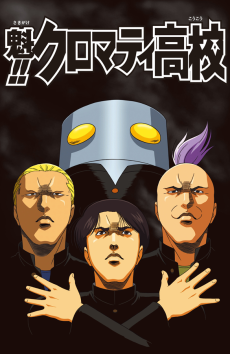
Cromartie High School
📺Anime Details
📝Editorial Analysis
The cafeteria at Cromartie High School smells like burnt toast and existential confusion—because someone just tried to grill a live octopus on the industrial stove while reciting Nietzsche in broken English, and no one blinks. Not the teacher slumped over his lunchbox, not the delinquent whose hair defies gravity and physics, not even the robot student who’s been quietly replacing cafeteria trays with miniature replicas of Tokyo Tower since Tuesday. This isn’t chaos for chaos’ sake—it’s calm absurdity, a world where the surreal isn’t disruptive; it’s the wallpaper. You don’t laugh at the madness—you exhale into it, shoulders dropping, breath syncing with the rhythm of utter, unshakable nonsense.
What makes Cromartie High School vibrate at this particular frequency isn’t just parody or episodic structure—it’s the weightlessness of consequence. There are no stakes, no arcs, no hidden trauma waiting to surface. Even the “delinquents” aren’t threatening—they’re soft-hearted, weirdly polite, emotionally transparent in ways that disarm rather than intimidate. It’s a space built on mutual recognition: everyone knows the rules are fake, the hierarchy is cardboard, the “danger” is a prop left on stage after curtain call. That creates a rare kind of relief—not joy, not satire, but respite. You feel safe inside the joke, because the joke has no teeth. It doesn’t mock youth culture; it wraps it in cotton batting and lets it float. You think about how exhausting it is to live in a world that insists on meaning—and then you watch Takashi stare blankly at a vending machine for three minutes while it debates whether to dispense soda or enlightenment, and your nervous system sighs.
That same emotional DNA hums in Like a Dragon: Pirate Yakuza in Hawaii, where JRPG narrative scaffolding holds up something deeply melancholic beneath its neon-lit absurdity. The game’s 73-score match isn’t about tone—it’s about contrast as comfort. Like Cromartie, it lets you wander through garish, impossible scenarios (pirate yakuza! tiki bars run by ex-bosses!) while quietly acknowledging loss, displacement, the quiet ache of reinvention. The melancholic exploration isn’t buried—it’s baked into the texture, just like Cromartie’s empty hallways echoing between gags. You don’t need to solve the sadness—you’re allowed to walk beside it, holding a flamingo floatie.
Then there’s Prince of Persia, described as “an all-new epic journey” with “a new prince, new lands and a brand new story completely separate from the sands…”—and yet, per player review, it’s the third reboot, a franchise constantly erasing itself to begin again. That mirrors Cromartie’s structural amnesia: every episode resets the logic, discards continuity, treats memory as optional. Both works thrive in renewal without resolution. There’s no grand answer, no final boss to defeat—just the pleasure of stepping onto fresh sand, knowing the tide will wash it away again tomorrow. The melancholic exploration here isn’t sorrow—it’s the gentle weight of impermanence, worn lightly.
And Song of Nunu: A League of Legends Story, also scoring 64 on Comedy & Parody and Melancholic Exploration, shares Cromartie’s tender absurdism. It’s a story about a child and a yeti walking across a frozen landscape, where jokes land softly—like snow—and silence carries as much narrative as dialogue. No one explains why the yeti sings off-key or why bridges grow out of tears. Like Cromartie’s robot student polishing doorknobs into tiny sculptures, it trusts you to feel the warmth in the weirdness, not decode it. The melancholic exploration isn’t despair—it’s the hush before laughter, the shared glance between friends who know the world is ridiculous, and that’s exactly why it’s bearable.
This pairing isn’t for fans of “wacky comedies” or “JRPGs with heart.” It’s for the person who watches Cromartie High School and feels seen—not because they relate to the delinquents, but because they recognize that exhausted, tender, slightly bewildered part of themselves that still believes in the dignity of a perfectly grilled octopus. It’s for the player who opens Like a Dragon: Pirate Yakuza in Hawaii and doesn’t skip the side quests about lonely bartenders or retired wrestlers running ukulele lessons—because those moments hold the same quiet, unspoken kindness as Takashi offering his lunch to a stray raccoon wearing sunglasses. It’s for anyone who’s ever needed respite, not escape—who wants to laugh until their ribs ache, then sit in the quiet afterward, feeling light, safe, and strangely understood.
🎮13 Games That Match the Vibe








Match Dimensions Explained
❓Frequently Asked Questions
Why is Like a Dragon: Pirate Yakuza in Hawaii listed as similar to Cromartie High School?
Because both lean hard into absurdist, over-the-top comedy with lovable delinquents—think Kiryu doing karaoke battles or getting roped into a fake pirate heist, just like Takashi's ridiculous gang standoffs and spontaneous sumo matches at Cromartie. The game’s JRPG Narrative + Comedy & Parody dimensions (73 score) mirror Cromartie’s tone far more than its melancholic exploration layer.
Is there a Cromartie High School video game adaptation?
No—there’s never been an official Cromartie High School game. But Burning Horns: A Bara Isekai JRPG (64 score) hits that same chaotic, self-aware energy: think muscle-bound isekai heroes arguing about lunch while accidentally summoning demons, much like the absurd non-sequiturs and visual gags from Cromartie’s hallway brawls and Genda’s deadpan stares.
How does Song of Nunu compare to Like a Dragon: Pirate Yakuza in Hawaii for Cromartie-style humor?
Song of Nunu leans into wholesome, character-driven parody—Nunu and Willump’s buddy-comedy banter and exaggerated expressions feel like a gentler, cozier cousin to Cromartie’s rowdy antics—while Pirate Yakuza goes full satirical chaos: Kiryu in a parrot hat, drunken yakuza karaoke, and fake pirate lore that rivals Cromartie’s ‘Takashi is secretly a genius’ running gag. Both score 64 and 73 on Comedy & Parody, but Nunu’s vibe is more ‘heartfelt absurdity,’ Pirate Yakuza is ‘delinquent fever dream.’
What’s the best game like Cromartie High School if I want that same ‘stupid-but-we-love-them’ delinquent energy?
Like a Dragon: Pirate Yakuza in Hawaii is your top pick—it’s got Kiryu’s gruff-but-goofy leadership, side characters like the flamboyant, sword-swinging ‘Captain’ who mirrors Iwaki’s unpredictable bravado, and set pieces like a beachside ‘yakuza talent show’ that channel Cromartie’s signature blend of dumb fights, sudden sincerity, and zero self-awareness. Burning Horns (64 score) also nails it with its over-muscled, emotionally transparent isekai heroes who shout declarations of loyalty mid-battle—very Genda energy.