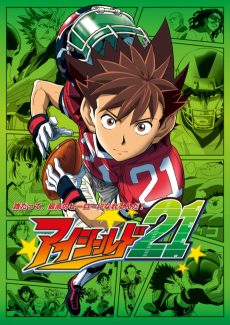
Eyeshield 21
Welcome To the Gridiron of the Damned! Huge hulking bodies throw themselves at each other, while a tiny lithe body runs between them for the goal! No, it's not a game of football, it's Sena Kobayakawa trying to evade the monstrous Ha-Ha brothers down the halls of Deimon High School! But wait! Sena's incredible skills at not getting caught have been spotted by the devilish (possibly actually demonic) captain of the school's embryonic American style football team, and when Sena asks to be the teams manager, he gets thrust onto the field as a running back instead! But there are two BIG catches: first, to keep the identity of their new "star" player an absolute secret, Yoichi makes Sena wear an opaque visor on his helmet and gives him the alias of "Eyeshield 21." And the second catch? Well, in order to hit his fastest "speed of light" running mode, Sena usually has to be absolutely terrified. Not that THAT will be a problem with the monstrous players that he'll soon find himself running from! The insanity hits the streets when the feet meet the cleats in EYESHIELD 21!
(Source: Sentai Filmworks)
📺Anime Details
📝Editorial Analysis
The hallway at Deimon High narrows into a tunnel of dread—Sena Kobayakawa’s sneakers squeak once, then silence as he tucks his chin, pivots mid-stride, and slides under the outstretched arm of a Ha-Ha brother like water slipping through fingers. His breath hitches—not from exhaustion, but from the sheer, absurd relief of evasion. That split-second grace isn’t just speed. It’s survival turned ballet. It’s humiliation weaponized into art.
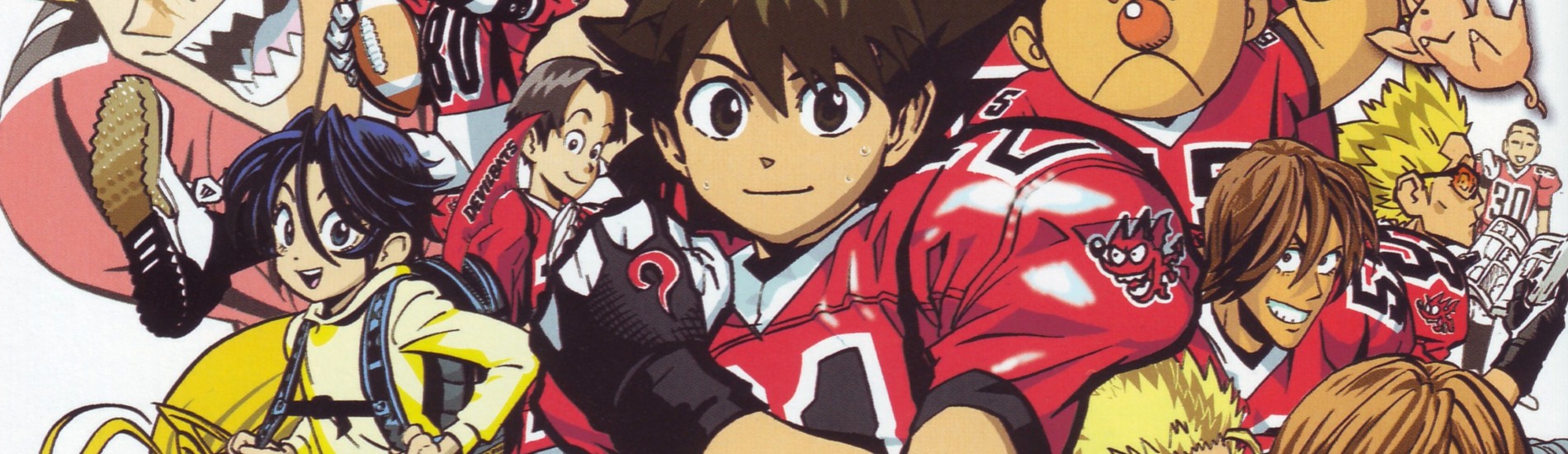
That’s the heartbeat of Eyeshield 21: a world where physics bend not to realism, but to emotional logic. Every tackle shudders with cartoonish weight; every fumble bounces with slapstick timing; every play unfolds like a chaotic, high-stakes game of tag where dignity is optional and momentum is sacred. It doesn’t ask you to believe in American football—it asks you to believe in Sena’s pulse, in Hiruma’s grin that feels less human and more like a crack in reality, in the way a single sprint down the field can make your chest tighten with shared adrenaline. This isn’t sports-as-metaphor. It’s sports-as-communal nervous system: frantic, sweaty, ridiculous, and deeply kind beneath the chaos.
Which is why Team Fortress Classic lands with such uncanny resonance. Its nine wildly asymmetrical classes—Medic scrambling behind cover, Spy vanishing mid-laugh, Demolition Man lobbing explosives like confetti—aren’t balanced for realism. They’re tuned for comedic escalation, for moments where a well-timed backstab or a perfectly timed sentry trap detonation creates the same giddy whiplash as Sena weaving through three linemen who should have caught him. The player review nails it: “simply the best nostalgic game, i have dreams about this game.” That’s the feeling—less memory, more muscle memory of joy. Like watching Sena’s first real handoff, you don’t analyze the mechanics—you feel the rush of being in on the joke, part of a shared, slightly unhinged rhythm.
Then there’s FlatOut 2, where physics aren’t simulated—they’re celebrated. A car flips, a barrel rockets sideways, a fence disintegrates into splinters—and none of it feels punitive. It feels liberating, like Sena’s evasion isn’t about avoiding consequences, but about rewriting the rules of contact. The description says it outright: “throw yourself around on and off the track causing fences to shatter, tyre walls explode, water tanks and barrels fly across the track into other cars.” That’s the Ha-Ha brothers crashing into lockers after misjudging Sena’s angle. That’s Hiruma launching a trash can lid like a discus to clear a path. And the player review? “the physics are excellent, the gameplay is unique, the graphics are awesome…”—not because it’s polished, but because it honors the mess. Just like Eyeshield 21, it treats chaos not as failure, but as texture.
Even Penguins Arena: Sedna's World, with its “First Penguin Shooter” absurdity and reincarnation-as-respawn mechanic, taps the same nerve. Death isn’t an end—it’s a setup for the next gag, the next scramble, the next chance to re-enter the fray with fresh absurdity. The description mentions “the magic of reincarnation, combined with the supernatural ability to return to the game as a ghost”—which mirrors how Eyeshield 21 treats setbacks: not as defeats, but as plot coupons for comebacks so over-the-top they loop back into sincerity. That player review—“Still fun after all these years. Feels like tribes.”—hits the core: it’s tribal not in lore, but in energy. Same laughter, same shouted encouragement, same sense that winning matters less than how gloriously you lose before you win.
This pairing isn’t for the tactician who maps routes or studies frame data. It’s for the person who grins when someone trips, who cheers louder when the underdog stumbles then surges, who finds poetry in a perfectly mistimed slide tackle or a penguin ghost ricocheting off a frozen lake. It’s for anyone who’s ever sprinted down a school corridor—not to escape, but to feel the air rush past their ears like applause.
🎮22 Games That Match the Vibe


Match Dimensions Explained
❓Frequently Asked Questions
Why does the Eyeshield 21 anime's Christmas Bowl feel so chaotic and over-the-top compared to real football games?
That's because Eyeshield 21 leans hard into 'Competitive Spirit' and 'Comedy & Parody' — just like FlatOut 2, where physics go wild, cars flip mid-air, and barrels explode on impact. You get that same joyful chaos when Hiruma launches a smoke bomb during a fake punt, or when Monta catches a pass while flipping off a moving truck — it’s less Madden, more 'throw logic out the window and embrace the spectacle', exactly how FlatOut 2 makes you laugh while wrecking everything in sight.
Is there an Eyeshield 21 video game adaptation I can actually play?
No official Eyeshield 21 game exists — but fans who crave that same blend of absurd teamwork, character-driven rivalry, and cartoonish energy often land on Team Fortress Classic. Its nine distinct classes (like the fast-but-fragile Scout or the tactical Spy) mirror how Eyeshield 21’s Deimon Devil Bats rely on wildly different personalities — Hiruma’s scheming, Sena’s speed, Kurita’s brute force — all syncing up under pressure, just like coordinating a rocket-jump ambush or medic-respawn chain in TFC.
FlatOut 2 vs Penguins Arena: Sedna's World — which one captures Eyeshield 21’s energy better?
FlatOut 2 nails the breakneck, physics-fueled mayhem — think Musashi’s insane truck-jump tackle or the entire Deathmatch derby mode mirroring Eyeshield’s high-stakes, rule-bending showdowns. Penguins Arena trades vehicles for penguin ghosts and reincarnation gimmicks, channeling Eyeshield’s playful tone and team-based chaos (like when Kurita body-checks three guys at once), but FlatOut 2’s sheer destructive momentum feels closer to the adrenaline rush of a live Deimon vs. Shinryuji game.
What’s the best game like Eyeshield 21 if I want something fast, silly, and perfect for playing with friends after a long day?
Go straight to Penguins Arena: Sedna's World — it’s got quick, frantic rounds, ghost-penguin respawns, and that same irreverent, team-based joy as Eyeshield 21’s locker-room banter and last-second comebacks. One player even said it ‘feels like Tribes’, which tracks: it’s got the same low-barrier fun as watching Hiruma trick the opposing team with a fake handoff — no deep lore needed, just jump in, respawn, and laugh your way through another round of penguin mayhem.