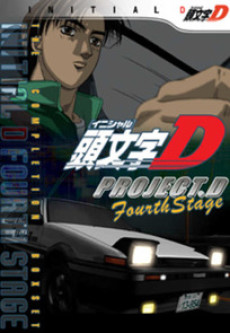
Initial D 4th Stage
Takumi Fujiwara and brothers Keisuke and Ryousuke Takahashi have formed "Project D," a racing team aimed at bringing their driving skills to their full potential outside their prefecture. Using the internet, Project D issues challenges to other racing teams and posts results of their races. Managed by Ryousuke, the team has Takumi engaging in downhill battles with his AE86, while Keisuke challenges opponents uphill. Among their rivals are the Seven-Star Leaf (SSR) and Todo-juku.
📺Anime Details
📝Editorial Analysis
The headlights cut twin tunnels through the mountain mist—cold, precise, unwavering—as Takumi’s AE86 leans into the final hairpin of Akina’s downhill, tires whispering against wet asphalt like breath held too long. No engine roar dominates; just the hiss of rubber, the thunk of suspension compressing, the low thrum of a 4A-GE breathing through its limits—and Ryousuke’s voice over the radio, calm as stone: “Don’t chase the car ahead. Chase the line.” That moment isn’t about speed. It’s about presence: the weight of decision in a split second, the silence between gears, the way exhaustion and focus fuse into something almost sacred.

Initial D 4th Stage doesn’t trade in spectacle for its own sake. Its atmosphere is tactile, grounded, ritualistic. You feel the chill off the mountain air, smell the damp concrete and hot brakes, sense the quiet tension in the garage before a challenge goes live—not because it tells you to, but because every frame lingers on hands adjusting mirrors, eyes scanning curves, fingers tapping the wheel in time with a thought no one speaks aloud. This isn’t racing as adrenaline dump. It’s racing as discipline made visible, as male friendship forged not in grand speeches but in shared silence after a near-miss, in Keisuke’s knuckles white on the steering wheel uphill while Ryousuke watches from the passenger seat—not as boss, but as witness. The CGI isn’t flashy; it’s functional, almost austere—like a mechanic’s diagram brought to life. And the rural setting isn’t backdrop—it’s character: winding, indifferent, demanding respect. You don’t conquer the mountain. You negotiate with it. Every race feels like a conversation—between driver and machine, brother and brother, youth and consequence.
That same weight, that same quiet intensity, lives in Prince of Persia. Not the acrobatics alone—but the healing rhythm of sand flowing backward, the deliberate pace of traversal across crumbling arches, the way time itself becomes a partner, not an enemy. The description calls it “an all-new epic journey” built by Ubisoft Montreal—a studio known for precision, for environmental storytelling where every ledge matters. A player notes it’s “the 3rd reboot… completely separate from the sands,” echoing how Initial D 4th Stage strips away earlier arcs’ melodrama to focus on process: no flashbacks, no filler—just Project D logging miles, analyzing data, refining lines. Both treat movement as philosophy. Both ask you to breathe between actions—to feel the cost of a misstep, the relief of recovery.
Then there’s AudioSurf, where “ride your music” isn’t a tagline—it’s architecture. Your song is the track: tempo dictates speed, bass drops shape walls, melody curves the path. Like Takumi reading the road’s rhythm—the rise and fall of elevation, the subtle camber shifts—he reads sound as terrain. The player review admits it’s “superior to the second game” despite “godawful UI” and crashes—because the core loop transcends polish. That’s the same devotion Initial D 4th Stage honors: Keisuke’s uphill battles aren’t about winning; they’re about syncing throttle input to gradient, matching RPM to incline—competitive spirit distilled into pure calibration. Both reward obsessive attention to pattern, to timing, to the invisible grammar beneath motion.
And Need for Speed Undercover, with its “all-out chase where you’re the hunted. And the hunter,” taps into the same adult & dark seinen gravity. Its description frames risk as identity—you “risk everything to infiltrate a ruthless international crime syndicate.” That’s not cartoonish stakes. It’s the weight Ryousuke carries managing Project D, the unspoken pressure behind every challenge issued online, the way victory never feels clean—just earned, fragile, temporary. A player calls it “very mid,” but that’s precisely why it resonates: it’s flawed, human-scaled, operating in moral grays where loyalty bends but doesn’t break. Like Takumi choosing not to gloat after a win, or Keisuke swallowing pride to adjust his line mid-race—no fanfare, just continuation.
This pairing isn’t for fans of speed-as-sensation. It’s for the ones who remember the smell of rain on hot asphalt, who replay a single lap three times to nail the apex, who find peace in repetition that deepens rather than dulls. It’s for the late-night driver, the meticulous modder, the person who pauses a game not to check stats—but to watch the light shift across a virtual cliffside, knowing exactly how many frames it takes for the shadow to creep forward. They don’t seek escape. They seek alignment: between hand and wheel, between beat and bend, between self and slope. That’s where Initial D 4th Stage lives—and where these games meet it, quiet and certain, on the edge of the curve.
🎮16 Games That Match the Vibe









Match Dimensions Explained
❓Frequently Asked Questions
Why does Need for Speed Undercover feel so much like Initial D 4th Stage’s street-racing tension?
Because both lean hard into that 'hunted hunter' vibe—Undercover drops you into undercover ops with high-stakes police chases, drifting through rain-slicked Miami streets just like Takumi’s mountain passes in 4th Stage. The handling model rewards precise throttle control and late braking, and the story’s moody, noir-tinged tone (think undercover agents, betrayal, neon-lit docks) mirrors 4th Stage’s grounded-yet-dramatic racing narrative.
Is there an Initial D anime or game adaptation that actually captures the drifting physics of 4th Stage?
Not really—the official Initial D games (like Arcade Stage or Zero) come closest, but among non-Initial D titles, AudioSurf surprisingly nails a *different* kind of rhythm-based precision: its rails react to your music’s tempo and intensity, forcing split-second timing and flow-state focus—kinda like how Takumi reads the road’s rhythm on Akina’s downhill. It won’t give you Keisuke’s FD or the Fujiwara Toudou’s banter, but it delivers that same visceral, reactive ‘feel’ in a totally unique way.
How does Prince of Persia compare to Initial D 4th Stage in terms of mood and pacing?
They’re polar opposites in genre but shockingly aligned in *vibe*: both are slow-burn, atmospheric, and steeped in adult melancholy—Prince of Persia’s sand-fueled time manipulation and crumbling ancient cities echo 4th Stage’s quiet intensity on Mount Haruna at dusk. Neither rushes; both use deliberate pacing, weighty movement (acrobatic grace vs. tire grip physics), and a dark, mature Seinen tone—no flashy cutscenes, just raw presence and consequence.
What’s the best game like Initial D 4th Stage if I want something competitive but not overly aggressive or violent?
AudioSurf is your sweet spot—it’s got fierce Competitive Spirit (top players battle for high scores on shared leaderboards), but zero violence, no enemies, just you, your playlist, and perfectly timed lane shifts synced to your music’s beat. It’s healing, meditative, and deeply personal—like drifting alone at night—but with leaderboard heat when you drop that perfect Daft Punk track. No guns, no spies, just pure kinetic flow.