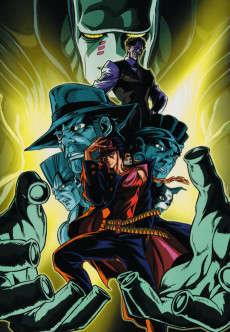
JoJo's Bizarre Adventure
Kujo Jotaro is a normal, popular Japanese high-schooler, until he thinks that he is possessed by a spirit, and locks himself in prison. After seeing his grandfather, Joseph Joestar, and fighting Joseph's friend Muhammad Abdul, Jotaro learns that the "Spirit" is actually Star Platinum, his Stand, or fighting energy given a semi-solid form. Later, his mother gains a Stand, and becomes sick. Jotaro learns that it is because the vampire Dio Brando has been revived 100 years after his defeat to Jonathan Joestar, Jotaro's great-great-grandfather. Jotaro decides to join Joseph and Abdul in a trip to Egypt to defeat Dio once and for all.
📺Anime Details
📝Editorial Analysis
The desert wind howls—not with heat, but with weight. Jotaro’s knuckles crack as Star Platinum materializes, not with a flash, but a shudder—a body tearing itself into existence from thin air, muscles coiling like live wire beneath translucent skin. His mother lies motionless in the hospital bed behind him, her breath shallow, her veins faintly pulsing black under pale skin—not from illness, but from something older, something that hungers and remembers. That moment isn’t just action—it’s dread wearing a tailored coat, elegance fused with violation, where power doesn’t liberate—it contorts.
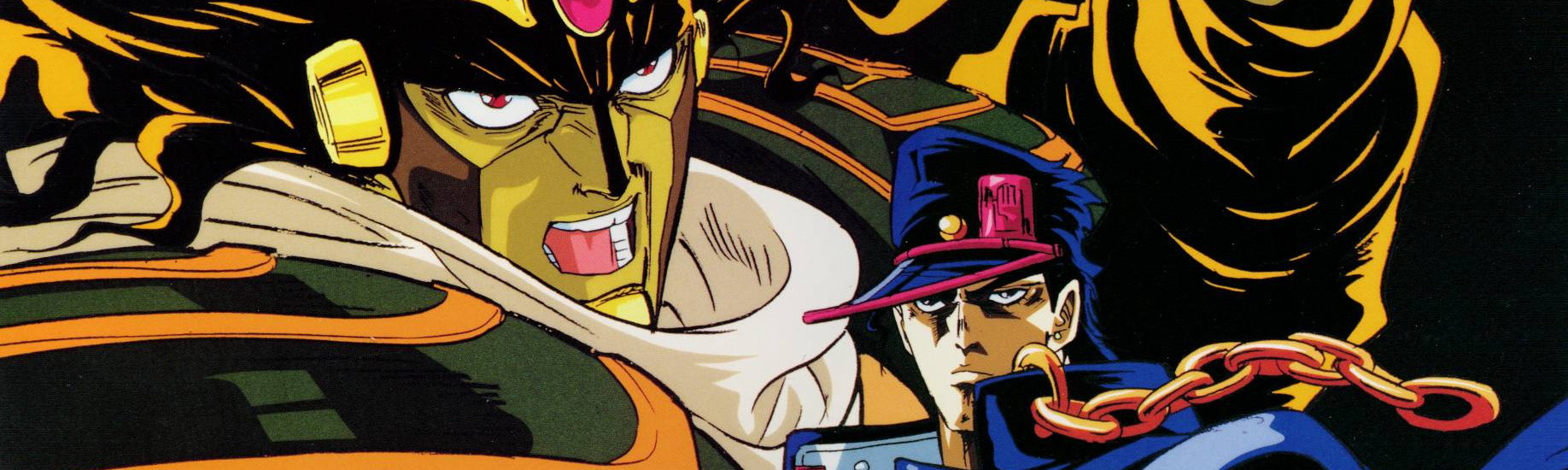
What makes JoJo's Bizarre Adventure vibrate at this frequency isn’t its shōnen structure or vampire lore—it’s the unease of transformation. It lives in the gap between control and corruption: a Stand isn’t a tool—it’s a second nervous system grafted onto your spine; vampirism isn’t immortality—it’s your own blood turning against you; even the desert isn’t empty—it’s a stage where bodies warp under inherited curses and names echo across generations like incantations. You don’t just watch characters fight—you feel their tendons strain under their powers, their identities fraying at the edges of absurdity and grandeur. It’s dignified horror: every pose is deliberate, every scream measured—but the rot underneath is real, intimate, biological.
That same tremor lives in Heretic: Shadow of the Serpent Riders, where you play “a heretic… one of the last Sidhe elves” in a realm “corrupted by the evil magic of three brothers known as the Serpent Riders.” Not conquest. Not salvation. Corruption. The player review doesn’t praise mechanics—it says: “Pick up the remaster…”—as if the game’s pull is visceral, almost devotional. Like Jotaro locking himself away, the Sidhe aren’t heroes—they’re survivors clinging to identity while their world curdles around them. Both treat magic and power as invasive, not empowering—rituals that twist bone, spells that unmake flesh. The Serpent Riders don’t rule with armies—they infect. Just like Dio’s revival doesn’t restart history—it reopens a wound.
Then there’s Dark Messiah of Might & Magic, described as “a new breed of Action-RPG… ferocious combat in a dark and im…”—the sentence cuts off, but the player review fills the silence: “A fantastic melee combat game that still holds up pretty well today.” That phrase—ferocious combat—is pure JoJo. Not button-mashing, not combos for spectacle—but impact: the crunch of a Stand punch landing, the stagger of a body thrown ten meters, the way violence reconfigures space. In both, combat isn’t abstract—it’s physical theater. You feel the weight of your own limbs, the recoil of power misfired, the split-second where muscle memory becomes instinct—and instinct becomes horror, because your body is no longer just yours. The review even name-checks Arx Fatalis, another game where magic feels like carving runes into your own ribs.
And Alice: Madness Returns, with its “grim reality of Victorian London” and “beautiful yet ghastly Wonderland,” mirrors JoJo’s dual-layered reality—where the mundane (a Tokyo hospital, a dusty train station) is always leaking into the uncanny. Alice doesn’t escape trauma—she re-embodies it, her world warping with each suppressed memory. So does Jotaro: his Stand doesn’t appear in void—it erupts beside his mother’s hospital bed, in the fluorescent glare of a real-world hallway. The player review admits the game “kinda works… after editing config files manually”—a perfect metaphor: like JoJo’s logic, it demands active recalibration. You don’t adapt to its rules—you rewire your perception to survive inside them.
This pairing isn’t for fans of “cool powers” or “epic battles.” It’s for the ones who lean in when a character’s jaw unhinges just a fraction too far during a Stand cry—not to laugh, but to check their own pulse. For players who pause mid-gameplay not to strategize, but to stare at a corrupted texture on a wall and wonder: Is that supposed to look like a vein? It’s for people who love the tactile wrongness of a world where dignity and decay share the same breath—and who understand that the most terrifying thing isn’t the monster in the mirror… but the way your reflection blinks a half-second too late.
🎮12 Games That Match the Vibe




Match Dimensions Explained
❓Frequently Asked Questions
Why does Heretic feel so much like a JoJo's Stand battle even though it's from 1994?
Because Heretic’s magic system leans hard into flashy, personality-driven spells—like the 'Mace of the Serpent Riders' or 'Hellstaff'—that explode with visual flair and require timing, positioning, and improvisation, just like Jotaro dodging DIO’s time stops. The game’s sidescrolling combat rhythm, enemy telegraphs, and over-the-top boss patterns (especially the Serpent Riders themselves) mirror JoJo’s theatrical, almost choreographed violence—no wonder fans call it 'the Stand RPG before Stands existed.'
Is there a JoJo's Bizarre Adventure game adaptation I can actually play right now?
No official JoJo game exists in this match list—but if you're craving that same vibe of surreal body horror, occult escalation, and flamboyant power systems, Alice: Madness Returns nails it: its twisted Victorian London and grotesque Wonderland transformations echo Hol Horse’s stand effects or Enya’s psychic storms. Even the combat—where Alice’s weapon shifts mid-fight like a Stand manifesting—feels ripped from Battle Tendency’s escalating stakes.
How does Dark Messiah of Might & Magic compare to Thief: Deadly Shadows for JoJo-style action?
Dark Messiah is all about explosive, physics-driven melee chaos—think Jotaro’s Star Platinum smashing through walls with ragdoll guards flying everywhere—while Thief is pure tension and precision, like Joseph using Ripple to subtly redirect a guard’s attention without breaking stealth. If you want JoJo’s bravado and spectacle, go Dark Messiah; if you want Joseph-level cunning and environmental trickery, Thief delivers that cerebral, almost musical stealth flow.
What’s the best game on this list for that ‘over-the-top, dark fantasy + body horror’ JoJo mood after watching Part 6?
Alice: Madness Returns—hands down. Its decaying Victorian London bleeds into Wonderland’s flesh-and-bone architecture (think the Dollhouse level’s pulsating walls and teeth-lined corridors), and Alice’s sanity mechanics mirror Trish’s emotional volatility or Emporio’s reality-warping dread. Even the combat has that Part 6 tonal whiplash: brutal one-hit kills mixed with surreal, almost balletic evasion—exactly what you need after witnessing Pucci’s universe reset.