
Kanon (2006)
As a young child, Aizawa Yuuichi had often visited his cousin in the city. However, something drastic happened to keep him away for seven long years. Now, Yuuichi returns, his memories of those days are simply gone.
Settling into the wintry town, Yuuichi comes across several young girls, all of whom are connected to his past. As he befriends them and continues to interact with them, the long forgotten memories from his childhood begin to resurface...
📺Anime Details
📝Editorial Analysis
The snow falls sideways in the opening shot of Kanon (2006)—not gently, not romantically, but with a quiet, insistent weight, catching in Yuuichi’s breath as he steps off the train. His coat is thin. His hands are bare. He stares at the town square, blank-faced, and for three seconds, the world holds its breath: no music, no voiceover, just wind rattling a loose shutter somewhere down an alley. That silence isn’t empty. It’s full—of absence, of names half-remembered, of promises buried under seven winters.
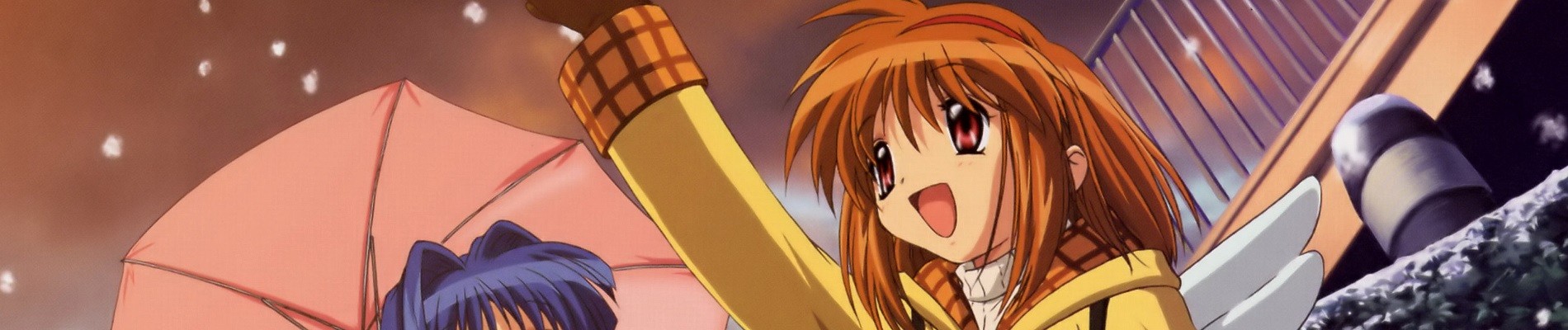
What makes Kanon (2006) ache like nothing else isn’t its tragedy—it’s how tenderly it treats memory as something fragile, not faulty. Not amnesia as plot device, but as physical sensation: the way Yuuichi’s fingers tremble when he touches the frost-rimed gate of the old school; how his throat closes when a girl hums a lullaby he almost knows. This isn’t nostalgia—it’s haunting, but without ghosts yet. The supernatural here doesn’t roar or bleed; it settles, like snow on a windowsill, softening edges until you forget where the real ends and the remembered begins. You don’t watch it to solve a mystery—you watch to relearn how to feel sorrow without flinching.
That emotional DNA—the slow, snow-muffled unraveling of self through other people’s grief—echoes in games that treat narrative not as exposition, but as atmospheric archaeology. Disco Elysium - The Final Cut, for instance, shares that same suffocating intimacy with brokenness: a detective whose mind is a crime scene he can’t escape, whose every internal monologue is a shard of identity he must reassemble while standing knee-deep in urban decay. Its description calls it “a groundbreaking role playing game” where you carve a path across “a whole city”—but the player review cuts deeper: “Capital has the ability to subsume all critiques into itself. Even those who would critique capital end up reinforcing it instead.” That’s Kanon’s core tension too—not capitalism, but time: how returning to a place forces you to re-enact your own erasure, how love becomes complicit in forgetting. Both make you feel trapped inside your own past, not as flashback, but as gravity.
Then there’s Condemned: Criminal Origins, described with chilling minimalism: “What twists the mind of an ordinary human into a serial killer?” No grand villain, no cosmic evil—just proximity to violence, sensory overload, the slow corrosion of perception. Its player review insists: “Get this game… This is a gem.” Why? Because it trusts silence, shadow, and the weight of a single hallway’s echo—just like Kanon (2006) trusts the sound of a girl’s footsteps stopping mid-snowfall, or the pause before she says, “You don’t remember me, do you?” Both understand that horror isn’t jump-scares or gore—it’s the moment your body remembers a truth your mind refuses to name.
And Nikopol: Secrets of the Immortals, though draped in cyberpunk scaffolding, carries that same emotional narrative dimension—its description notes “a mysterious pyramid ship suddenly appears above Paris,” but the player review zeroes in on atmosphere: “The story is interesting and the whole cyberpunk atmosphere gives it a nice vibe. The animations and cutscenes enhance…” Not spectacle. Not lore dumps. Vibe. Like Kanon’s snowscapes, Nikopol’s dystopia isn’t backdrop—it’s pressure, shaping how characters speak, hesitate, reach out. Both build worlds where emotion isn’t expressed—it leaks, through lighting, pacing, the space between words.
This pairing isn’t for fans of catharsis or closure. It’s for the ones who reread letters they wrote to themselves in high school. For players who pause mid-game just to stare at rain on a virtual windowpane. For viewers who cry not at the deathbed scene—but at the quiet shot of a teacup, still warm, left behind on a desk. They’re drawn to stories where healing isn’t linear, where love is less about union and more about witnessing—bearing the unbearable weight of someone else’s sorrow until it reshapes your bones. They don’t want answers. They want the snow to keep falling. They want the silence to hold. They want to stay in the ache—because in that ache, for just a little while, they remember how deeply it means to be alive.
🎮42 Games That Match the Vibe











Match Dimensions Explained
❓Frequently Asked Questions
Why does Disco Elysium keep showing up in 'games like Kanon (2006)' lists when it’s about a detective and not romance?
Good question—it’s not about the surface plot, but how both games gut-punch you with quiet, emotionally raw character moments: like Kanon’s snow-covered hospital scene with Ayu, Disco Elysium has those devastating late-night monologues where Harry’s voice cracks while staring at a cracked ceiling in his squalid hotel room. Both lean hard into melancholy atmosphere, internalized grief, and narrative weight over action—hence why critics and players consistently cite its 'Emotional Narrative' dimension as the real bridge.
Is there an anime or visual novel adaptation of Crash Time 2?
Nope—Crash Time 2 is purely a 2007 German arcade racing/crime-sim game starring an Autobahn cop, and it’s never been adapted into anime, manga, or a visual novel. It’s often mis-matched with Kanon due to shared 'Emotional Narrative' tagging in databases, but that’s misleading—the player review calling its controls 'factually BAD' and 'janky physics' tells you it’s *not* the delicate, character-driven experience Kanon fans seek.
How does Nikopol: Secrets of the Immortals compare to Kanon in terms of emotional payoff?
Nikopol trades Kanon’s intimate, tear-soaked domestic scenes (like Mai’s piano solo or Shiori’s rain-soaked confession) for dystopian sci-fi sorrow—think haunting cutscenes of the pyramid ship looming over occupied Paris, or the protagonist’s memories flickering through glitchy holograms. It nails 'Emotional Narrative' via atmosphere and loss, but lacks Kanon’s tender, grounded romance; if you loved Kanon’s slow-burn vulnerability, Nikopol satisfies that same ache—but through cyberpunk decay, not sakura petals.
What’s the best 'Games Like Kanon (2006)' for someone who wants that quiet, rainy-afternoon-feel with deep character sadness?
Disco Elysium — The Final Cut is your top pick. Forget the detective trappings: it’s all about those hushed, introspective moments—Harry sitting alone on a park bench at dawn, radio static humming, replaying a memory of someone he failed—exactly the same fragile, contemplative vibe as Kanon’s 'Snowy Night' route where Yuuichi watches the snow fall beside a sleeping Ayu. Its 82 score in 'Emotional Narrative' isn’t hype—it’s earned in every whispered line and bruised silence.