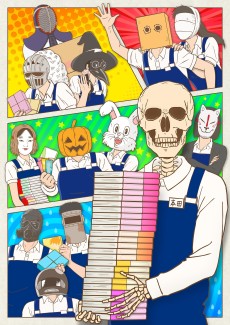
Skull-face Bookseller Honda-san
📺Anime Details
📝Editorial Analysis
The fluorescent hum of a Tokyo bookstore at 3 a.m., the clack-clack-clack of Honda-san’s bony fingers flipping through a manga volume, her skull tilted just so as she deadpans, “This one’s got three plot holes—like Swiss cheese dipped in existential dread.” No laugh track. No cutaway gags. Just quiet, bone-dry exhaustion radiating off her hollow sockets, and the soft rustle of pages turning under flickering lights. That’s the heartbeat of Skull-face Bookseller Honda-san—not a punchline delivered, but a sigh held mid-breath, then exhaled into the humid air of a cramped, lived-in space where otaku culture isn’t fetishized—it’s breathed.
What makes it vibrate differently isn’t its skeleton protagonist or its slapstick—it’s how deeply tired it feels, yet never cynical. It’s the warmth of shared fatigue: between Honda-san and her coworkers, between reader and clerk, between you and the screen at 2 a.m. scrolling for that one rare doujin. There’s no grand arc, no redemption—just the slow accumulation of small victories: a customer finding the exact edition they needed, a misfiled book finally located, the quiet pride in knowing which publisher’s spine font means “this is probably decent.” It’s surreal, yes—but the surrealism comes from how accurately it renders the emotional texture of adult creative labor: absurd, repetitive, oddly sacred, and laced with bone-deep weariness that somehow still leaves room for tenderness.
That feeling—the melancholic hum beneath the comedy, the gentle weight of daily ritual—echoes in Prince of Persia, not in its desert vistas or acrobatics, but in its melancholic exploration. The description calls it “an all-new epic journey” built by Ubisoft Montreal, and a player review notes it’s “the 3rd reboot… completely separate from the sands.” That separation matters: like Honda-san’s bookstore, this Prince isn’t chasing legacy—he’s navigating unfamiliar terrain, learning new rules, moving through spaces heavy with history he didn’t make but must inhabit. Both are about carrying on, not triumphing—Honda-san shelving another stack of light novels at closing time; the Prince tracing forgotten corridors, his movements precise, weary, strangely reverent. The melancholy isn’t sadness—it’s the quiet gravity of continuity, of showing up even when your bones are literally hollow.
Apex Legends™ shares that same dim—comedy & parody layered over melancholic exploration. Not the battlefield chaos, but the way the game’s lore lives in fragmented voice lines, in character bios buried in menus, in the way Lifeline’s medical kit animations feel like tiny, tender rituals amid gunfire. Like Honda-san’s coworkers debating whether a certain BL title qualifies as “literature,” Apex’s squad banter lands because it’s rooted in shared exhaustion—jokes told to keep the dread at bay. Neither work shouts its heart; both let it seep in sideways, through repetition, through rhythm: the clack-clack-clack of fingers on keyboard or shelf, the reload sound echoing like a page turned.
And Song of Nunu: A League of Legends Story—also tagged comedy & parody and melancholic exploration—mirrors Honda-san’s emotional architecture in its pacing and tone. It’s not about saving Runeterra; it’s about walking. With Nunu. Through snow. Watching footprints fill in behind you. Like Honda-san guiding a flustered customer to the doujin section—not because it’s urgent, but because someone has to. The game’s quietness, its focus on small gestures (a shared snack, a repaired sled), its refusal to rush past the weight of silence—that’s the same air the anime breathes. Both understand that melancholy can be soft, communal, even warm—like steam rising off a cup of instant coffee in a backroom break area.
This pairing isn’t for fans of “funny skeletons” or “cool action games.” It’s for the person who bookmarks a manga chapter not to finish it later, but to savor the pause before the next panel. For the player who replays Spider-Man’s web-swinging not for speed, but for the way the city lights blur into streaks of gold as he coasts—tired, yes, but present. For anyone who’s ever stood in a real bookstore at closing time, watching the last customer leave, and felt that strange, quiet swell—not of accomplishment, but of continuance. That’s the resonance: not escape, but recognition. The kind that makes you nod slowly, adjust your glasses, and reach for one more volume—bone-deep, gentle, true.
🎮13 Games That Match the Vibe






Match Dimensions Explained
❓Frequently Asked Questions
Why does Prince of Persia keep showing up in 'Games Like Skull-face Bookseller Honda-san' lists?
Because both lean hard into Comedy & Parody *and* Melancholic Exploration — like when Prince of Persia’s silent prince stumbles through absurdly over-the-top palace slapstick, then pauses mid-leap to watch golden light fade over crumbling ruins (a vibe straight out of Honda-san’s quiet bookstore melancholy). It’s that rare blend of physical comedy + wistful world-weariness that makes it a tonal twin, not just a visual one.
Is there an anime or manga adaptation of Skull-face Bookseller Honda-san that’s been turned into a game?
No — there’s no official anime, manga, or game adaptation of Skull-face Bookseller Honda-san. All the matches (like Song of Nunu or Marvel’s Spider-Man Remastered) are *standalone games* that happen to share its signature mix of Comedy & Parody + Melancholic Exploration — think Nunu and Willump’s goofy banter undercut by quiet moments of loss in the Freljord snow, not licensed tie-ins.
How does Like a Dragon: Pirate Yakuza in Hawaii compare to Prince of Persia for Skull-face Bookseller Honda-san fans?
Both nail that offbeat tonal whiplash: Like a Dragon throws you into ridiculous karaoke battles and pirate-themed yakuza shenanigans (Comedy & Parody), then pivots to tender, rain-soaked monologues on identity and belonging (Melancholic Exploration) — just like Prince of Persia swaps acrobatic pratfalls for haunting, empty desert vistas where the prince walks alone. Neither’s about plot logic; they’re about *feeling* absurdity and ache in the same breath.
What’s the best game like Skull-face Bookseller Honda-san if I want something cozy but quietly sad?
Go straight to Song of Nunu: A League of Legends Story — it’s got the gentle pacing, warm-but-wistful art style, and bittersweet heart of Honda-san’s quiet bookstore scenes. Watching Nunu and Willump trek through snow-dusted forests while joking about snacks, only to hit emotionally raw moments about grief and home? That’s the exact cozy-yet-melancholic sweet spot, backed by its 69 score and shared Comedy & Parody + Melancholic Exploration dimensions.