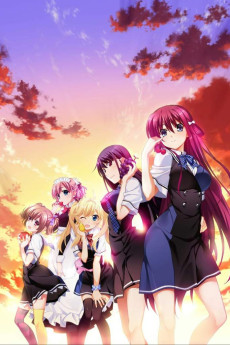
The Fruit of Grisaia
The anime revolves around Mihama Academy, a prison-like school built to preserve fruit that has fallen too far from its tree. It is home to five female students who each have their reasons for enrolling in the academy and live their life idly within the walls of Mihama.
One day, Kazami Yuuji the institute’s first male student arrives and throws the orderly rhythm of Mihama off balance. Is Yuuji what the girls need to hold of their lives once more, or will the weight of their pasts prove too steep a wall to overcome? Or is his past even heavier than any of the others?
(Source: Crunchyroll)
📺Anime Details
📝Editorial Analysis
The fluorescent hum of Mihama Academy’s hallway—low, persistent, slightly warped—fills your ears as Yuuji walks past a row of identical lockers, each one dented in the same place, each door slightly ajar. A single fallen grape rolls to a stop against his shoe. Not symbolic. Not poetic. Just there: small, purple, faintly sticky, already bruised at the stem. That grape is the first thing you notice—not the girls, not the harem setup, not even the ecchi glances—but the quiet weight of something that fell and wasn’t caught.
That’s the atmosphere: not despair, not hope, but suspension. Mihama isn’t a school—it’s a preservation chamber, built to hold fruit after it’s fallen too far from its tree. The air doesn’t breathe; it settles. You feel the pressure of unspoken trauma like static before lightning—not because it’s loud, but because it’s contained, layered under routines, half-smiles, and the soft scrape of chair legs on linoleum. It makes you think about how much emotional labor it takes just to stay upright when gravity has already decided you’re falling. How survival isn’t dramatic—it’s making tea without spilling, remembering to close the bathroom door, blinking slowly so no one sees the tremor behind your eyelids. The tragedy isn’t in what happened to them. It’s in how ordinarily they keep going.
Chains, with its physics-driven bubble-linking, resonates in this exact way. Its description calls it “a relaxing arcade match 3 casual game”—but the player review nails the quiet tension: “link 3 or more of the same color and clear enough till you can proceed and hit the next stage.” That’s Mihama in mechanic form: fragile, rhythmic, iterative survival. One misaligned chain collapses the whole structure. Every cleared cluster is a tiny reprieve—not triumph, just enough space to breathe again. Like Yuki’s meticulous origami folding, or Michiru’s silent piano practice—small, precise acts that hold back entropy, one link at a time.
Then there’s The Witcher 3: Wild Hunt, whose description centers Geralt tracking Ciri—the Child of Prophecy across a war-torn, monster-infested continent. The player review mentions DLC announced 11 years later, calling it “my favourite game keeps getting better…” That echo of long-haul care, of love persisting across unbearable time and loss—that’s the anime’s emotional DNA. Yuuji doesn’t “fix” the girls. He witnesses them across seasons, through regressions and breakthroughs, in scenes where nothing changes—and yet, everything does. Like Geralt returning to Novigrad after months, finding Triss older, quieter, still waiting—not for rescue, but for continuity. Both works treat healing as nonlinear, adult, and stubbornly tender.
And Tank Universal, though seemingly distant—a sci-fi tank FPS inspired by Tron and Battlezone—carries its own buried resonance. Its player review is devastating in its simplicity: “Play cool tank game with dad when you were 6… time goes on; loose access to game. Grew up dad passes away…” That’s the core ache of The Fruit of Grisaia: the way memory lives in sensory fragments—sound effects, colors, the weight of a controller in small hands—and how grief doesn’t roar. It fades in and out, like radio static between transmissions. In Mihama, trauma isn’t monolithic. It’s Sachi’s dissociative episodes flickering like corrupted video feed. It’s Makina’s laughter cutting off mid-sentence, replaced by silence so thick you hear your own pulse. Tank Universal’s review isn’t about tanks—it’s about what remains when the game is gone, the world is bigger, and love survives only as texture: cool sound effects, bright colors, the ghost of a hand guiding yours on the joystick.
This pairing isn’t for fans of “dark romance” or “harem wish-fulfillment.” It’s for the person who rewatched episode 12 of The Fruit of Grisaia three times—not for the confession, but for the five-second shot of Yuuji’s hand hovering over Yumiko’s shoulder, not touching, not knowing if he should, while rain streaks the window behind them. It’s for the player who paused The Witcher 3 mid-battle to watch a squirrel dart across a ruined bridge, or who booted up Tank Universal at 2 a.m., not to win, but to hear that old engine whine one more time. It’s for those who understand that the most vital stories aren’t about saving the world—but about holding someone’s gaze long enough to remember they’re still here, still real, still bruised but breathing, like a grape on linoleum, waiting—not for rescue—but for the next gentle, deliberate, human touch.
🎮28 Games That Match the Vibe



Match Dimensions Explained
❓Frequently Asked Questions
Why is The Witcher 3 listed as similar to The Fruit of Grisaia when they’re so different?
Great question — it’s not about gameplay (Grisaia’s visual novel format vs. Witcher 3’s open-world RPG), but about shared emotional weight and mature, morally gray storytelling. Both dive deep into trauma, identity, and complex relationships — like Geralt’s fraught bond with Ciri echoing Yuuji’s protective, guilt-laced dynamics with the girls at Mihama Academy. That ‘Adult & Dark Seinen’ dimension in the match list flags this tonal kinship, not genre overlap.
Is there an anime or manga adaptation of Chains?
Nope — Chains is purely a casual match-3 arcade game (think physics-driven bubble linking, not story-driven adaptation). Unlike Grisaia, which got full anime seasons and light novels, Chains has zero narrative expansions beyond its stages — one player even compared it to 'Connect 4 in a nutshell.' So if you're hoping for character arcs or voice acting like Amane or Yumiko, Chains won’t deliver that vibe.
How does The Witcher 2 compare to The Fruit of Grisaia in terms of branching choices and consequences?
Both demand tough decisions with lasting ripples — but in very different ways. Grisaia locks you into route-specific emotional turning points (like choosing between Sachi’s fragile trust or Makina’s silent pain), while Witcher 2 forces political and personal trade-offs that reshape entire regions (e.g., siding with Roche or Iorveth drastically alters Act II’s world and character fates). Player reviews call Witcher 2 'more thoughtfully designed' than its sequel precisely because of how tightly those choices bind to consequence.
What’s the best game like Grisaia if I want that melancholic, character-driven late-night vibe?
Go straight to The Witcher: Enhanced Edition Director's Cut — it nails that quiet, heavy intimacy. Think Geralt’s late-night talks with Yennefer in Vizima’s rain-slicked alleys, or the hushed tension before a morally irreversible choice — it’s got the same 'adult & dark seinen' texture as Grisaia’s Mihama scenes. One fan even joked that playing it reveals 'why team Yenn and not team Tress is a thing,' capturing that exact blend of longing, regret, and quiet devotion.