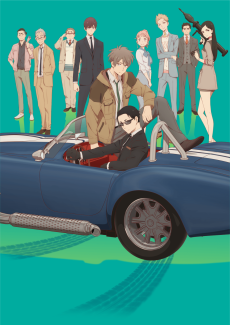
The Millionaire Detective - Balance: UNLIMITED
Based on Yasutaka Tsutsui's novel, Fugou Keiji.
The story centers around millionaire Daisuke Kambe, the heir to one of the wealthiest families in Japan, who is assigned as a detective to the Modern Crime Prevention Task Force (aka MCPTF), at the Tokyo Metropolitan Police Department. Taking full advantage of his vast family wealth, he spares no expense in solving complex crimes, and has the tendency to evaluate everything including individual human lives in terms of their monetary value. Haru Katou, a detective with a compassionate heart who believes that money isn’t everything, is chosen as Kambe’s partner but is repulsed by his materialistic attitude. Having diametrically opposing personalities, witness how the two join forces to tackle seemingly unsolvable crimes and mysteries!
(Source: Fuji Creative Corporation)
Note: Although Tsutsui's novel was published between 1975 and 1977, the anime plays out in the modern era.
📺Anime Details
📝Editorial Analysis
Rain slicks the Tokyo streets like spilled mercury—cold, reflective, indifferent. Daisuke Kambe’s black Maybach glides past a crime scene tape fluttering in the wind, its headlights cutting twin blades through the downpour. Inside, he doesn’t look at the body. He looks at the cost: the forensic team’s overtime budget, the municipal cleanup fee, the lost productivity of the nearby convenience store now cordoned off. His voice is calm, unblinking: “This homicide has a balance sheet. Let’s audit it.” Not callousness—not quite. A kind of exhausted arithmetic, where grief wears a price tag and justice arrives with an itemized invoice.

That’s the feeling The Millionaire Detective - Balance: UNLIMITED lives inside: not noir’s smoky fatalism, not sci-fi’s awe at the future—but the dull hum of systemic saturation, where capital isn’t just power, it’s oxygen. You feel it in the way Kambe’s wealth doesn’t dazzle—it flattens. Every suspect, every witness, every grieving family member becomes data points in his ledger. The tragedy isn’t that he’s cold; it’s that he’s accurate. The urban sprawl isn’t a backdrop—it’s a financial instrument. Cars aren’t props—they’re assets, liabilities, tactical tools. And the AI? Not Skynet or HAL—it’s the quiet, humming logic behind Kambe’s predictive models, the invisible hand pricing human error, emotional volatility, even grief, into operational risk. It’s not dystopian spectacle. It’s banal calculation, dressed in silk and sirens.
Which is why Disco Elysium - The Final Cut hits with such eerie resonance. Its description calls it a “groundbreaking role playing game” where you “carve your path across” a city—but the player review nails the DNA: “Capital has the ability to subsume all critiques into itself. Even those who would critique capital end up reinforcing it instead.” That’s Kambe’s entire posture—not as villain, but as system incarnate. In both, ideology isn’t debated in speeches—it’s baked into skill checks, dialogue trees, budget allocations. You don’t overthrow capital in Disco Elysium—you negotiate with it, bargain for scraps of dignity while your own mind quotes Marx and monetarist textbooks in the same breath. Just like Kambe reviewing autopsy reports alongside stock tickers.
Then there’s Max Payne and Max Payne 2: The Fall of Max Payne, both tagged Neon Noir, Mystery & Detective. Their descriptions frame them as “violent, film-noir love stories” and “man[s] with his back against the wall”—but what binds them to Kambe isn’t the bullets or the trench coats. It’s the tragic weight of competence in a broken machine. Max doesn’t win—he survives, bleeding, remembering, failing upward. Kambe doesn’t solve crimes—he optimizes outcomes, often leaving moral residue unaccounted for in his spreadsheets. The player review for Max Payne 2 says it’s “a stellar sequel… successfully improving on many of the original's key mechanics”—and that’s the shared ache: mastery without resolution. You clear rooms. You close cases. But the city stays wet. The balance never truly balances.
Crash Time 2? Its description positions it as “an open-world arcade racing game” where you’re “an Autobahn police officer” doing “criminal investigations”—but the player review is brutal: “awful controls… janky physics… factually BAD controls.” That dissonance—the gap between intended function (police work as systemic, procedural, precise) and grinding friction (the world resisting clean solutions)—mirrors The Millionaire Detective’s central joke-turned-tragedy. Kambe deploys hyper-expensive tech, elite consultants, private satellites—and still, the human variable glitches. A witness lies. A memory fractures. A child’s drawing contradicts three forensic reports. The anime doesn’t mock his wealth—it honors the exhaustion of trying to engineer empathy, ethics, even truth, into a system built for efficiency.
Who loves this pairing? Not fans of tidy justice or wish-fulfillment power fantasies. It’s the viewer who watches Kambe pause mid-briefing—not because he’s moved, but because he’s calculating the emotional depreciation rate of a widow’s testimony—and feels a slow, sick recognition. It’s the player who reloads after Max Payne’s fourth failed jump not out of frustration, but because the stumble itself feels honest. It’s the one who reads Disco Elysium’s skill checks and whispers, “Yeah. That’s how my brain actually talks to me.” They’re people who find poetry in the gap between what systems promise and what humans cost. Who don’t want heroes—they want accountants of the soul, driving fast cars through rain-slicked cities they’ll never truly fix, but will keep auditing, relentlessly, until the numbers stop lying.
🎮14 Games That Match the Vibe



Match Dimensions Explained
❓Frequently Asked Questions
Why is Disco Elysium listed as similar to The Millionaire Detective when it’s so bleak and philosophical?
Great question—it’s not about tone matching, but about shared DNA in detective work and neon-noir atmosphere. Like Balance: UNLIMITED’s Kuroda using absurd wealth and unorthodox logic to crack cases, Disco Elysium’s Detective Harrier has 24 distinct skills (like Logic, Empathy, or Electrochemistry) that let him talk his way through crime scenes in wildly unconventional ways—think interrogating a pigeon or deducing a suspect’s trauma from graffiti. Both lean hard into stylized, self-aware mystery where the ‘how’ of solving matters more than realism.
Is there a live-action or anime adaptation of Crash Time 2 like there is for The Millionaire Detective?
Nope—Crash Time 2 has never been adapted beyond its original 2009 PC release. Unlike The Millionaire Detective (which got both an anime and live-action drama), Crash Time 2 remains a niche arcade racer with no spin-offs, manga, or streaming versions. Its police-procedural framing is purely functional: you’re chasing suspects on Germany’s Autobahn, not building character arcs—hence why fans often cite its janky controls and lack of narrative depth (one reviewer bluntly called it 'factually BAD controls') rather than clamoring for adaptations.
How does Sherlock Holmes versus Jack the Ripper compare to Max Payne 2 in terms of detective storytelling?
Sherlock Holmes vs. Jack the Ripper leans into grounded, clue-driven deduction—like reconstructing Whitechapel’s fog-drenched crime scenes step-by-step using period-accurate forensics—while Max Payne 2 trades investigation for noir-infused *consequences*: think slow-motion shootouts revealing flashbacks mid-gunfight, or dialogue choices that deepen Max and Mona’s tragic love story. Both hit 81 on the score and share Neon Noir + Mystery & Detective dimensions, but Sherlock’s methodical pacing contrasts sharply with Max’s visceral, emotionally charged momentum.
What’s the best game like The Millionaire Detective if I want something stylish, fast-paced, and full of over-the-top action?
Max Payne 2: The Fall of Max Payne is your perfect match—especially if you love Kuroda’s flair and theatricality. It’s got bullet-time combat that feels like choreographed ballet (clearing rooms full of enemies while narrating your own inner monologue), a moody, rain-slicked cityscape straight out of a neo-noir film, and a plot full of shocking twists that rival Balance: UNLIMITED’s tonal whiplash. One fan even called it 'a stellar sequel to a masterpiece'—and yeah, it absolutely delivers that same blend of wit, style, and high-stakes swagger.