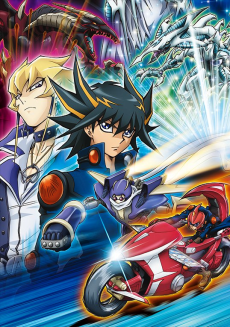
Yu-Gi-Oh! 5D's
Yu-Gi-Oh! 5D's is set in Neo Domino City some time after the events concerning Yugi Mutou (DM) and Judai Yuki (GX). A new form of dueling, "Riding Duels", now take place on motorcycles called "D-Wheels". While regular dueling still exists, Riding Duels have become a popular form of entertainment for spectators, who watch them in specially-designed stadiums.
📺Anime Details
📝Editorial Analysis
Rain slicks the neon-drenched asphalt of Neo Domino City’s lower sector—cold, wet, alive. Yusei Fudo leans into a turn on his D-Wheel, engine screaming, hair whipping back as holographic dragons tear across the sky above him—not just summoned, but borne aloft by velocity, by trust, by the raw, trembling edge between control and collapse. His hand doesn’t shake. His breath doesn’t catch. He rides the duel like it’s the only thing holding time together—and for him, it is.
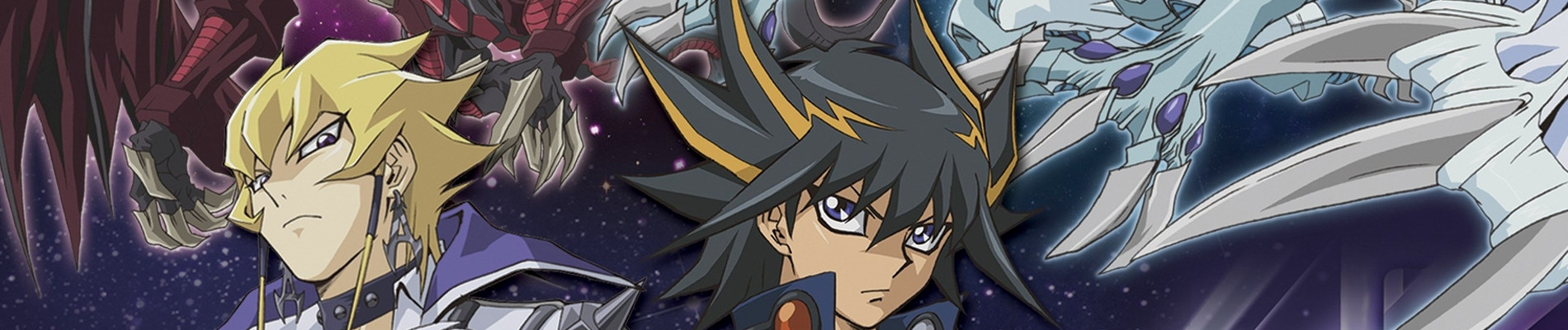
That’s the feeling Yu-Gi-Oh! 5D's lives inside: not just speed or spectacle, but gravitas in motion. It’s the weight of memory strapped to a motorcycle frame—the ghosts of Satellite’s rubble, the silence after a friend vanishes mid-race, the way a dragon’s roar echoes less like power and more like grief given wings. This isn’t urban fantasy as decoration; it’s urban fantasy as testimony. The cyberpunk isn’t chrome and slogans—it’s rust on railings, flickering ads that never quite say what they mean, and a city built on layered lies where the highest stadium seats overlook the poorest rooftops. You don’t watch 5D's to escape. You watch it to remember how it feels to be young, wronged, and still choosing hope while leaning into the curve at 120 kph.
That emotional DNA—melancholic urgency, time-fractured loyalty, dystopia you can smell—pulses through BioShock Infinite, where Booker DeWitt’s debt isn’t just financial but temporal, his past a wound he carries like armor. The game’s description calls him “indebted to the wrong people, with his life on the line”—exactly how Yusei carries the weight of Rex Goodwin’s betrayal, of Jack Atlas’s fall, of Akiza’s isolation—all debts paid not in currency, but in risk, in sacrifice, in riding toward the light even when the track ends in smoke. A player review admits “some people are still bitter about the Bioshock Infinite we could have gotten”—and that ache mirrors 5D's own unresolved edges: the gaps between Satellite and Neo Domino, the fractures in time during the Dark Signers arc, the way every victory tastes faintly of what was lost. Both refuse tidy closure. They linger.
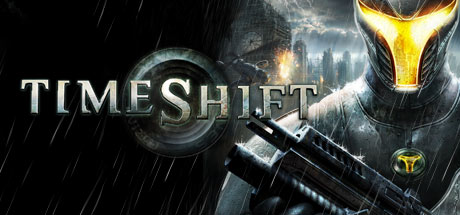
Then there’s TimeShift™, where Dr. Aiden Krone’s “reckless act” fractures reality itself—“a disturbing alternate reality has emerged.” That phrase lands like a punch. Because 5D's doesn’t treat time manipulation as plot convenience; it treats it as trauma made physical. When Yusei and Jack race through the ruined ruins of the old city during the Fortune Cup, time doesn’t bend—it stutters, glitching like corrupted memory. The game’s player review calls it “a little 4 hour game… a blast, but it takes a little work to get it into a playable state.” That effort—patching, tuning, coaxing life from unstable systems—is exactly what Yusei does every episode: jury-rigging duels, repairing D-Wheels with scavenged parts, rebuilding trust one gear at a time. Both demand patience with broken things—not because they’re flawed, but because brokenness is where meaning begins.
And Mirror's Edge™? A city where “information is heavily monitored,” where couriers move unseen, hunted—but free in motion. Its player review says: “Running smooth w zero issue at all… a dream to play.” That sensation—fluidity as resistance, grace as rebellion—is pure 5D's. Yusei doesn’t duel to win trophies. He duels to be seen, to prove Satellite isn’t disposable, to make the system feel the vibration of his wheels on its concrete veins. The game’s “seemingly utopian paradise” is Neo Domino’s polished upper tiers—gleaming, surveilled, sterile—while the Runners’ parkour across rooftops and pipes is the show’s spiritual twin to Riding Duels: movement as truth-telling, as defiance you can feel in your shoulders.
Who loves this pairing? Not just fans of motorcycles or card games. It’s the person who pauses mid-gameplay to watch rain slide down a neon sign in Cyberpunk 2077, then rewinds an anime scene just to hear the exact pitch of Yusei’s voice cracking on “I believe in us.” It’s the reader who underlines lines in Nikopol: Secrets of the Immortals’ description—“a mysterious pyramid ship suddenly appears above Paris”—and thinks, that’s how the Signer dragons feel: ancient, alien, inevitable. It’s the one who doesn’t want escapism. They want resonance: the shiver when time stutters, the burn in the thighs after a long ride, the quiet pride of fixing something by hand, and the unbearable, beautiful weight of believing—still—in tomorrow’s horizon, even when your engine’s sputtering and your past is chasing you down the track.
🎮16 Games That Match the Vibe




Match Dimensions Explained
❓Frequently Asked Questions
Why does Yu-Gi-Oh! 5D's feel so different from other Yu-Gi-Oh! games when it comes to dueling?
Because 5D's introduced Turbo Duels—riding motorcycles while dodging obstacles and launching attacks mid-air—which is way more kinetic and cinematic than the static, turn-based duels in earlier series. Games like Mirror's Edge™ capture that same high-speed, precision-driven flow: you're constantly navigating tight urban corridors, timing jumps and slides just like Yusei weaving through Neo Domino City’s aerial tracks.
Is there a Cyberpunk 2077 anime or game adaptation that nails the 5D's vibe?
Not an official anime, but Cyberpunk 2077 *itself* channels 5D's core energy—especially its Night City setting, where street-level rebellion (like Yusei’s Satellite origins) clashes with oppressive megacorps (think the Arcadia Movement vs. the World Racing Association). The melancholic exploration of ruined districts and morally gray allies—say, Jackie Welles echoing Jack Atlas’s arc—makes it the closest tonal sibling on the list.
How does TimeShift™ compare to BioShock Infinite for fans of 5D's time-bending duels and emotional twists?
TimeShift™ leans hard into *mechanical* time manipulation—rewinding, freezing, and slowing time mid-combat—just like how 5D's duel monsters bend causality (e.g., 'Stardust Dragon' negating destruction effects). BioShock Infinite goes deeper on *narrative* time & memory layers—Booker/Comstock parallels echo Yusei’s fractured past and the Crimson Nova prophecy—but TimeShift™’s 4-hour, action-packed sprint feels more like a Turbo Duel’s adrenaline rush.
What’s the best game like Yu-Gi-Oh! 5D's if I want that gritty, rain-slicked dystopian vibe with quiet character moments?
Nikopol: Secrets of the Immortals—it’s got that same melancholic exploration feel: Paris under a fascist theocracy, eerie pyramid ships hovering overhead, and cutscenes dripping with noir atmosphere, like when Yusei stares out over Satellite’s ruins after a loss. The point-and-click pacing gives space for reflection, much like 5D's quieter scenes with Akiza or Carly before the next big duel.