
Girls' Last Tour
Civilization is dead, but Chito and Yuuri are still alive. So they hop aboard their beloved Kettenkrad motorbike and aimlessly wander the ruins of the world they once knew. Day after hopeless day, they look for their next meal and fuel for their ride. But as long as the two are together, even an existence as bleak as theirs has a ray or two of sunshine in it, whether they're sucking down their fill of soup or hunting for machine parts to tinker with. For two girls in a world full of nothing, the experiences and feelings the two share give them something to live for…
(Source: Yen Press)
📺Anime Details
📝Editorial Analysis
The kettle whistles—thin, sharp, impossibly loud in the hollow silence of the cathedral-sized ruin. Chito pours steaming soup into two chipped enamel mugs while Yuuri leans against the Kettenkrad’s cold frame, watching dust motes spiral in a single shaft of light piercing the collapsed dome above. No music swells. No flashback explains why this place exists or how it fell. Just heat rising, steam curling, the soft clink of a spoon against metal—and the quiet, unspoken weight of two girls sharing warmth in a world that forgot how to hold it.
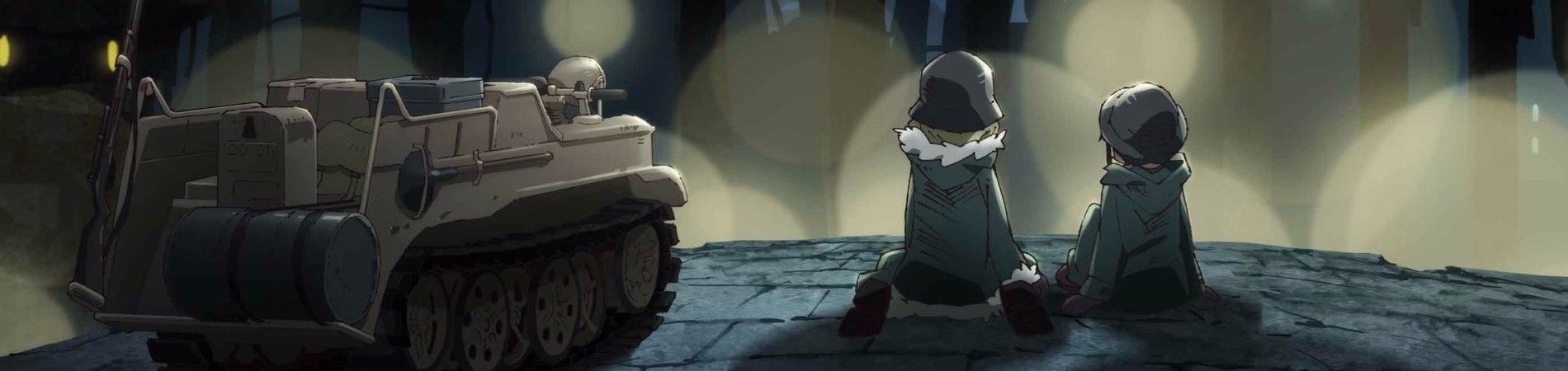
That’s the heart of Girls’ Last Tour: not despair as spectacle, but presence as resistance. It doesn’t ask you to grieve civilization—it asks you to notice how Yuuri’s fingers tremble slightly when she adjusts the bike’s throttle, how Chito hums off-key while wiping grease from her goggles, how the taste of canned peaches lingers like a small miracle. The feeling isn’t hopelessness—it’s tenderness, stretched thin but unbroken across endless gray horizons. You don’t feel small against the ruins; you feel intimate with them—like running your palm over cold concrete and sensing the ghost of human hands that once laid each brick. It’s philosophy worn as routine: boiling water, checking oil levels, reading faded signs whose languages no longer matter—but whose shapes still whisper someone was here. That slowness isn’t passive. It’s deliberate. Sacred.
Chains, despite being a match-3 arcade game, echoes this rhythm—not in story, but in pulse. Its description calls it “relaxing,” built on linking bubbles with “increasingly difficult physics-driven” flow. Player reviews call it “connect 4 in nutshell”—a phrase that lands with startling accuracy. Like Chito and Yuuri tracing circuits on salvaged panels or aligning gears by instinct, Chains asks for quiet attention, repetition with variation, small victories measured in color-matches and chain-lengths. There’s no enemy, no timer screaming—just the soft pop of bubbles clearing, the gentle resistance of gravity nudging pieces into place. It mirrors the anime’s ethos: meaning isn’t found in grand revelation, but in the act of connection itself—linking, aligning, sustaining.
Then there’s Prince of Persia, described as a “melancholic exploration” reboot set in “new lands” with a “brand new story.” A player notes it’s “completely separate from the sands timeline”—which matters. Like Girls’ Last Tour, it refuses inherited myth. Its melancholy isn’t theatrical; it’s architectural—the way light pools in an abandoned courtyard, how wind moves through fractured archways, how every leap across crumbling ledges feels less like conquest and more like conversation with decay. The anime and this game share a grammar of silence: long pauses where the only sound is footfall on rubble, or the creak of ancient stone yielding. Neither shouts its tragedy. Both let emptiness speak—and in that shared hush, something fragile blooms.
And Stardew Valley, with its “healing & slow life” dimension and player confessing they spent “days upon days… never having enough time,” nails the same paradox: abundance within limitation. Chito and Yuuri ration fuel like Stardew farmers ration stamina—every action weighed, every resource honored. The anime’s soup-making scene isn’t just survival; it’s ritual, like watering crops at dawn or feeding chickens before sunrise. The player’s exhaustion—“constantly running around trying to find the town”—mirrors Yuuri’s tired grin after pushing the Kettenkrad up a hill, or Chito’s quiet satisfaction when a scavenged part finally fits. Both are about building continuity, not catharsis. Not “winning,” but waking up again.
Who would love these pairings? Someone who cries when a vending machine lights up in an empty subway tunnel—not because it works, but because it remembers how to. Someone who saves their favorite mug not for its design, but because it holds exactly the right amount of warmth. Someone who finds solace not in answers, but in the shape of a question asked softly, over and over: What do we do now? And then, without fanfare, does it—pours the soup, links the bubbles, climbs the ledge, plants the seed. Not to rebuild the world. But to stay here, together, breathing in the same thin, precious air. That’s the quiet, unshakeable truth both Girls’ Last Tour and these games hold: presence is the first act of love.
🎮31 Games That Match the Vibe


























Match Dimensions Explained
❓Frequently Asked Questions
Why does Prince of Persia keep coming up when I search for games like Girls' Last Tour?
Because both lean hard into melancholic exploration—Prince of Persia’s ruined, sun-drenched ruins and quiet, reflective traversal (like walking alone through the Silent City’s empty halls) mirror Girls’ Last Tour’s tone of gentle desolation and quiet awe. The game’s emphasis on solitude, environmental storytelling, and moments where you pause just to watch light shift across ancient stone feels spiritually kin to Chito and Yuuri’s bike rides through abandoned cities.
Is there a Girls' Last Tour game adaptation?
No official Girls’ Last Tour game exists—but Tank Universal taps into that same emotional narrative and melancholic exploration vibe, especially in its lone-tank-in-a-vast-ruined-world structure. Its sci-fi desolation, slow-burn atmosphere, and moments of quiet reflection (like drifting through silent neon-lit corridors while your tank hums softly) hit similar notes as the manga’s contemplative, post-collapse serenity.
How is Stardew Valley different from Prince of Persia if both are 'like Girls' Last Tour'?
Stardew Valley matches the healing & slow life dimension through daily rhythms—feeding chickens at dawn, chatting with villagers like Emily or Sebastian, tending crops under soft rain—while Prince of Persia leans into solitary, poetic melancholy via acrobatic silence and crumbling architecture. Both avoid urgency, but Stardew soothes with repetition and community; Prince soothes with scale, stillness, and the weight of forgotten empires.
What’s the best game like Girls’ Last Tour if I want that calm, reflective, ‘just us two in a quiet world’ feeling?
Chains fits surprisingly well—not because it’s narrative-driven, but because its bubble-linking mechanic creates rhythmic, meditative flow, like Chito and Yuuri’s simple routines: brewing tea, fixing the motorcycle, watching clouds. Players describe it as ‘connect 4 in a nutshell,’ and that gentle, physics-based focus—clearing chains one calm breath at a time—mirrors the show’s unhurried, deeply human intimacy.