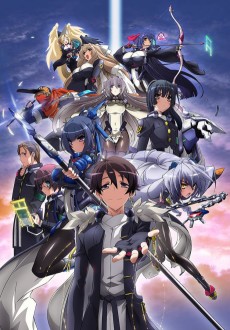
Horizon in the Middle of Nowhere
📺Anime Details
📝Editorial Analysis
The scent of ozone and old paper hangs thick in the air—not from lightning, but from the crackle of a spell-scroll igniting mid-air as a student in a 17th-century doublet leaps off a floating Dutch galleon, katana drawn, while a mecha shaped like a Shinto kami descends through clouds stitched with GPS coordinates and Edo-period calligraphy. That’s not dissonance—it’s breath. That’s Horizon in the Middle of Nowhere.
This isn’t world-building as backdrop—it’s world-breathing: history exhaling into sci-fi, politics folding into romance like origami, yuri confessionals whispered between artillery barrages. You don’t watch it—you lean in, heart racing not just from action, but from the sheer weight of meaning layered onto every gesture: a bow that’s both feudal deference and diplomatic maneuver, a kiss that’s both emotional release and ideological alignment. It makes you feel vertigo—not from spectacle, but from how deeply it trusts you to hold contradiction: reverence and rebellion, absurdity and anguish, bureaucracy and ballet. It’s exhausting, yes—but in the way breathing deep in thin mountain air is: sharp, clarifying, strangely sacred.
Tribes: Ascend shares that same electric exhaustion. Its player review calls it “mindless fun”—but that’s the surface shimmer. Beneath? A high-speed, low-gravity ballet where strategy lives in millisecond decisions, where team coordination feels less like gaming and more like conducting an orchestra mid-cannonade. Like Horizon, it weaponizes precision—not just of aim, but of timing, positioning, role. Both demand you read intention in motion: the flicker of a rival’s jetpack flare, the micro-pause before a character’s kuudere mask cracks. And its DLC packaging—“ten previous expansions” bundled with “new featured content”—mirrors Horizon’s own layered architecture: each arc isn’t additive, but recursive, revisiting themes with new political gravity, like Tribes’ maps recontextualizing speed and terrain across iterations.
Horizon Zero Dawn™ Complete Edition and Horizon Forbidden West™ Complete Edition—both scoring 82, both anchored in Mecha & Military Sci-Fi, Cyberpunk & Dystopia—resonate not because they share robots (they do), but because they share grief as infrastructure. Aloy walks ruins where ancient war machines graze like deer, her world built atop collapsed civilizations whose archives whisper in corrupted data-speech. Just like Horizon’s characters debate treaty clauses while standing on the hull of a sky-fortress powered by stolen divine engines, Aloy deciphers log entries that double as love letters, war manifestos, and suicide notes—all encoded in the same language. The dystopia isn’t just rubble; it’s palimpsest. Every gear-turn, every corrupted terminal, carries the echo of choice—just like every parliamentary vote in Horizon carries the weight of erased histories and suppressed identities.
BioShock™, at 77, lands harder than its score suggests—not for its “revolutionary” status (though the review rightly hails it), but for its unblinking political intimacy. Its description calls it “a shooter unlike any you’ve ever played,” loaded with “weapons and tactics never seen”—but what lingers is the voice in your ear, the ideology dripping like brine from every flooded corridor. Like Horizon, it forces ideology into flesh: Rapture’s objectivism isn’t abstract—it’s in the tremor of a splicer’s hand, the hollow eyes behind a cracked mask. Both make politics visceral, not theoretical. When Horizon’s characters argue over the sovereignty of a floating island-state while their own bodies are literal vessels for contested divine contracts, it’s BioShock’s underwater halls all over again—just swapped for tatami mats and tactical exosuits.
You’d love this pairing if you’ve ever cried during a budget committee meeting scene in anime—or paused a game not to heal, but to reread a faction’s charter aloud. If you crave stories where love letters arrive stamped with diplomatic seals, where a robot’s power core hums the same melody as a Heian-era lute, where queerness isn’t subtext—it’s statute. Not escapism. Embodiment. Where every frame, every loading screen, every dialogue branch insists: the future is already written—in ink, code, blood, and covenant. And you? You’re not just watching or playing. You’re signing on the dotted line.
🎮23 Games That Match the Vibe


Match Dimensions Explained
❓Frequently Asked Questions
Why does Horizon in the Middle of Nowhere match with BioShock despite being so different?
Great question — it’s all about that shared 'Cyberpunk & Dystopia' dimension and the way both use decaying, layered worldbuilding to explore lost civilizations. In BioShock, you’re diving into Rapture’s art deco ruins while uncovering audio diaries and twisted ideologies — just like how Horizon’s Nora and Carja tribes navigate overgrown ruins of Old Ones tech, revealing fragmented logs and holographic echoes. Both lean hard into environmental storytelling where the setting *is* the plot.
Is there an anime or manga adaptation of Horizon in the Middle of Nowhere?
Nope — unlike Horizon Zero Dawn or Forbidden West (which have official novels and a Netflix-style animated short), 'Horizon in the Middle of Nowhere' is a niche visual novel with zero licensed adaptations. It’s stayed firmly in its original format: a romance-driven JRPG narrative with branching paths centered on characters like Yuki, Sora, and the quiet tension between the Student Council and Cultural Club — no anime, no manga, no spin-offs.
How does Baldur’s Gate 3 compare to Horizon in the Middle of Nowhere for story-driven romance?
They’re surprisingly aligned on 'Romance & Shoujo' and 'JRPG Narrative', but BG3 leans into deep, consequence-heavy choices — think Astarion’s morally gray banter or Shadowheart’s faith crisis — while Horizon in the Middle of Nowhere delivers softer, slice-of-life emotional beats, like Yuki’s shy confessions during cultural festival scenes or Sora’s quiet support after club failures. Both reward re-playability, but BG3’s romances reshape entire questlines; Horizon’s unfold through intimate dialogue trees and seasonal event triggers.
What’s the best game like Horizon in the Middle of Nowhere if I want that calm, thoughtful vibe with sci-fi mystery?
Go straight to Horizon Forbidden West Complete Edition — it nails that same reflective, discovery-driven pace, especially early on in the Tenakth Valley, where you’re piecing together ancient data logs and watching machines graze peacefully before things escalate. The 'Mecha & Military Sci-Fi' dimension matches perfectly, and unlike Tribes: Ascend’s frantic arena combat or BioShock’s oppressive urgency, Forbidden West gives you space to breathe — like walking through the Sunfall Ruins at sunset, scanning for clues while listening to Aloy’s quiet voiceover.