
SCHOOL-LIVE!
Why would anyone form a School Living Club? Could four girls, their advisor, and a puppy really love their school so much that they’d want to live in it? Or is there another reason, something that lurks behind the façade of their comfortable existence? Something that waits outside their school’s doors. Something that has already robbed one girl of her sanity? While the others try to come to grips with a dark new reality, the rest of the world falls to ruin at the hands of a ravenous force, and insanity may be the last hope for survival. Shocks, heartbreak and stunning revelations await as the twisted tale unfolds.
(Source: Sentai Filmworks)
📺Anime Details
📝Editorial Analysis
The fluorescent hum of the school cafeteria. A tray clinks. A spoon stirs tea—steam rising, gentle, warm—while outside the window, a hand smears red across the glass. Not blood. Not yet. Just rain. But you know. You feel the weight of that unspoken thing behind the smile on Yuki’s face as she pours for her friends, as if pouring normalcy itself, thin and trembling, into chipped ceramic cups.
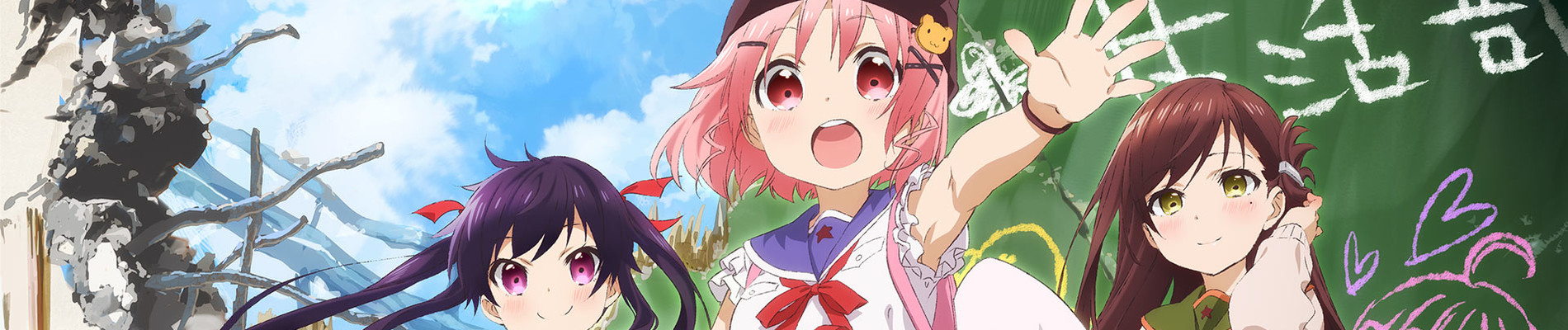
That’s the ache of SCHOOL-LIVE!: not jump scares or gore-first dread, but the quiet, suffocating dissonance between ritual and ruin. It makes you hold your breath—not in fear of what’s coming, but in terror of what’s already been erased. The feeling isn’t adrenaline; it’s vertigo. A slow, sickening lurch when the cheerful club meeting dissolves into the hollow echo of an empty hallway, when laughter bounces off boarded windows instead of sunlight. It forces you to question memory—not as plot device, but as lifeline. What do we keep? What do we bury? What do we pretend is still whole, just to keep breathing? That fragility—the way hope becomes a kind of self-harm, tender and necessary—is what lingers long after the final bell.
Chains, with its “relaxing arcade match 3” loop and physics-driven bubbles, sounds nothing like a zombie apocalypse—until you read the player’s note: “Reminds me of connect 4 in nutshell.” That’s it. The ritual. The deliberate, almost meditative act of linking three colors—small, controlled, meaningful gestures in a world governed by chaos. Like Yuki arranging tea sets while the roof leaks rust-colored water. Like Miki folding origami cranes beside a barricaded door. The game doesn’t simulate survival—it mirrors its emotional architecture: tiny acts of order, repeated until they become prayer. No grand victory, just enough chain, enough clarity, to reach the next stage. Survival as continuance, not conquest.
Then there’s Stardew Valley, where you “inherit your grandfather’s old farm plot” and “learn to live off the land.” The player review nails the emotional friction: “Spent the first 2 years trying to do everything and never having enough time… Days upon days of constantly running around.” That exhaustion—the beautiful, crushing weight of tending to life despite loss—is pure SCHOOL-LIVE!. Yuki doesn’t rebuild civilization; she waters the clubroom’s dying potted plant. She feeds the puppy. She writes in her notebook like it’s scripture. Stardew’s rhythm—planting, watering, harvesting, repairing—mirrors that same sacred futility: love as labor, care as resistance. The valley isn’t safe. Neither is the school. But both demand the same tenderness—a kind of stubborn, sunlit grief.
And The Sims™ 4, despite its broken DLC economy and player frustrations (“TS4 has become awful… no fun without dlc”), offers something vital: the ability to construct domesticity from scratch. To build a home, assign routines, watch a Sim make toast at 7 a.m., then collapse into bed at midnight—because you chose the rhythm. That’s the core illusion Yuki sustains: the clubroom is home. The school is world. The Sims’ quiet, granular control over daily life—cooking, sleeping, socializing—echoes how SCHOOL-LIVE! weaponizes slice-of-life tropes. Every “normal” moment is a defiance. Every cup of tea, every shared laugh, every carefully drawn club poster is a pixel placed in a mosaic of refusal. Not denial. Refusal.
This pairing isn’t for fans of zombies or survival mechanics alone. It’s for the person who cries when their Sim finally adopts a stray cat. For the one who replays Stardew’s first spring, just to hear the birds again. For the one who watches Yuki kneel beside Kurumi’s hospital bed—not to fix anything, but to hold her hand—and feels their throat close. It’s for those who understand that healing isn’t always loud. Sometimes it’s a chain of three bubbles. Sometimes it’s planting parsnips at dawn. Sometimes it’s whispering “We’re still here” into the silence behind a locked classroom door. That’s the real horror—and the real grace. Tenderness. Ritual. Refusal. Memory. Love, even when it breaks your heart.
🎮18 Games That Match the Vibe















Match Dimensions Explained
❓Frequently Asked Questions
Why does Chains keep coming up in 'games like SCHOOL-LIVE!' lists when it’s just a match-3 game?
Great question—it’s not about the match-3 mechanics alone, but how Chains leans hard into *Healing & Slow Life* and *Emotional Narrative*, just like SCHOOL-LIVE!'s quiet classroom moments and emotional weight. Players describe linking bubbles as meditative, almost ritualistic—similar to Yuki tending the rooftop garden or reciting notes softly to herself. It’s that same gentle pacing and understated emotional resonance (not action or plot) that makes it a surprising but fitting match.
Is there an anime-style visual novel adaptation of SCHOOL-LIVE! with gameplay similar to The Sims 4?
No official visual novel or Sims-style adaptation exists—but *The Sims™ 4* is often recommended for fans craving SCHOOL-LIVE!’s slice-of-life rhythm and character-driven downtime. You can recreate the school clubroom, assign traits like ‘Shy’ or ‘Creative’ to mirror Yuki, Miki, or Rumi, and even mod in pastel uniforms or a rooftop greenhouse. Just be warned: the base game feels bare without DLC (per that player review complaining about limited options), so it’s more about *building your own quiet world* than following a fixed story.
How does Stardew Valley compare to Chains for someone who loves SCHOOL-LIVE!’s healing vibe?
Stardew Valley and Chains both nail the *Healing & Slow Life* dimension, but in totally different ways: Chains gives you micro-moments of calm through rhythmic bubble-linking (like Yuki’s notebook sketches), while Stardew has you planting crops, chatting with townsfolk like Maru or Emily, and slowly rebuilding the community center—mirroring how SCHOOL-LIVE! finds hope in small, daily acts of care. Both scored high on Healing & Slow Life (74 and 83 respectively), but Chains is lighter and more abstract; Stardew is deeper, seasonal, and emotionally cumulative.
What’s the best SCHOOL-LIVE!–like game if I want something comforting but with subtle melancholy—not dark or violent?
Go straight to *Chains*: it’s the only match on the list with *no* Adult & Dark Seinen or Time & Memory tags—just pure *Healing & Slow Life* and *Emotional Narrative*. Unlike BioShock Infinite or Prince of Persia: Warrior Within (which dive into trauma and violence), Chains mirrors SCHOOL-LIVE!’s tone: soft colors, deliberate pace, and emotional weight carried in silence—not exposition. One player even called it ‘connect 4 in a nutshell,’ which fits how SCHOOL-LIVE! finds gravity in simple, repeated gestures—like lining up chairs or watering a single plant.