Mysteria Friends
📺Anime Details
📝Editorial Analysis
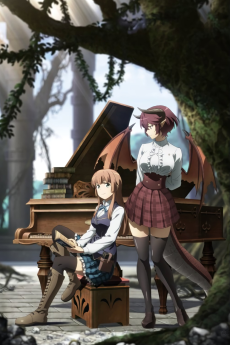
Sunlight pools like warm honey on the stone floor of the Mysteria Academy library—dust motes swirling above an open grimoire bound in soft, moss-green leather. A girl with fox ears and a ribbon tied just so leans over the page, tracing a spell diagram with her fingertip while another, her hair the deep violet of twilight orchids, rests her chin on folded arms, watching—not the book, but her. No grand incantation, no battle cry—just breath syncing, silence holding its shape, the quiet hum of magic as ordinary as breathing.
That’s the heart of Mysteria Friends: not spectacle, but presence. It doesn’t ask you to believe in magic—it asks you to inhabit it. The medieval setting isn’t about thrones or conquest; it’s about cobblestone paths worn smooth by generations of girls walking side by side, about shared tea cups left steaming on sunlit windowsills, about the way a tail curls instinctively around a chair leg when someone laughs too hard. This is fantasy stripped of urgency—no ticking clock, no chosen one, no looming war. Just the slow, tender weight of being known, of love unfolding in glances, in borrowed scarves, in the way a spell’s glow reflects in two pairs of eyes at once. It makes you feel safe, not because danger is absent—but because safety is practiced, daily, deliberately.
Prince of Persia shares that same hushed reverence for time—not as a resource to spend, but as atmosphere to steep in. Its description calls it “an all-new epic journey” built by Ubisoft Montreal, yet player reviews emphasize its rebooted nature: “a new prince, new lands and a brand new story completely separate from the sands…” That deliberate fresh start, that refusal to lean on legacy or trauma as narrative fuel—it mirrors Mysteria Friends’ insistence on building intimacy from ground zero. Both treat romance not as plot device but as terrain: something you walk through slowly, learning its contours, its shadows, its light-dappled clearings. The “Melancholic Exploration” dimension isn’t sorrow—it’s the gentle ache of beauty passing, of moments so vivid they shimmer with quiet impermanence. You don’t conquer the world in either—you wander it, hand-in-hand with someone whose rhythm you’re learning to match.
The Sims™ 4, despite its fractured player reception (“TS4 has become awful… packs are insanely expensive and often broken”), taps into the same core impulse: life as creation, not crisis. Its description invites you to “Play with life and discover the possibilities”—to sculpt relationships, homes, routines, moods. That’s Mysteria Friends in engine form: no win condition, no fail state—just the joy of arranging a picnic blanket under a cherry tree, choosing which monster-girl friend gets the last moonberry tart, watching how affection blooms in tiny, unscripted gestures. Even the review’s frustration—“you can barely do a…”—underscores what both share: their power lives in freedom of smallness. Neither demands heroism. Both reward attention—to how light falls, how voices soften, how magic feels less like force and more like tenderness made visible.
Jade Empire™: Special Edition, though lower-scoring (71), resonates through its grounding in Mythology & Folklore—not as lore-dumps, but as lived texture. Its description places you “in the role of an aspiring martial-arts master” choosing between “the open palm or the closed fist,” a duality echoed in Mysteria Friends’ gentle tension between tradition and self-definition. Player reviews mention needing Reddit-sourced fixes (“Copy and paste ‘steam.dll’…”), hinting at a game that requires care to run smoothly—much like the anime’s relationships, which thrive only when tended with patience, ritual, and quiet consistency. Both understand that belonging isn’t granted—it’s woven, stitch by careful stitch, in shared meals, whispered confessions, and the sacred ordinariness of folding laundry together in a sunlit dorm room.
This pairing isn’t for fans of high stakes or fast burns. It’s for the person who replays the same 30 seconds of a game just to watch rain gather on a character’s eyelashes. For the reader who bookmarks pages where two characters sit in silence, not because words fail—but because none are needed. For anyone who’s ever held a hand just to feel the warmth, not to claim it. They’re for those who know love isn’t always loud—and sometimes, the most magical thing in the world is simply being here, with her, right now, while the light holds its breath.
🎮22 Games That Match the Vibe









Match Dimensions Explained
❓Frequently Asked Questions
Why does Prince of Persia keep showing up in 'Games Like Mysteria Friends' lists?
Because it nails the same delicate blend of romance, melancholic exploration, and quiet emotional weight—like when you’re wandering the ruined palace gardens with the Prince and Farah, sharing hushed conversations that feel intimate and bittersweet. Its Healing & Slow Life dimension mirrors Mysteria Friends’ gentle pacing, and fans consistently highlight how its Shoujo-tinged storytelling (especially in the 2024 reboot) resonates with players who love character-driven, emotionally textured bonds.
Is there an anime or manga adaptation of Mysteria Friends?
No—Mysteria Friends itself hasn’t been adapted, but fans drawn to its Romance & Shoujo + Mythology & Folklore vibe often pivot to Jade Empire™: Special Edition, which delivers rich cultural storytelling through its wuxia-inspired world and moral choices affecting relationships with characters like Dawn Star and Silk Fox. It’s the closest official game match with that grounded-yet-mythic emotional texture.
How does The Sims 4 compare to Mysteria Friends for building slow-burn romantic relationships?
TS4 shines for open-ended, player-driven romance—think crafting daily routines with your Sim partner, sharing quiet moments on the couch, or slowly unlocking relationship milestones—but lacks Mysteria Friends’ narrative cohesion and emotional arc. Still, its Healing & Slow Life dimension (and 83 score) makes it a top pick for players who want to *live* those tender, low-stakes connections without cutscenes or fixed story beats.
What’s the best Mysteria Friends-like game if I’m craving something cozy but with subtle dark fantasy undertones?
Baldur’s Gate 3 is your answer—it layers Romance & Shoujo depth (like deep, choice-driven bonds with Astarion or Shadowheart) over a rich Dark Fantasy world where intimacy feels earned and fragile, much like Mysteria Friends’ emotional stakes. Reviewers note how its high-stakes choices contrast beautifully with quiet, character-led moments—like sharing a campfire confession under starlight, then facing consequences at dawn.