
Grand Blue Dreaming
A new life begins for Kitahara Iori as he begins his college career near the ocean in Izu city, full of excitement for his new life. He will be moving into his Uncle's diving store "Grand Blue." There he finds the beautiful ocean, beautiful women, and men that love diving and alcohol. Will Iori be able to live his dream college life?
📺Anime Details
📝Editorial Analysis
The salt-sting of seawater in your nostrils. The sudden, absurd thwack of a wet towel snapping against bare skin. Iori’s face—wide-eyed, slack-jawed—as he’s yanked backward off the diving board by a rogue current and a drunken senior’s misplaced grip, limbs flailing mid-air while a bikini-clad classmate calmly adjusts her goggles below. No music swells. No dramatic pause. Just the hollow ploop of his body hitting the water, then laughter bubbling up from six different throats, some slurred, some breathless, all utterly unselfconscious. That’s not setup. That’s arrival.
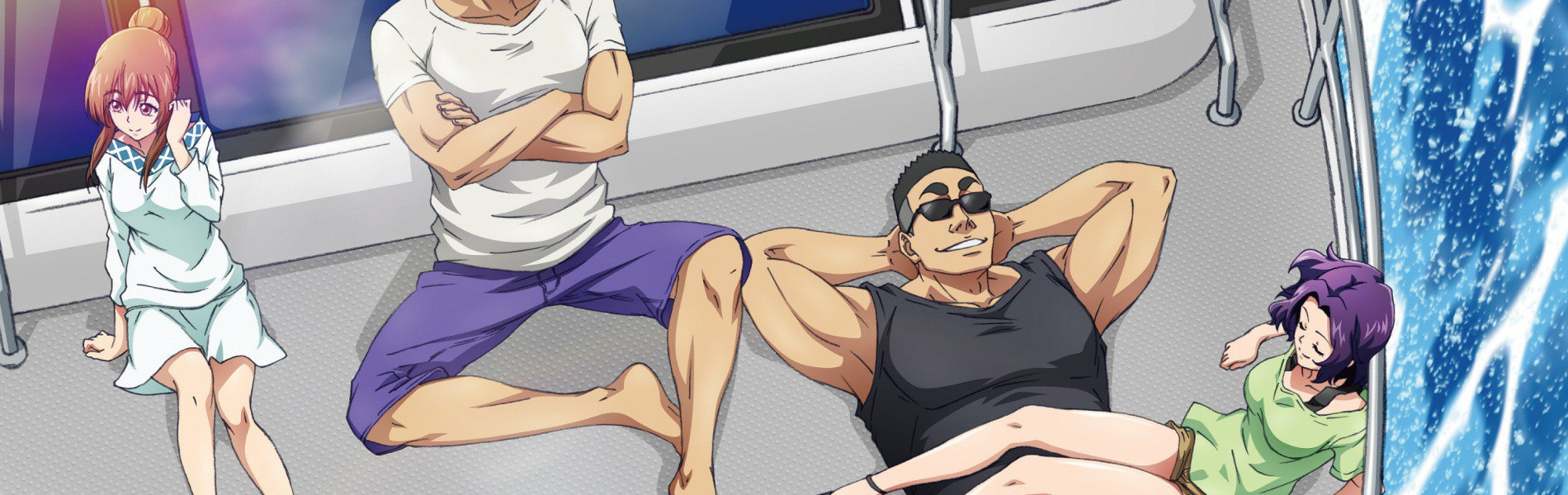
Grand Blue Dreaming doesn’t build tone—it submerges you. It’s the feeling of stepping out of a stuffy dorm room into humid coastal air thick with the smell of sunscreen, cheap beer, and chlorine; of realizing your college dreams aren’t about ambition or achievement, but about how much nonsense you can survive before lunch. It’s surreal, yes—but never detached. The slapstick isn’t cartoonish violence; it’s physics gone feral in a world where hangovers warp time, diving gear doubles as party props, and nudity isn’t titillation—it’s just weather, as casual and unavoidable as a breeze off the Pacific. You don’t watch it to escape reality—you watch it to remember how physical, how unpredictably tender, real human chaos can feel when stripped of pretense. It’s warm, damp, and deeply, stupidly alive.
That same DNA hums in Portal, where the sterile horror of Aperture Labs curdles into something deliciously absurd: a sentient cake, a passive-aggressive AI who weaponizes corporate jargon, and a portal gun that turns gravity into a punchline. The player review calls it “a short, brilliant, and absolutely flawless puzzle game that completely redefined first-person…”—but what it redefined was tone. Like Grand Blue Dreaming, it trusts its audience to laugh with the dissonance, not at it. The genius isn’t in the mechanics—it’s in how deeply it commits to its own ridiculous logic, letting surrealism feel earned, not arbitrary. Same with Portal 2, whose “Perpetual Testing Initiative” expands that commitment into something cinematic, yet never loses the bone-dry, slightly unhinged wit that makes GLaDOS feel like she’d absolutely join the Grand Blue crew for a post-dive sake toast—if only to critique their buoyancy calculations.
Then there’s Psychonauts, described as “A Psychic Odyssey Through the Minds of Misfits, Monsters, and Madmen.” That phrase—misfits, monsters, and madmen—is pure Grand Blue. Not villains, not archetypes: people, vibrating at frequencies too loud for polite society. The player review’s bizarre, fragmented line—“This game allows in-depth milking of certain highly creamy men, his utters are beautifully rendered…”—feels less like a typo and more like the show’s own language: affectionate, nonsensical, hyper-specific, bodily. It’s the same energy as Iori being force-fed raw squid while trying to explain scuba certification. Both revel in the textural mess of being human—sweat, saliva, awkwardness, joy—all rendered with tactile, almost tactile absurdity.
Who loves this? The person who laughs hardest when someone trips over their own flip-flops on the way to the beach. The one who keeps a half-empty bottle of shochu in their desk drawer “for emergencies.” The player who doesn’t skip cutscenes—they lean in, waiting for the next perfectly timed sigh, the next glance exchanged between two characters who know exactly how ridiculous they look, and love each other more for it. Not fans of “college life” as aspiration—but fans of college life as shared, sunburnt, slightly hungover improvisation. They don’t want stakes. They want splashes. They want laughter that starts in the gut and ends in the throat, raw and unfiltered. They want to feel, just for twenty-two minutes—or four hours—the sheer, glorious relief of being allowed to be gloriously, unapologetically silly in a world that insists on being serious. That’s the current pulling them back, again and again—not to a plot, but to a pulse.
🎮14 Games That Match the Vibe



Match Dimensions Explained
❓Frequently Asked Questions
Why does Portal keep showing up in 'Games Like Grand Blue Dreaming' lists?
Because both lean hard into absurdist, self-aware comedy with darkly surreal undertones—like GLaDOS’s deadpan cruelty mirroring Iori’s deadpan suffering during yet another drunken dive bar meltdown. The Aperture Science labs’ escalating bureaucratic nonsense (e.g., ‘the cake is a lie’) hits the same satirical sweet spot as Grand Blue’s parody of diving culture and anime tropes.
Is there an anime or game adaptation of Grand Blue Dreaming?
No official game adaptation exists—but Psychonauts nails the same chaotic, character-driven absurdity: Raz’s over-the-top psychic powers, like literally jumping into a camp counselor’s paranoid conspiracy fantasy, feel like a direct cousin to Grand Blue’s surreal cutaways (e.g., Iori hallucinating himself as a samurai while passed out in a hot tub). Both weaponize escalating ridiculousness with emotional sincerity underneath.
How does Runaway: A Road Adventure compare to The Longest Journey for Grand Blue fans?
Runaway leans into slapstick, fast-paced farce—Brian’s panicked, Mafia-chased road trip mirrors Grand Blue’s frantic energy (think the ‘dive shop vs. rival club’ chaos), while The Longest Journey trades that for witty, dialogue-heavy worldbuilding and tonal whiplash (April bouncing between gritty realism and cartoonish fantasy), much like Grand Blue’s shifts from beachside hangouts to full-blown anime parody musical numbers.
What’s the best Grand Blue-like game if I just want to laugh *hard* without caring about plot?
Go straight to Portal—its razor-sharp, dry-as-bone writing (GLaDOS’s passive-aggressive test chamber announcements) and perfectly timed physical comedy (like falling through portals into your own backside) deliver nonstop, no-nonsense laughs. It’s got zero exposition bloat and maximum payoff per minute—exactly like Grand Blue’s best episodes where the plot is just an excuse for Iori screaming into the void after being tricked into wearing a mermaid costume.