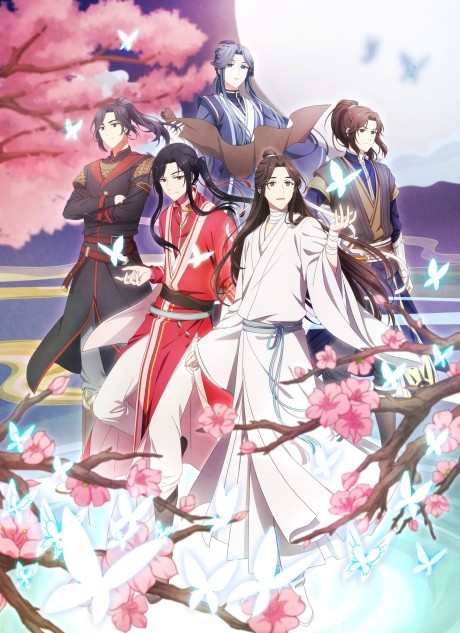
Heaven Official's Blessing
Xie Lian, the crown prince of Xian Le Kingdom, successfully ascends to Heaven during his third trial in spite of successive demotions. However, he accidentally breaks the Gold Palace of heavenly officials. With no human worshiping him, Xie Lian has to descend to the secular world to exorcise ghosts, which may help him sustain his divinity.
(Source: Funimation)
📺Anime Details
📝Editorial Analysis
Rain slicks the cobblestones of a nameless town at dusk—not the clean, cinematic rain of a hero’s entrance, but the tired, clinging kind that soaks through cloth and memory alike. Xie Lian stands beneath a broken eave, sleeves rolled, hair damp, holding out a trembling hand to steady a flickering paper lantern he’s just lit for a ghost who hasn’t spoken in three centuries. There’s no fanfare. No divine light. Just the quiet hiss of wet rice paper catching flame—and the unbearable weight of someone choosing tenderness when no one is watching.
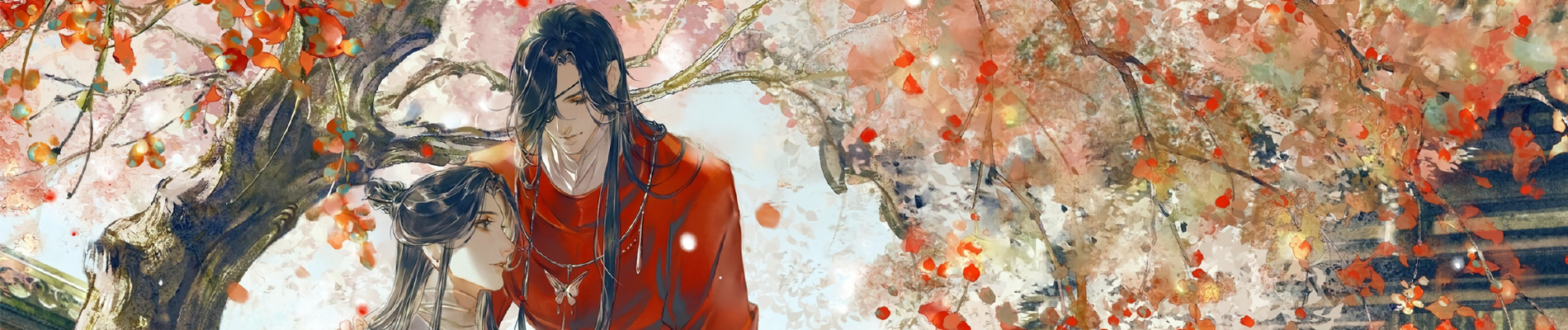
That’s the heart of Heaven Official's Blessing: not ascension, but return. Not power reclaimed, but presence reoffered—again and again—to those the heavens have erased. Its atmosphere isn’t built on spectacle or even romance as spectacle, but on resonance: the way a sigh echoes in an empty temple hall, how silence thickens when two people almost touch but don’t, how divinity feels less like gold and more like worn silk—soft, frayed, stubbornly warm. It makes you feel the ache of longing without expectation, the quiet dignity of enduring without applause, and the radical gentleness of healing that asks for nothing in return. This isn’t wuxia as conquest—it’s cultivation as care. Not gods above, but gods alongside, kneeling in mud to mend what broke long before they were named.
Which is why Prince of Persia (2023) lands with such startling kinship. Its description names “Melancholic Exploration” as a core dimension—and yes, there’s sand and swordplay, but what lingers is the Prince walking alone through ruins where statues weep dust, his movements deliberate, his breath audible, his grief slow, not loud. A player review calls it “the 3rd reboot… completely separate from the sands”—and that separation matters. Like Xie Lian unmoored from Xian Le’s glory, this Prince carries legacy without armor, moving through landscapes that remember loss better than they remember him. Both ask: What does it mean to walk forward when your past has been erased by the very system that crowned you?
Then there’s Stardew Valley, whose description invites you to “learn to live off the land and turn these overgrown fields into a home.” Not a kingdom. Not a palace. A home. A player review confesses exhaustion—not from danger, but from time: “Spent the first 2 years trying to do everything and never having enough time.” That’s Xie Lian’s secular world in microcosm: no grand trials, just the relentless, tender labor of showing up—watering crops, mending fences, listening to old women tell stories about ghosts they’ve known longer than gods. The romance here isn’t fireworks; it’s shared silence at the bus stop, a gift left on the porch, the slow unfurling of trust across seasons. Like Xie Lian and Hua Cheng, Stardew’s bonds deepen not through confession, but through consistency—through being there, day after rain-slicked day.
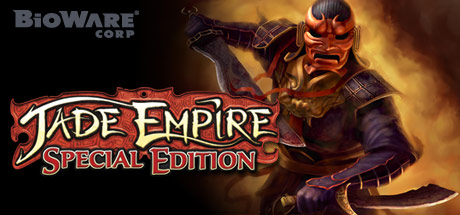
And Jade Empire™: Special Edition, with its dimension of “Mythology & Folklore” and “Emotional Narrative,” mirrors the anime’s spiritual architecture. Its description places you “in the role of an aspiring martial-arts master” choosing between philosophies—the open palm or the closed fist—echoing Xie Lian’s own path: compassion as discipline, mercy as cultivation. A player review notes technical friction (“had to follow instructions from Reddit”), yet still calls it “Fantastic.” That dissonance—beauty persisting despite broken systems—is pure Heaven Official's Blessing: a story where divinity stutters, servers crash, and yet the lantern stays lit.
This pairing sings to the person who cries at grocery store parking lots because the light hits a puddle just right—who saves letters they’ll never send, who replants herbs twice because the first batch wilted, who understands that love isn’t always a declaration, sometimes it’s just not looking away when someone’s tired. It’s for the ones who find holiness in laundry folded neatly, who feel godhood in holding space for another’s sorrow, who know that the most revolutionary act in a broken world is to kneel—gently—and light a lantern.
🎮49 Games That Match the Vibe



















Match Dimensions Explained
❓Frequently Asked Questions
Why does Prince of Persia keep coming up when I search for games like Heaven Official's Blessing?
Because both lean hard into melancholic exploration and slow-burn emotional intimacy—like wandering the ruined palace gardens in Prince of Persia’s ‘Healing & Slow Life’ vibe, mirroring Xie Lian’s quiet walks through abandoned celestial halls. The romance isn’t flashy, but tender and layered (think Prince & Elika’s unspoken trust vs. Xie Lian & Hua Cheng’s aching devotion), and the score (86) reflects how well it nails that wistful, myth-tinged atmosphere.
Is there a Heaven Official's Blessing game adaptation?
Not yet—and none of the matched titles are official adaptations. Jade Empire™: Special Edition (score 84) is the closest *spiritual* fit: its wuxia world, moral choice system (Open Palm/Closed Fist), and deep romantic subplots (like the optional bond with Dawn Star) echo HOB’s blend of folklore, emotional stakes, and shoujo-adjacent tenderness—but it’s set in a wholly original pan-Asian-inspired realm, not the novel’s canon.
Stardew Valley vs. The Sims 4—which is better for that cozy, healing HOB ‘found family’ vibe?
Stardew Valley (score 82) wins hands-down for HOB’s gentle, purposeful warmth—think bonding with villagers like Sebastian or Abigail over shared meals and seasonal festivals, echoing Xie Lian’s reconnection with old friends. The Sims 4 (score 85) *can* do romance and slow life, but player reviews call out how broken and DLC-gated it feels—‘you can barely do a...’ without paywalls, which clashes hard with HOB’s sincere, accessible heart.
What’s the best HOB-like game if I just want to unwind and feel quietly hopeful?
Chains (score 84) is your unexpected gem—it’s a soothing match-3 arcade game where linking bubbles feels meditative, like watching cherry blossoms fall in the Flower City. Its ‘Healing & Slow Life’ + ‘Emotional Narrative’ dimensions mirror HOB’s restorative pacing, and reviewers compare its calm rhythm to ‘connect 4 in a nutshell,’ perfect when you need soft focus after a heavy episode or chapter.