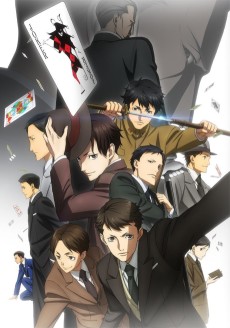
Joker Game
In 1937, before World War II begins in earnest. Lieutenant Colonel Yuuki of the Imperial Japanese Army forms the "D Agency," an army intelligence outfit under his command and tutelage. Army General Staff attaches Lieutenant Sakuma to observe the unit's performance. D Agency casts a wide net to find agents beyond Japanese military personnel, and Yuuki establishes D Agency's tenets, which go against IJA doctrine: "Don't kill, don't get killed, don't get captured." With this, Yuuki trains a team of operatives who conduct missions against domestic and foreign powers.
(Source: Anime News Network)
📺Anime Details
📝Editorial Analysis
The smell of rain on hot concrete in Shanghai, 1937 — not the clean scent of a storm breaking, but the acrid tang of damp wool uniforms, cigarette smoke clinging to collar edges, and the low hum of a foreign-language radio transmission bleeding from a cracked window. Lieutenant Sakuma stands motionless in that doorway, watching Yuuki’s agents move without moving: a glance held half a second too long, a teacup set down with deliberate asymmetry, a pause before answering a question that wasn’t asked. No gunfire. No shouting. Just silence thick enough to taste — and the quiet, terrifying weight of knowing someone is already three steps ahead of you.

That’s the feeling Joker Game lives inside: dread without violence, trust without confession, loyalty without certainty. It doesn’t thrill with spectacle — it tightens your throat with the realization that every handshake could be a test, every promotion a trap, every “yes” a lie wrapped in protocol. This isn’t wartime heroism; it’s wartime calculation, where survival means mastering the art of being forgettable, unremarkable, invisible — even to your own side. The historical setting isn’t backdrop; it’s pressure. Every decision carries the weight of an empire’s collapse, yet the characters speak in hushed tones over ink-stained reports, their exhaustion written in the slump of shoulders under stiff collars, their brilliance hidden in footnotes and misfiled memos. It makes you think about obedience as performance, patriotism as camouflage, and how easily ideology curdles when filtered through bureaucracy and fear.
That same emotional DNA pulses in Assassin's Creed™: Director's Cut Edition — not in its parkour or blade-work, but in its Political Thriller and Melancholic Exploration dimensions. The player review admits the models are dated, but notes “no issues with me” — because what lingers isn’t visual fidelity, but the weight of walking Jerusalem’s alleys as Altaïr, constantly reading faces, parsing allegiances, choosing silence over speech, deception over truth. Like Yuuki’s agents, Altaïr operates in a world where killing solves nothing — it only deepens the fog. Both demand you observe before acting, internalize systems before subverting them, and feel the hollowness of victory when it comes at the cost of self-erasure.
Then there’s BioShock™, tagged Adult & Dark Seinen and Political Thriller. Its player review calls it “revolutionary” — not for guns or graphics, but for how it forces you to question the architecture of belief itself. Just as D Agency’s tenets — “Don’t kill, don’t get killed, don’t get captured” — seem humane until you realize they’re designed to preserve the state’s ability to deny, so Rapture’s founding ideals curdle into something grotesque beneath surface logic. You walk past faded propaganda posters and listen to fragmented audio diaries, piecing together how doctrine becomes dogma becomes delusion — exactly like Sakuma, cross-referencing field reports while wondering if Yuuki’s methods serve Japan… or only Yuuki’s vision of it. The dread isn’t supernatural — it’s ideological, slow and suffocating.
And the Tomb Raider trilogy — Legend, Anniversary, Underworld — all sharing Melancholic Exploration, Tactical Warfare, and Adult & Dark Seinen. One review calls Anniversary “the best Tomb Raider game” for its precision and restraint; another says Underworld is recommendable “not just” for action, but for its unwelcome figures from [Lara’s] mysterious past. That’s the core resonance: Lara doesn’t conquer tombs — she re-enters them, each chamber echoing with memory, consequence, and buried identity. Like D Agency agents returning to old posts, re-interviewing old contacts, re-living failures disguised as routine debriefs. There’s no triumphant music when the artifact is found — just wind whistling through broken arches, the click of a safety being re-engaged, the quiet realization that some doors, once opened, can never fully close.
This pairing speaks to the viewer who watches a character adjust their cufflinks twice before entering a room — and feels their pulse rise. To the player who saves before every dialogue choice, not out of fear of death, but fear of misreading. To the person who finds catharsis not in explosions, but in the slow, agonizing alignment of a single, perfect lie — told not to deceive others, but to hold oneself together just one more day. They don’t want heroes. They want operators. And they’ll recognize one, instantly, whether they’re standing in a rain-slicked Shanghai alley or staring at a flickering radio in a crumbling lighthouse.
🎮23 Games That Match the Vibe






Match Dimensions Explained
❓Frequently Asked Questions
Why does Assassin's Creed feel like Joker Game even though it's set in the Middle Ages?
Because both lean hard into political thriller tension—think Joker Game’s tense embassy standoffs and coded radio transmissions, mirrored in Assassin’s Creed’s stealthy bureau infiltrations and morally gray Templar-Assassin power struggles. The melancholic exploration vibe hits too: wandering Acre’s narrow alleys or Damascus’ shadowed markets feels just like walking through Tokyo’s rain-slicked streets in Joker Game, all quiet dread and layered loyalties.
Is there a Joker Game anime adaptation I can watch while waiting for similar games?
No—Joker Game is already an anime (2016, 24 eps), not a game, so there’s no 'adaptation' to wait for. But if you loved its espionage mood and want games that *feel* like watching it, go straight to BioShock: its Rapture propaganda broadcasts, Andrew Ryan’s chilling monologues, and the slow-burn unraveling of ideology hit the same adult & dark seinen notes as Daisuke Aramaki’s quiet intensity and the Zero Unit’s covert ops.
Tomb Raider: Legend vs. Anniversary—which one captures Joker Game’s tone better?
Anniversary wins, hands down. Both share melancholic exploration and tactical warfare dimensions, but Anniversary’s tightly scripted flashbacks to Lara’s origin—especially the haunting, rain-lashed Nepal sequence—echo Joker Game’s brooding character studies and wartime regret. Legend’s globe-trotting energy is fun, but Anniversary’s quieter, more somber pacing and emphasis on silent observation (like watching a target from a ledge) mirrors how Joker Game lingers on stillness before action.
What’s the best ‘Joker Game-like’ game if I want something moody, cerebral, and low on combat chaos?
Assassin’s Creed™: Director’s Cut Edition—it’s got that deliberate, almost meditative rhythm: tailing targets across rooftops, eavesdropping on hushed political debates in Jerusalem’s souks, and piecing together conspiracies without flashy set-pieces. The 82-score political thriller dimension lines up perfectly with Joker Game’s focus on intelligence over firepower, and yes, the textures are dated—but that grainy, analog feel actually deepens the melancholic exploration vibe, like watching a 1960s spy film on VHS.