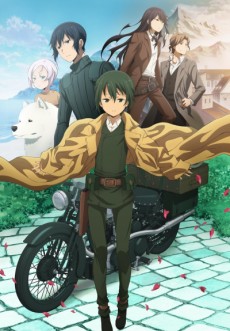
Kino's Journey -the Beautiful World- the Animated Series
The story follows the travels of Kino, a young adventurer who rides a talking motorcycle named Hermes. They explore the people and cultures of different places throughout their adventures, spending only three days at each location.
(Source: ANN)
📺Anime Details
📝Editorial Analysis
The wind carries dust across a sun-bleached road. Kino stands beside Hermes, both silent, watching smoke rise from a distant village where no one will speak of the war they’ve just ended—only of the new law that bans mirrors, and why. Three days. Two more to go. No music swells. No voiceover explains. Just the low hum of the motorcycle’s engine, the dry rustle of grass, and the weight of a choice not made but held: to witness, not intervene; to remember, not fix.
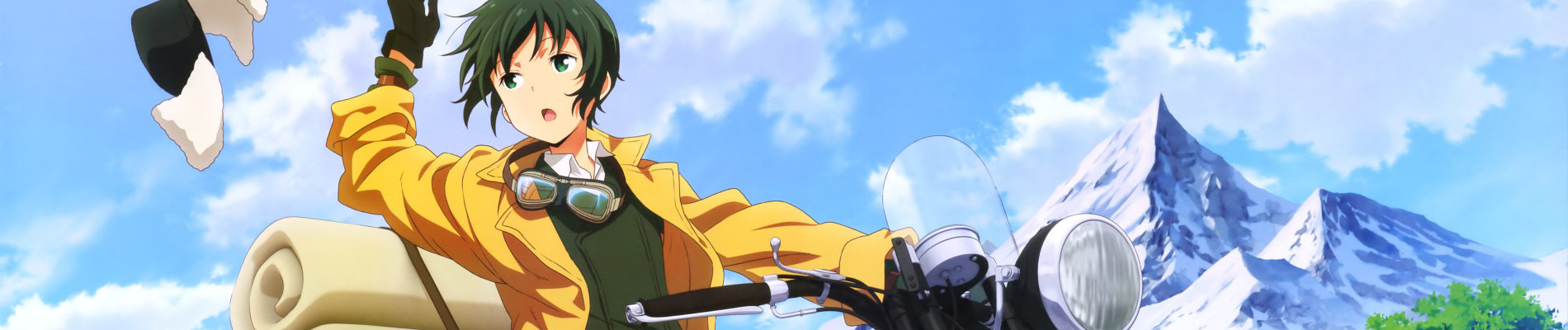
That stillness—not emptiness, but fullness held at arm’s length—is Kino's Journey -the Beautiful World- the Animated Series’s heartbeat. It doesn’t trade in urgency or escalation. It trades in duration: three days, long enough to hear a child’s laugh echo down an alley, long enough to notice how light falls on a cracked ceramic bowl in a widow’s kitchen, long enough for grief to settle like dust on your collar. The CGI isn’t polished spectacle—it’s grainy, tactile, almost documentary-like, reinforcing the sense that these aren’t fantasy realms, but places, weathered and real. The motorcycle isn’t a weapon or a symbol of rebellion—it’s a companion who sighs, jokes, and sometimes refuses to start. Guns are carried, yes—but rarely fired. When they are, the recoil shakes Kino’s frame, and the silence after is louder than the shot. This is melancholic exploration: not sadness as despair, but as deep, quiet attention—the kind that comes when you realize every culture’s solution is also its wound, and every answer contains a new question.
Prince of Persia (2024) shares that same hush beneath motion. Its description calls it “an all-new epic journey” built by Ubisoft Montreal—yet player reviews emphasize it’s separate from past iterations, anchored in “new lands” and “a brand new story.” That deliberate freshness, that refusal to rely on nostalgia or established mythos, mirrors Kino’s blank-slate arrivals: no backstory baggage, no preordained quest—just terrain, texture, and the slow dawning of meaning. Like Kino, the Prince moves through spaces thick with unspoken history—not ruins to be looted, but thresholds to be crossed with care. The shared dimension isn’t action—it’s healing & slow life: the way both linger on a sunlit courtyard, a crumbling archway, the weight of a decision that changes nothing outwardly but shifts everything inward.
Celeste, too, breathes the same air—not as a platformer about speed or mastery, but as a pilgrimage measured in breaths. Its description frames Madeline’s climb as survival “of her inner demons,” and though player reviews call it “super-tight,” they pivot instantly to emotional resonance: “I feel like I don’t need to review this game”—as if words fail where feeling lands. That’s Kino’s world: no exposition dump, no villain monologue—just the tremor in a hand offering tea, the pause before a confession, the way a single line (“We don’t kill people here… unless they break the rule”) hangs like fog. Both works treat psychology not as plot device, but as geography: cliffs to scale, narrow ledges to balance on, sudden drops where the ground vanishes beneath certainty.
And then there are the Tomb Raider titles—Legend, Anniversary, Underworld—each described not as combat simulators, but as journeys “down a path of discovery,” across “remote, exotic locales,” where “each [place] is designed with incredible attention.” Player reviews don’t praise combat—they praise exploration: “great platforming and puzzling,” “the best Tomb Raider game,” “I would recommend not just…”—trailing off, as if the experience defies summary. That reverence for place—for how stone feels under fingertips, how light fractures in an ancient chamber—is pure Kino. Lara doesn’t conquer tombs; she reads them, just as Kino reads the rhythm of a market square or the silence between two villagers’ words. Both move through worlds where architecture holds memory, and every artifact is a question mark wearing a crown.
This pairing isn’t for fans of lore dumps or power fantasies. It’s for the person who replays the opening minutes of Kino’s Journey just to watch Hermes tilt his head in the golden hour light. For the one who saves Celeste not at checkpoints, but at benches, sitting beside Madeline as she stares at the sky. For the player who lingers in Tomb Raider: Underworld, not to find the next lever—but to trace the carvings on a forgotten wall, wondering who made them, and why they stopped. These are stories for those who understand that the most radical act isn’t saving the world—it’s staying long enough to see it clearly.
🎮29 Games That Match the Vibe











Match Dimensions Explained
❓Frequently Asked Questions
Why does Prince of Persia keep coming up when I search for games like Kino's Journey?
Because both lean hard into melancholic exploration and adult, dark-seinen vibes — think quiet moments wandering ancient, weathered ruins while reflecting on loss or identity, just like Kino’s stops in the desolate Clockwork City or the silent, snow-covered village. Prince of Persia (2024) mirrors that tone with its new prince navigating morally ambiguous lands, introspective narration, and a world where beauty and decay coexist — exactly what fans of Kino’s philosophical pacing and atmospheric stillness respond to.
Is there a Kino's Journey visual novel or RPG adaptation?
No — there’s never been an official Kino’s Journey visual novel, RPG, or game adaptation of any kind. All the matches you’ll find (like Celeste or Tomb Raider: Legend) are *spiritual* parallels, not licensed ports. That’s why fans turn to games like Celeste, where Madeline’s climb up Celeste Mountain — full of quiet dialogue, internal monologue, and hauntingly sparse environments — captures Kino’s emotional weight without borrowing plot or characters.
Celeste vs. Tomb Raider: Anniversary — which feels more like Kino’s Journey?
Celeste wins on vibe — its focus on inner struggle, poetic voiceover, and deliberate pacing (like Madeline pausing mid-climb to reflect on anxiety or memory) echoes Kino’s philosophical interludes far more than Anniversary’s action-driven tomb raiding. That said, Anniversary nails the *melancholic exploration* dimension too — especially in isolated, echoing chambers like the Atlantis ruins — but it’s less about stillness and more about discovery through movement and puzzle-solving.
What’s the best game like Kino’s Journey if I want that slow, healing, ‘quiet world’ feeling?
Prince of Persia (2024) is your strongest match — it’s explicitly tagged with ‘Healing & Slow Life’ and ‘Melancholic Exploration’, and reviewers highlight how its new prince moves with weary grace through sun-drenched, crumbling cities, often stopping to watch dust motes drift or listen to ambient wind — just like Kino sipping tea in a train car as landscapes blur past. It’s not flashy; it’s contemplative, tactile, and tender in exactly the way Kino’s Journey lingers in your chest.