
Migi&Dali
After finally adopting a child, the Sonoyamas were unprepared for the mystery that would soon unravel. Hitori seems to be the perfect son for his loving parents. He's handsome, intelligent, and grateful for his new lavish life—but he has a dark secret. Hitori is actually the twins Migi and Dali pretending to be one boy. And they have a terrifying motive behind their hidden identity.
(Source: Crunchyroll)
📺Anime Details
📝Editorial Analysis
The silence after Hitori smiles—just that smile, calm and polished, while the camera lingers a half-second too long on his left hand twitching toward his pocket—is where Migi&Dali lives. Not in the reveal, not in the shouting, but in the quiet, suspended breath before the lie settles into the wallpaper of the Sonoyama home. You feel it in your molars: the weight of two boys breathing as one, their synchronized blinks, the way their shared voice doesn’t quite land in the same emotional register twice. It’s not suspense—it’s dissonance, humming beneath a perfectly set dinner table.
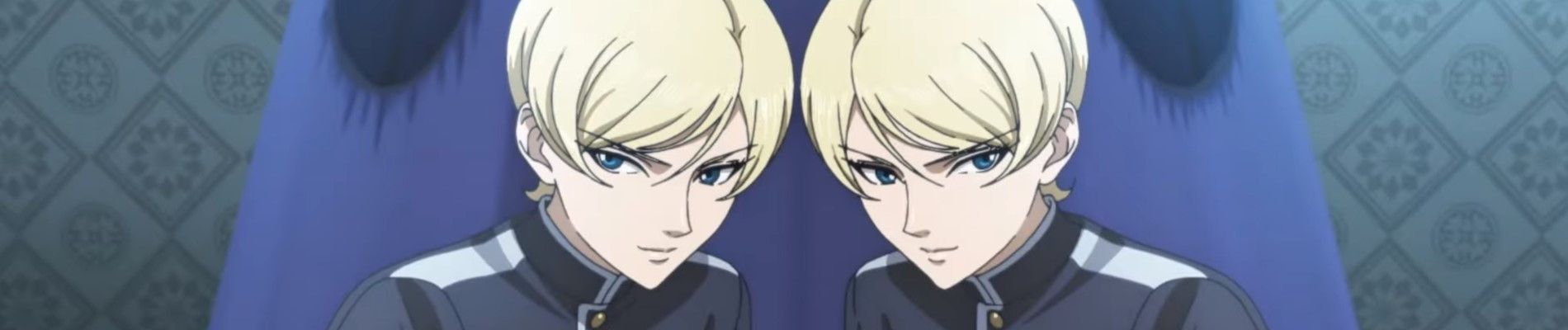
What makes Migi&Dali’s atmosphere singular isn’t its twin premise or its revenge plot—it’s how deeply it weaponizes domestic comfort as both camouflage and wound. This isn’t gothic horror or noir dread; it’s the slow, suffocating chill of recognizing that love can be rehearsed, gratitude can be scripted, and “family” can be a stage set so convincing it starts to rewrite reality. You don’t fear what’s coming—you fear how easily you accept it. The surreal comedy isn’t slapstick; it’s the cognitive whiplash of watching Migi and Dali negotiate grocery lists while mentally cross-referencing alibis, or adjusting their posture mid-conversation to maintain the illusion of a single nervous system. It’s uncanny, yes—but more precisely, it’s intimate betrayal. You’re not outside looking in. You’re sitting at that table, passing the soy sauce, wondering if your own laughter has ever been fully yours.
That emotional DNA pulses strongest in Disco Elysium - The Final Cut, where ideology isn’t debated—it’s lived in the bones, spoken through fractured internal monologues, and buried under layers of self-deception so thick they become personality. Like Migi and Dali performing “Hitori,” the detective performs “Detective”—a role stitched together from half-remembered doctrines, corrupted instincts, and desperate charm. The player review nails it: “Capital has the ability to subsume all critiques into itself. Even those who would critique capital end up reinforcing it instead.” That’s Migi and Dali’s tragedy—not that they lie, but that their vengeance is already metabolized by the very system they seek to dismantle. Their performance doesn’t disrupt the Sonoyama fantasy; it completes it. The game’s political thriller dimension isn’t about grand conspiracies—it’s about how power colonizes the interior. So does the anime.
Then there’s BioShock, whose player review calls it “one of the most revolutionary games ever!”—not for its shooting, but for how its world breathes ideology. Rapture isn’t just a setting; it’s a character whose logic infects every corridor, every audio log, every twisted Little Sister. Like the Sonoyamas’ mansion, it’s a gilded cage built on beautiful, rotten premises—objectivism made flesh, then decay. Both BioShock and Migi&Dali trap their protagonists inside architectures of belief so total they become indistinguishable from air. The twins don’t just infiltrate a family—they inherit its foundational myth. And when that myth cracks? It doesn’t shatter outward. It implodes inward, leaving characters staring at their own reflections, wondering which face is real and which is the mask they’ve worn so long it’s grown skin.
Tank Universal, with its player review whispering “Play cool tank game with dad when you were 6… time goes on; loose access to game. Grew up dad passes away…”, shares something quieter but no less vital: the ache of found continuity. Migi and Dali aren’t just faking kinship—they’re building it, stitch by painful stitch, in the margins of their deception. Their bond isn’t inherited; it’s forged in shared risk, whispered strategy, the silent language of elbows brushing under a shared school desk. That review isn’t about tanks—it’s about how memory and love persist despite fragmentation, loss, and time’s erosion. Migi&Dali treats adoption not as an endpoint, but as a verb—a daily, fragile act of choosing each other, even when the choice began as a weapon.
This pairing won’t resonate with someone craving clean catharsis or heroic clarity. It’s for the viewer who watches Hitori fold napkins just so, and feels a lump rise—not because he’s lying, but because the gesture is so tender, so human, that the lie becomes secondary to the care embedded in it. It’s for the player who replays Disco Elysium’s dialogue trees not to win, but to hear the detective’s voice crack on a line about fatherhood—or who stares at Tank Universal’s neon-lit treads long after the match ends, remembering the weight of a small hand on a joystick. These are stories for people who understand that truth is often less important than the shape of the silence around it—and that the most devastating conspiracies aren’t hatched in boardrooms, but in the quiet, shared breath between two people pretending, desperately, to be one.
🎮28 Games That Match the Vibe




Match Dimensions Explained
❓Frequently Asked Questions
Why does Disco Elysium keep coming up when people talk about games like Migi & Dali?
Because both lean hard into psychological tension, unreliable narration, and morally gray political intrigue—like when Harry Du Bois debates capitalism while his own mind fractures, mirroring how Migi & Dali’s dual consciousness blurs truth and perception. The ‘Political Thriller’ and ‘Emotional Narrative’ dimensions overlap tightly, and that player quote about capital subsuming critique? It vibes *exactly* with Migi & Dali’s themes of systemic control and fractured identity.
Is there an anime or live-action adaptation of Disco Elysium or BioShock that captures the Migi & Dali feeling?
No official adaptations exist yet—but BioShock’s Rapture feels like a natural cousin to Migi & Dali’s claustrophobic, ideology-saturated world: imagine Andrew Ryan’s objectivist dystopia colliding with the twins’ eerie symbiosis in that underwater city. Disco Elysium has no adaptation either, but its tone—especially scenes where Harry argues with his own skill checks (like 'Logic' vs. 'Empathy')—mirrors how Migi & Dali literally debate inside one body.
How is Assassin’s Creed Director’s Cut different from The Witcher 3 if both are compared to Migi & Dali?
Assassin’s Creed leans into historical political conspiracy and silent, observant duality (Altaïr’s stoic precision vs. the Hidden Ones’ ideology), much like Migi & Dali’s outward calm masking inner conflict—while The Witcher 3 dives deeper into emotional consequence, like Geralt’s quiet grief over Ciri or Yennefer’s sacrifices, echoing the twins’ tender, tragic bond. Both share ‘Adult & Dark Seinen’, but AC’s rigidity contrasts with Witcher’s layered empathy.
What’s the best game like Migi & Dali if I want that slow-burn, melancholic, emotionally heavy vibe?
Tank Universal—yes, really. Don’t let the tank combat fool you: its player review mentions losing access to the game after childhood, then grieving a dad who passed away… that raw, personal sorrow mirrors Migi & Dali’s haunting intimacy. Paired with its ‘Emotional Narrative’ dimension and sci-fi loneliness (fighting AI allies in a neon-drenched void), it hits that same wistful, bittersweet frequency as the twins’ quiet moments under the streetlights.